
If you’re choosing the best Mac Studio configuration in 2025, it really depends on your workload. For heavy tasks like 3D rendering or video editing, I recommend a setup with more CPU and GPU cores, larger RAM, and faster storage. If your work isn’t as demanding, a mid-tier model may suffice. Curious about which setup fits your needs best? Keep going to find out how each option matches your workflow.
Key Takeaways
- Match configuration choices (CPU, GPU, RAM, storage) to your workload, such as creative, scientific, or development tasks.
- Prioritize higher core counts and RAM for resource-intensive activities like 3D rendering and video editing.
- Consider display and connectivity needs, including multi-display setups and high-resolution support (6K, 8K).
- Balance budget with essential features, opting for higher-tier models for future-proofing and demanding workflows.
- Evaluate your storage requirements, choosing larger SSD options to handle extensive files and data-heavy applications.

Apple 2024 Mac mini Desktop Computer with M4 Pro chip with 12‑core CPU and 16‑core GPU: Built for Apple Intelligence, 24GB Unified Memory, 512GB SSD Storage, Gigabit Ethernet. Works with iPhone/iPad
SIZE DOWN. POWER UP — The far mightier, way tinier Mac mini desktop computer is five by five...
As an affiliate, we earn on qualifying purchases.
Apple Mac Mini 2024 Desktop with M4 Pro Chip
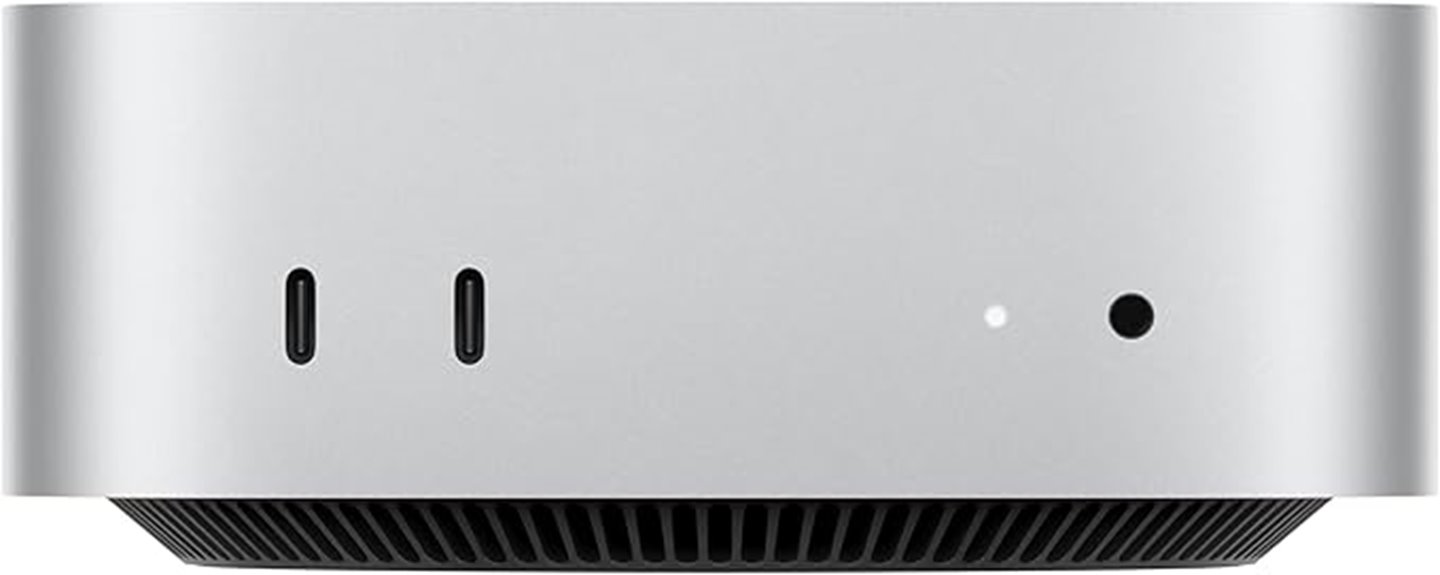
If you’re looking for a compact yet powerful desktop that fits seamlessly into any workspace, the Apple Mac Mini 2024 with the M4 Pro chip is an excellent choice. Despite its small size—just five by five inches—it packs a punch with a 12-core CPU, 16-core GPU, and a 16-core Neural Engine. It supports up to three 6K displays and offers fast connectivity with Thunderbolt 5 ports, HDMI, and Ethernet options. Designed for Apple Intelligence, it works effortlessly with macOS and integrates smoothly with iPhone and iPad. Plus, it’s carbon neutral, aligning with Apple’s environmental goals. It’s the perfect blend of size, power, and eco-consciousness.
Best For: professionals and creatives seeking a compact, powerful desktop that seamlessly integrates with their Apple ecosystem and supports demanding tasks.
Pros:
- Compact size (5 x 5 inches) fits easily into any workspace
- Powerful M4 Pro chip with a 12-core CPU and 16-core GPU for high performance
- Supports up to three 6K displays and fast Thunderbolt 5 connectivity
Cons:
- Limited to 24GB of standard memory (expandable but additional costs apply)
- Up to 8TB SSD storage, which may be insufficient for some users requiring extensive storage
- Higher cost compared to other small form-factor PCs not equipped with Apple Silicon
Apple 2024 Mac mini Desktop Computer with M4 chip with 10‑core CPU and 10‑core GPU: Built for Apple Intelligence, 16GB Unified Memory, 512GB SSD Storage, Gigabit Ethernet. Works with iPhone/iPad
SIZE DOWN. POWER UP — The far mightier, way tinier Mac mini desktop computer is five by five...
As an affiliate, we earn on qualifying purchases.
Apple Mac mini Desktop Computer with M4 Chip (2024)
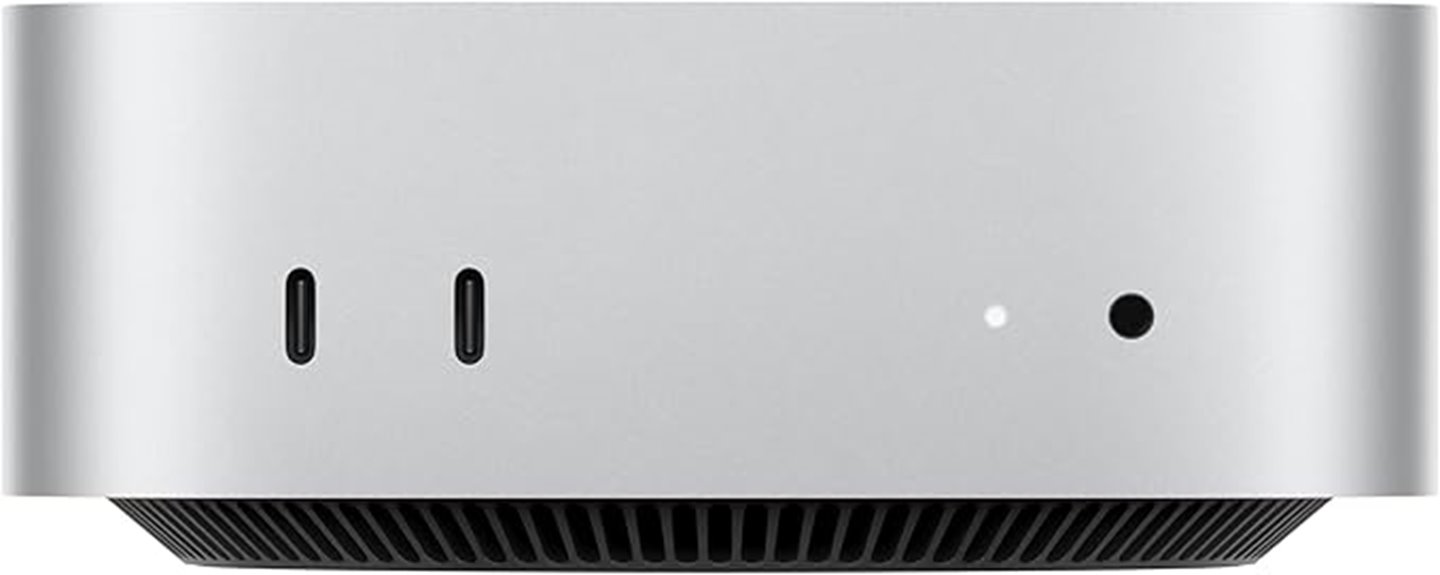
The Apple Mac mini Desktop Computer with M4 Chip (2024) is an excellent choice for professionals and creatives who need powerful performance in a compact design. Its five-by-five-inch form fits easily on any desk, making it perfect for tight spaces or cluttered workstations. Powered by the M4 chip with a 10-core CPU and GPU, it offers blazing-fast speed and smooth multitasking. With 16GB of unified memory and 512GB SSD storage, it handles demanding applications effortlessly. Connectivity is versatile, with Thunderbolt, HDMI, USB-C, and Ethernet ports. Plus, seamless integration with other Apple devices and advanced privacy features make it a reliable, efficient, and eco-friendly desktop option.
Best For: professionals, creatives, and users seeking a compact yet powerful desktop with seamless Apple ecosystem integration.
Pros:
- Compact design easily fits in tight workspaces or cluttered desks
- Powerful performance with M4 chip, 10-core CPU and GPU, and ample memory and storage
- Versatile connectivity options including Thunderbolt, HDMI, USB-C, and Ethernet
Cons:
- Limited upgrade options due to integrated hardware design
- May be more expensive than comparable non-Apple mini desktops
- Lacks built-in keyboard and monitor, requiring additional peripherals
Apple 2024 Mac mini Desktop Computer with M4 chip with 10‑core CPU and 10‑core GPU: Built for Apple Intelligence, 16GB Unified Memory, 256GB SSD Storage, Gigabit Ethernet. Works with iPhone/iPad
SIZE DOWN. POWER UP — The far mightier, way tinier Mac mini desktop computer is five by five...
As an affiliate, we earn on qualifying purchases.
Apple 2024 Mac mini Desktop Computer with M4 Chip
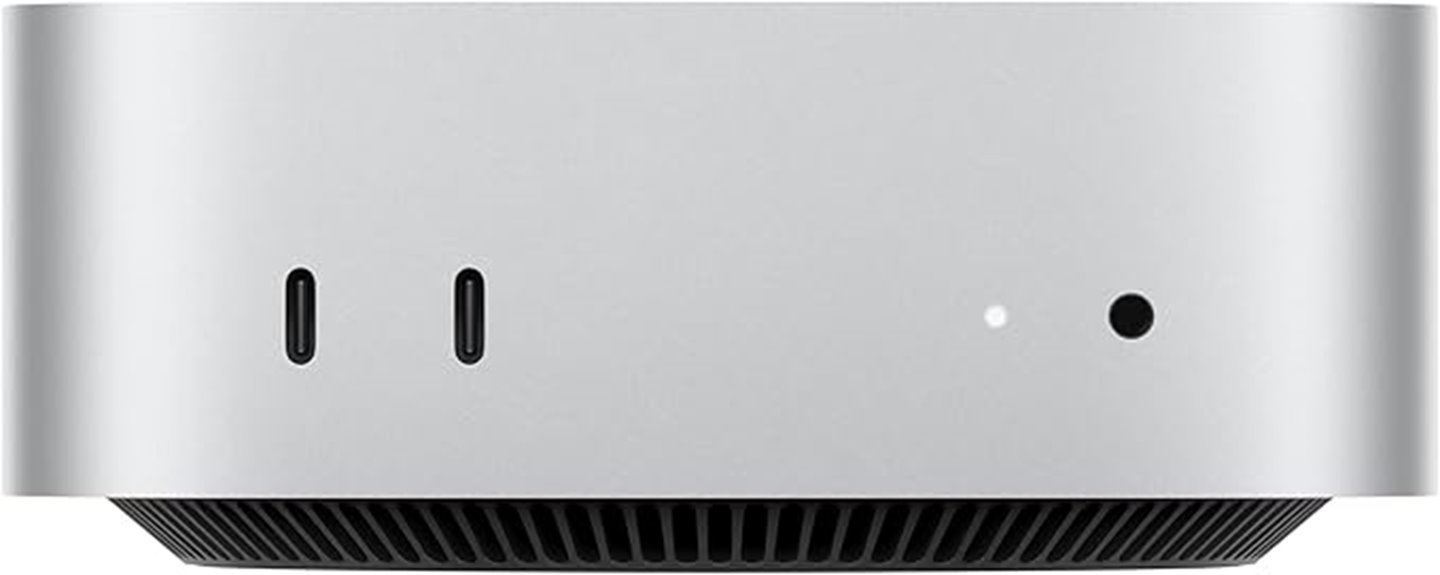
For anyone seeking a compact yet powerful desktop solution, the Apple 2024 Mac mini with the M4 chip stands out as an ideal choice. Its small 5×5-inch design and 1.5-pound weight make it easy to place anywhere, whether next to your monitor or in tight spaces. Powered by the advanced M4 chip, it offers a 10-core CPU, 10-core GPU, and Neural Engine for impressive performance. With up to 32GB of memory and configurable storage up to 2TB, it handles demanding tasks effortlessly. Seamlessly integrating with iPhone and iPad, it supports multiple high-resolution displays, making it a versatile and efficient mini powerhouse.
Best For: individuals or small businesses seeking a compact, high-performance desktop that seamlessly integrates with Apple devices and supports demanding creative and productivity tasks.
Pros:
- Small, lightweight design easily fits into any workspace or home setup.
- Powerful M4 chip with 10-core CPU and GPU delivers strong performance for various applications.
- Supports multiple high-resolution displays, ideal for multitasking and creative work.
Cons:
- Limited storage options starting at 256GB, which may require external storage for some users.
- Only three display outputs, potentially restricting multi-monitor setups for advanced users.
- Premium price point may be a consideration for budget-conscious buyers.
Apple 2024 Mac mini Desktop Computer with M4 chip with 10‑core CPU and 10‑core GPU: Built for Apple Intelligence, 24GB Unified Memory, 512GB SSD Storage, Gigabit Ethernet. Works with iPhone/iPad
SIZE DOWN. POWER UP — The far mightier, way tinier Mac mini desktop computer is five by five...
As an affiliate, we earn on qualifying purchases.
Apple 2024 Mac mini Desktop Computer with M4 Chip

Designed for users seeking a powerful yet space-efficient desktop, the Apple 2024 Mac mini with the M4 chip offers impressive performance in a compact form factor. Its five-by-five-inch size fits easily beside monitors or in tight spaces, maximizing workspace efficiency. Powered by the M4 chip with a 10-core CPU and GPU, it delivers snappy, fluid performance for demanding tasks. With 24GB of unified memory and a 512GB SSD, it guarantees fast data access and ample storage. The device includes versatile ports like Thunderbolt, HDMI, USB-C, and Ethernet, making connectivity seamless. It’s built for the Apple ecosystem, supporting popular apps and effortless device integration.
Best For: professionals and creatives who need a compact yet powerful desktop that seamlessly integrates with the Apple ecosystem and supports demanding tasks.
Pros:
- Compact and space-efficient design perfect for small workspaces
- Powerful M4 chip with 10-core CPU and GPU delivers high performance
- Extensive connectivity options including Thunderbolt, HDMI, and Ethernet
Cons:
- Limited to 512GB SSD storage, which may require external drives for large files
- No dedicated graphics card option, which could impact high-end gaming or intensive 3D tasks
- Price may be higher relative to other compact desktops with similar specs
Factors to Consider When Choosing Mac Studio Configurations
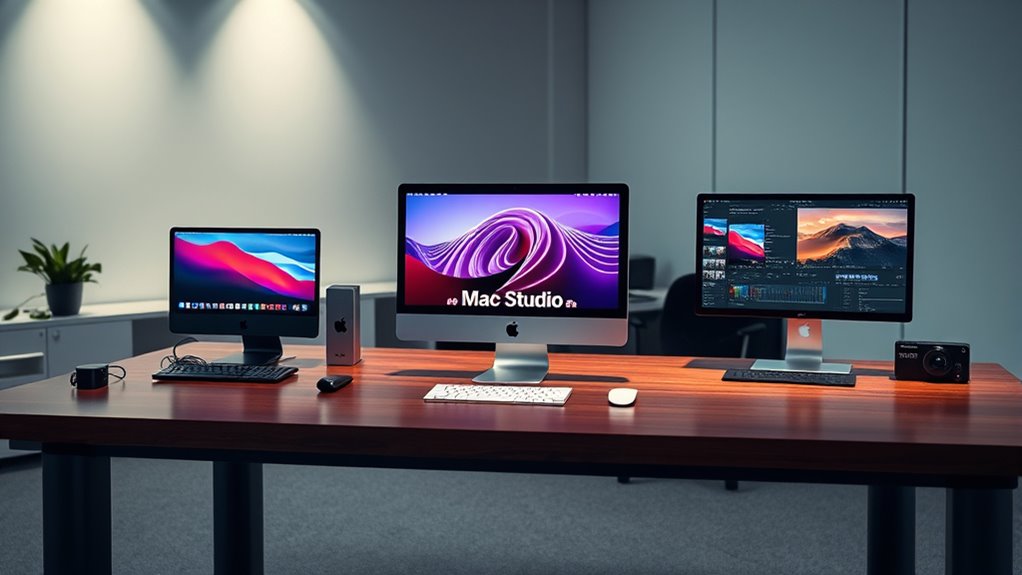
When choosing a Mac Studio setup, I focus on your processing power needs, memory capacity, and storage options to match your workload. It’s also important to take into account display support, compatibility, and connectivity requirements to ensure everything works smoothly. Let’s explore these factors to help you pick the best configuration for your workflow.
Processing Power Needs
Choosing the right processing power for your Mac Studio depends on the types of tasks you’ll be tackling. If you handle resource-intensive work like 3D rendering, video editing, or scientific simulations, you’ll need a powerful CPU with multiple cores. More cores mean better multitasking and faster execution of complex applications. If your work involves single-threaded applications, a processor with a higher clock speed will enhance performance. Upgrading to a more capable processor can also future-proof your setup, helping it handle increasing software demands. Additionally, balancing CPU cores with GPU capabilities matters—compute-heavy tasks benefit from more cores, while graphics-intensive work needs a strong GPU. Assess your workload carefully to choose a configuration that offers the right blend of power and efficiency.
Memory Capacity Requirements
Selecting the right memory capacity for your Mac Studio is vital, especially if you work with large files or run multiple demanding applications simultaneously. For most creative tasks and development work, 16GB to 32GB of RAM offers a good balance of performance and affordability. However, if your workflow involves intensive multitasking, 48GB or even 64GB may be necessary to prevent slowdown and improve efficiency. Resource-heavy applications like 3D rendering, video editing, or virtual machines benefit considerably from higher memory capacities. Keep in mind, upgrading RAM later is often limited, so configuring ample memory at purchase guarantees peak performance and future-proofing. Insufficient memory leads to slower performance, increased disk swapping, and reduced productivity during demanding tasks.
Storage Options Flexibility
Considering the storage options available for the Mac Studio is essential, as they directly impact your workflow and data management. With SSD choices ranging from 512GB to 8TB, I can tailor my setup to match my needs, whether for casual use or professional media editing. The ability to upgrade storage at purchase gives me flexibility for future expansion, avoiding the need for external drives and streamlining my workspace. Higher storage options also boost efficiency, reducing data access times and simplifying project management. This modular approach ensures I can select a configuration that aligns with my current requirements while allowing room to grow. Overall, flexible storage options help me optimize performance and data handling, making my Mac Studio a versatile tool for any workload.
Display Support Compatibility
When setting up my Mac Studio, I focus on its display support capabilities to match my workflow needs. I verify the configuration can handle the number of displays I plan to use, up to three simultaneously. It’s essential to confirm each display’s resolution requirements, whether I need 6K at 60Hz or 8K at 60Hz, and confirm that the Mac Studio supports these resolutions. I also check if the video outputs include Thunderbolt or HDMI ports that meet DisplayPort 2.1 or HDMI 2.1 standards for higher resolutions. Additionally, I consider whether my displays require specific ports or adapters, like Thunderbolt or HDMI, and make sure the Mac Studio can accommodate these. Bandwidth limitations of the ports are key to guaranteeing smooth performance for my multi-display setup.
Connectivity Requirements
Making sure your Mac Studio has the right connectivity options is essential for a seamless workflow. First, check that it has enough Thunderbolt 5 (USB-C) ports to connect all your external devices without hassle. If you work with high-resolution displays, verify support for HDMI 2.1 to handle 8K at 60Hz or 4K at 240Hz. For fast network needs, see if the Ethernet port can be upgraded to 10Gb Ethernet. Compatibility with your peripherals is also key—confirm support for USB-C, USB 4, and traditional USB-A devices. Ultimately, consider audio output options like the headphone jack and HDMI multichannel support to meet your audio requirements. These connectivity features ensure your setup is versatile, efficient, and ready for any task.
Software Performance Demands
Choosing the right Mac Studio configuration depends heavily on your software performance needs. If you’re working with demanding applications like 3D rendering, video editing, or data analysis, you’ll want a setup with more CPU and GPU cores to manage intensive tasks efficiently. Higher RAM capacity and faster storage are vital for complex workflows and multitasking across multiple demanding apps. For software that leverages hardware-accelerated features, such as ray tracing or ProRes encoding, selecting configurations with advanced media engines and higher-end specs makes a big difference. To future-proof your workflow and handle evolving software requirements, opt for the most capable hardware within your budget. This guarantees your Mac Studio remains powerful enough for current and upcoming software demands, maximizing your productivity and creative potential.
Budget Considerations
Budget considerations play a crucial role in selecting the right Mac Studio configuration because they directly influence which features and performance levels are achievable within your financial limits. Higher configurations with more cores, RAM, and storage markedly increase the overall cost, so I recommend determining your budget early. This helps prioritize essential features, such as GPU power for creative workflows or extra memory for multitasking. Keep in mind, opting for a lower-tier model with fewer cores or less storage may save money initially but could impact long-term performance and upgradeability. Investing in a more expensive setup might offer better future-proofing, reducing the need for future upgrades. Balancing your budget with your actual usage ensures you get the best value without overspending on unnecessary features.
Frequently Asked Questions
How Do I Upgrade Storage on the Mac Studio?
To upgrade storage on my Mac Studio, I usually start by checking the existing SSD capacity through System Information. If I need more space, I opt for an external SSD or Thunderbolt drive, as the internal storage isn’t user-upgradable. For internal upgrades, I’d contact Apple or an authorized service provider, since the SSD is soldered in the 2025 model, making DIY upgrades impossible.
Can I Customize the Graphics Card in the Mac Studio?
Can you customize the graphics card in the Mac Studio? Sadly, no. Apple designs the Mac Studio with integrated components, making hardware customization like swapping out the GPU impossible. Think of it as a sealed box of potential—you get what’s built in. If high-end graphics are essential, choose a configuration with the most powerful GPU from the start; it’s the closest option to customizing.
What Is the Warranty Period for Mac Studio Configurations?
The warranty period for Mac Studio configurations is typically one year from the date of purchase. I recommend checking with Apple directly or visiting their website, since warranty terms can vary based on your region or if you purchase additional AppleCare coverage. If something goes wrong, I find it’s reassuring to know that Apple’s support team can help troubleshoot or repair during the warranty period, giving you peace of mind.
Are There Specific Accessories Recommended for Mac Studio?
Yes, I recommend getting a high-quality monitor, like the Apple Studio Display, for crisp visuals. A good keyboard and mouse or trackpad are essential for comfortable working. You might also consider an external storage drive for extra space and a reliable surge protector to safeguard your setup. These accessories boost productivity and protect your investment, making your Mac Studio experience smoother and more enjoyable.
How Energy-Efficient Are Different Mac Studio Setups?
The energy efficiency of Mac Studio setups varies, but honestly, they’re so advanced, they could power a small city! I find the base models quite efficient, using minimal power for everyday tasks, while the higher-end configurations with multiple GPUs and extra memory consume more but still stay well within eco-friendly limits. Overall, I think Apple’s engineering keeps power consumption low, making these setups both powerful and environmentally conscious.
Conclusion
No matter which Mac Studio setup you choose, I promise it’ll boost your productivity and creativity. I get it—spending on new tech can feel risky. But investing in the right configuration means smoother workflows and future-proofing your work. Don’t let hesitation hold you back; with these options, you’ll find a perfect fit that truly elevates your creative game. So go ahead—make the leap and upgrade confidently!