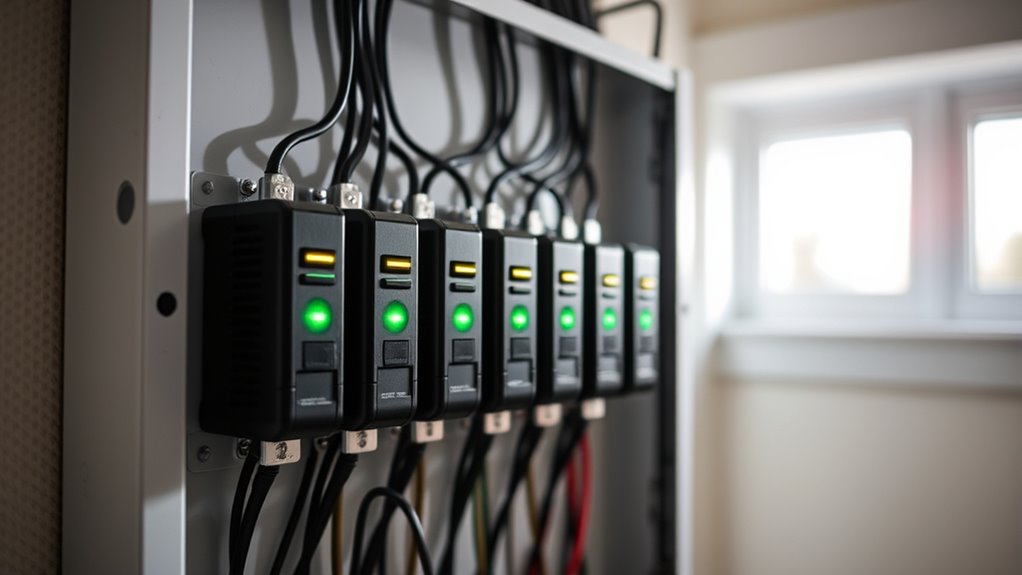

Choosing the right whole house surge protector installation is essential for safeguarding your home’s electrical system from power surges. The best overall pick, EVOSPD2SURGE, combines high joule ratings with reliable performance, making it suitable for most homes. For those seeking robust outdoor protection, the Eaton CHSPT2SURGE offers durable NEMA 4 enclosure, ideal for harsh conditions. Meanwhile, Siemens BoltShield provides high amperage capacity for homes with high electrical demands. Keep in mind, the main tradeoffs involve balancing protection levels, ease of installation, and cost. Continue reading for a detailed breakdown of these top options and what matters most for your home security.
Key Takeaways
- High joule ratings correlate strongly with surge protection longevity and overall safety.
- Outdoor-rated models like Eaton CHSPT2SURGE are better suited for harsh weather environments.
- Amperage capacity varies significantly; homes with high electrical loads need higher-rated devices.
- Ease of installation can differ, with some units requiring professional help, impacting overall value.
- Price often reflects build quality and protection features, but premium options aren’t always necessary for average homes.



| whole house surge protector installation | Voltage |
|---|---|
| EVOSPD2SURGE Whole House Surge | 120/240V |
| Eaton CHSPT2SURGE SPD Type 2 W | 120/240 Volts |
| Siemens BoltShield FSPD036 Lev | 240 volts |
| FHSPD108S Whole House Surge Pr | 120/240V |
| Square D by Schneider Electric | 120/240V |
| Siemens Boltshield FSPD140 Lev | 120/240V |
| Leviton Type 1 Surge Protectiv | 120/240 VAC |
| FHSPD36S Whole House Surge Pro | 120/240V |
| Eaton Surge Protection Device | 120/240V |
More Details on Our Top Picks
EVOSPD2SURGE Whole House Surge Protector for 72,000 Amps/Phase, 1880 Joules, 120/240V
This surge protector stands out for its exceptionally high surge current capacity of 72,000 amps per phase and robust energy absorption of 1880 Joules, making it suitable for homes with high electrical demands or light commercial use. Compared to the Siemens BoltShield FSPD036, which offers a lower 36,000-amp rating, this model provides a more comprehensive safety margin, though it comes at a higher cost and less detailed installation guidance. Its thermally protected MOVs contribute to longevity, and the visual LED indicator simplifies monitoring system health. While designed mainly for residential and light commercial systems, it might be overkill for smaller homes with simpler electrical loads. The lack of detailed installation instructions could pose a challenge for DIY installers. Overall, this pick is best for those seeking maximum surge protection and willing to invest in durability.
Pros:- Exceptional surge current capacity for comprehensive protection
- Durable thermally protected MOVs extend lifespan
- LED indicator simplifies system status monitoring
- Universal compatibility with major electrical panels
Cons:- Higher cost compared to basic surge protectors
- Limited installation guidance may challenge DIY installation
Best for: Homeowners with high-value electronics, light commercial setups, or those seeking maximum surge capacity
Not ideal for: Small residences with basic electrical needs, or DIYers who prefer detailed installation guidance
- Voltage:120/240V
- Surge Current:72,000 Amps per phase
- Energy Absorption:1880 Joules
- Protection Type:Type 2 Surge Protective Device
- Components:8 Thermally Protected MOVs
- Compatibility:Major electrical panels
Our verdict“This surge protector is best suited for users prioritizing maximum surge capacity and longevity over ease of installation or initial cost.”
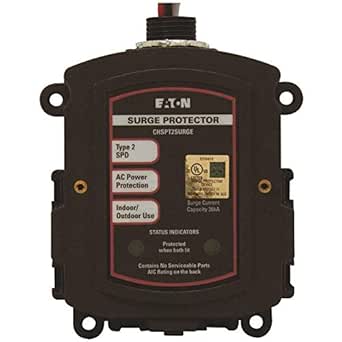
Eaton CHSPT2SURGE SPD Type 2 Whole Home Surge Protector, NEMA 4, Single Phase, 120/240 Volts
The Eaton CHSPT2SURGE offers a straightforward solution for protecting whole-home electrical systems with a quick connect design that simplifies installation. Compared to the Square D HEPD50, which has a lower surge current rating, Eaton’s unit provides a broad compatibility range and is easier for electricians to install, thanks to its universal design. However, it lacks specific details about surge capacity and lifespan, which could make long-term reliability harder to assess. Its NEMA 4 rating allows outdoor installation, making it versatile for various environments. Still, the absence of detailed technical specs might be a concern for those wanting precise surge capacity data. Overall, this model fits households seeking reliable protection with a focus on install convenience and broad compatibility.
Pros:- Universal compatibility with diverse load centers
- Quick connect design speeds up installation
- Provides comprehensive whole-home surge protection
- NEMA 4 rating allows outdoor installation
Cons:- Limited technical details on surge capacity and lifespan
- Potentially higher cost compared to smaller units
Best for: Homeowners wanting an easy-to-install, universally compatible surge protector
Not ideal for: Users requiring detailed surge capacity specs or higher surge ratings for extreme conditions
- Type:Type 2 Surge Protector
- NEMA Rating:NEMA 4
- Phase:Single Phase
- Voltage:120/240 Volts
- Country of Origin:China
Our verdict“This surge protector is ideal for homeowners seeking a hassle-free, versatile protection solution with broad compatibility.”
Siemens BoltShield FSPD036 Level 2 Whole House Surge Protection Device Rated for 36,000 Amps, 120/240V
The Siemens BoltShield FSPD036 provides a balanced level of protection with a 36,000-amp surge rating, suitable for typical residential needs. Compared with the Eaton CHSPT2SURGE, which offers a similar ease of installation, this model emphasizes outdoor durability with its polycarbonate enclosure and external surge monitoring. Its two outlets cover essential circuits, but may fall short for larger homes with multiple electrical branches. The lack of a built-in circuit breaker means additional components may be needed for comprehensive safety. This pick is well-suited for homeowners who want reliable outdoor protection at a lower cost, but those with more complex systems might find its surge capacity limiting.
Pros:- Outdoor-rated enclosure withstands weather exposure
- Easy to install with external surge monitoring
- Affordable option for basic protection
- Suitable for outdoor or exposed environments
Cons:- Limited to 2 outlets, not covering entire home
- No built-in circuit breaker for additional safety
- Surge capacity may be insufficient for high-demand systems
Best for: Budget-conscious homeowners needing outdoor-rated surge protection for basic residential setups
Not ideal for: Large homes or users needing extensive surge capacity or integrated circuit breakers
- Number of Outlets:2
- Voltage:240 volts
- Maximum Current:36 A
- Plug Type:Type B
- Enclosure Material:Polycarbonate
Our verdict“This surge protector fits budget-minded homeowners seeking outdoor durability and basic surge protection without extensive coverage.”
FHSPD108S Whole House Surge Protector for 108,000 Amps, Indoor/Outdoor Use, 120/240V
The FHSPD108S offers a high surge capacity of 108,000 amps, making it suitable for homes with high electrical loads or in areas prone to frequent surges. Compared with the EVOSPD2SURGE, which has a higher Joules rating but slightly lower amps, this model emphasizes capacity for extreme conditions and weather resistance, thanks to its commercial-grade enclosure. Its compact design allows for flexible installation in various load centers, but proper grounding and professional setup are essential to avoid startup issues. This protector is ideal for those seeking maximum surge capacity combined with outdoor resilience, although it involves somewhat complex installation procedures.
Pros:- Very high surge capacity of 108,000 Amps for extreme protection
- Compact, space-saving design
- Weather-resistant enclosure suitable for outdoor use
- LED indicators for status monitoring
Cons:- Requires professional installation and grounding
- Potential startup issues if not installed correctly
Best for: Homes in surge-prone areas needing maximum capacity and weather resistance
Not ideal for: DIY installers or smaller residences with simpler electrical needs
- Capacity:108,000 Amps
- Voltage:120/240V
- Frequency:60Hz
- Enclosure:Commercial-grade, indoor/outdoor
- Size:Compact
Our verdict“This surge protector is best for high-demand, outdoor installations where maximum surge capacity and weather resilience are priorities.”
Square D by Schneider Electric HEPD50 Universal Whole House Surge Protection Device, 1-Phase, 3-Wire + Ground for 120/240V, 50kA
The Square D HEPD50 offers a practical solution with a 50,000A surge current rating, tailored for residential load centers and sensitive electronics. Compared to the Siemens BoltShield FSPD036, which shares similar surge ratings, the HEPD50’s compact size and NEMA 4X rating make it easier to install in standard load centers, especially in outdoor or exposed environments. Its simplicity is a plus for homeowners with basic electrical needs, but the lack of remote monitoring or higher surge capacity may limit its use in more demanding situations. This model is ideal for those seeking reliable protection for household electronics in a straightforward, durable package.
Pros:- Reliable surge protection with 50,000A rating
- Easy to install in standard residential load centers
- Durable NEMA 4X rated enclosure for outdoor use
- LED indicator confirms proper operation
Cons:- Limited to 1-phase systems
- No remote monitoring features
- Lower surge capacity compared to larger units
Best for: Homeowners needing reliable, straightforward surge protection for household electronics
Not ideal for: Larger homes or users requiring high surge capacity or remote system monitoring
- Brand:Square D by Schneider Electric
- Model:HEPD50
- Voltage:120/240V
- Phase:1-Phase
- Wire Configuration:3-Wire + Ground
- Surge Current Rating:50,000A
Our verdict“This surge protector is ideal for homeowners focused on easy, dependable protection for household electronics without extensive additional features.”
Siemens Boltshield FSPD140 Level 2 Whole House Surge Protection Device 140,000 Amps, 120/240V
The Siemens Boltshield FSPD140 stands out as the best overall choice for homes requiring robust surge protection, thanks to its high 140,000-amp surge current rating. Compared with the FHSPD36S, which offers only 36,000 amps, this model provides a much greater capacity for handling severe power surges, making it suitable for areas prone to thunderstorms or unreliable power grids. Its visual and audible alerts simplify maintenance, while the outdoor-rated Type 4 enclosure allows flexible installation options. However, the larger size and need for professional installation may deter DIYers or those with limited space. This pick is ideal for homeowners seeking maximum protection without compromise, especially in high-risk regions.
Pros:- Exceptional surge current capacity of 140,000 Amps
- Visual and audible alerts for easy maintenance
- Outdoor-rated enclosure for versatile, weatherproof installation
Cons:- Requires professional installation, adding to upfront costs
- Potentially bulky, needing ample space in load centers
Best for: Homeowners in storm-prone areas or with high-value electronics needing heavy-duty surge defense
Not ideal for: DIY enthusiasts with limited electrical experience or small load centers where space is tight
- Surge Current Rating:140,000 Amps
- Voltage:120/240V
- Enclosure Rating:Type 4 outdoor
Our verdict“Best suited for those who prioritize maximum surge capacity and outdoor durability over ease of installation.”
Leviton Type 1 Surge Protective Panel, Residential Home Surge Protection, 120/240 VAC, Split Phase, 36kA per Phase, R2120-B SPD, Gray
The Leviton R2120-B offers a straightforward, space-efficient solution for residential surge protection, making it an excellent choice for typical homes. Compared with the Siemens Boltshield FSPD140, which is more advanced and suited for high-risk environments, this panel provides adequate protection for most residential needs, especially where NEC compliance is required. Its compact design simplifies installation and fits neatly into existing load centers, though it’s limited to residential applications and may not withstand extreme surges. This panel is ideal for homeowners who want compliant, reliable protection without fuss or extra bulk, provided their electrical system isn’t exposed to frequent or severe surges.
Pros:- Compact and easy to install in standard load centers
- Meets NEC requirements for dwellings
- Effective for typical residential surge events
Cons:- Limited surge capacity (36kA per phase), less suited for extreme conditions
- Designed mainly for residential use, not scalable for commercial needs
Best for: Homeowners seeking NEC-compliant, easy-to-install surge protection for standard residential wiring
Not ideal for: Properties in high-surge environments or with high-value electronics requiring maximum capacity
- Type:Type 1 Surge Protective Device
- Voltage:120/240 VAC
- Phase:Split Phase
- Current Rating:36kA per Phase
Our verdict“Ideal for homeowners who want NEC-compliant, straightforward surge protection with minimal installation effort.”
FHSPD36S Whole House Surge Protector for 36,000 Amps, Indoor/Outdoor Use
The FHSPD36S delivers a solid 36,000-amp surge capacity in a compact form, making it suitable for homes with limited space or those seeking a space-saving option. Compared to larger units like the Siemens Boltshield FSPD140, it sacrifices some capacity but gains in size and ease of installation, fitting well into various load centers. Its commercial-grade enclosure ensures durability for indoor or outdoor setups, though it still requires professional grounding and installation. This model strikes a balance between capacity and convenience, making it appropriate for homeowners who want reliable protection without bulky hardware needing extensive space.
Pros:- High surge capacity of 36,000 Amps
- Compact, space-saving design
- Compatible with all load center brands
Cons:- Requires professional installation and proper grounding
- Potential startup issues if not grounded correctly
Best for: Homeowners looking for a space-efficient, high-capacity surge protector suitable for indoor or outdoor use
Not ideal for: Homes with extreme surge risks or those preferring maximum current capacity for severe events
- Capacity:36,000 Amps
- Voltage:120/240V
- Enclosure:Commercial-grade
Our verdict“Perfect for those wanting a reliable, space-conscious surge protector that works indoors or outdoors.”
Eaton Surge Protection Device, 1 Phase, 120/240V, 2 Poles, 2 Wires
The Eaton CHSPT2ULTRA offers a straightforward solution for homes with 1-phase electrical systems, providing essential surge protection in a simple, easy-to-install package. Compared with the Leviton R2120-B, which is more specialized for residential load centers, this device’s universal compatibility makes it a versatile choice across different load centers. Its minimalistic setup and high-quality build make it suitable for standard homes, though it’s limited to 120/240V 1-phase systems, which excludes multi-phase commercial or industrial environments. This surge protector is best for homeowners wanting a reliable, no-frills device that offers robust protection in typical residential settings.
Pros:- Universal compatibility with various load centers
- Simple installation process
- High-quality construction
Cons:- Limited to 1-phase systems, not suitable for larger or commercial setups
- No detailed surge capacity specifications provided, less transparency
Best for: Homeowners with standard 1-phase electrical systems seeking an easy, reliable surge protector
Not ideal for: Homes with three-phase systems or those requiring higher surge capacities for high-value equipment
- Model Number:CHSPT2ULTRA
- Voltage:120/240V
- Poles:2
- Wires:2
Our verdict“Suitable for standard residential systems where straightforward, reliable surge protection is the priority.”

How We Picked
I evaluated these products based on several key factors: surge protection capacity (joules and amps), durability for indoor versus outdoor use, ease of installation, and overall build quality. Cost-effectiveness was also considered to provide options for different budgets. The rankings reflect a balance between high performance, user-friendliness, and value, favoring models that deliver reliable protection without excessive complexity or expense. Products with higher amperage ratings and outdoor suitability generally ranked higher, as they offer better long-term protection and versatility for various home setups.Factors to Consider When Choosing Whole House Surge Protector Installation
When selecting a whole house surge protector installation, several factors should influence your decision. Understanding these can help you avoid common pitfalls like under-protection or overly complex installations. The right choice depends on your home’s electrical load, environment, and budget. Here are key considerations to keep in mind:Protection Capacity (Joules and Amperage)
Protection capacity is central to how well a surge protector can absorb and dissipate energy. Higher joule ratings typically mean longer-lasting protection, especially during frequent or large surges. Additionally, the amperage rating indicates how much current the device can handle without failure, crucial for homes with high electrical demands. Matching these ratings to your home’s electrical profile ensures you get sufficient protection without overspending on unnecessary capacity.
Indoor vs. Outdoor Use
Many surge protectors are designed specifically for indoor or outdoor environments. Outdoor models feature weather-resistant enclosures, making them suitable for installation near service entrances or outdoor panels. Installing an indoor-only device outdoors can lead to premature failure due to exposure to moisture, dust, and temperature fluctuations. Choosing the right rated device for your installation site guarantees durability and reliable protection over time.
Ease of Installation
Some surge protectors are straightforward to install with basic electrical skills, while others may require a licensed electrician, especially for panel-mounted units. Consider your comfort level and whether the device’s wiring and mounting requirements align with your skills. Proper installation is vital to ensure the surge protector functions correctly; improper setup can compromise your home’s safety and void warranties.
Compatibility and System Integration
Ensure the surge protector matches your electrical system’s configuration, including voltage, phase, and wiring type. Compatibility issues can result in ineffective protection or installation difficulties. For example, some units are designed specifically for split-phase systems common in North American homes, while others support single-phase setups. Correct compatibility avoids unnecessary upgrades or modifications and guarantees optimal operation.
Price and Long-Term Value
While premium models offer higher ratings and additional features, they often come with a higher price tag. Balance your budget with the level of protection needed. Sometimes, investing in a slightly more expensive unit offers better resilience and longer lifespan, saving money on replacements later. Conversely, for homes with lower electrical loads or less exposure to surges, a more affordable model might be sufficient without sacrificing safety.
Frequently Asked Questions
Can I install a whole house surge protector myself?
Installing a whole house surge protector can be straightforward if you have electrical experience and the right tools. However, for most homeowners, especially those unfamiliar with electrical systems, hiring a licensed electrician is recommended. Proper installation ensures the device functions correctly and safely, and professional help can help avoid code violations or damage to your electrical system.
How often should I replace my surge protector?
Most surge protectors do not have a visible indicator when they fail, so it’s wise to check the manufacturer’s recommendations. Typically, replacing every 5 to 10 years is a good practice, especially after a large surge event. Regular inspection of the device, and replacing it if it shows signs of wear or damage, helps maintain optimal protection for your home.
Is a higher joule rating always better?
Generally, a higher joule rating indicates a greater capacity to absorb energy, which is beneficial for continuous protection. However, the specific needs of your home, such as local power quality and electrical load, influence whether a very high rating is necessary. Overspending on excessively high ratings for modest needs can be unnecessary, but under-protecting can leave your home vulnerable to damage.
What is the difference between Type 1 and Type 2 surge protectors?
Type 1 surge protectors are installed on the main service line before the electrical panel, offering protection from external surges like lightning strikes. Type 2 protectors are installed inside the panel or at sub-panels, safeguarding against residual surges from within the home or indirect external surges. Many homeowners combine both types for comprehensive coverage, but Type 2 units are often sufficient for most residential needs.
Do outdoor surge protectors require special maintenance?
Outdoor surge protectors are designed to withstand environmental elements, but regular inspections are still advisable. Check for physical damage, corrosion, or signs of wear after severe weather events. Ensuring the enclosure remains sealed and free of debris helps maintain the device’s effectiveness, extending its lifespan and protecting your home reliably.
Conclusion
For most homeowners seeking reliable, straightforward protection, the EVOSPD2SURGE offers a balanced mix of high capacity and ease of installation, making it the best overall choice. Those with outdoor setups or harsh environments will benefit from the rugged durability of the Eaton CHSPT2SURGE. If you’re upgrading a high-demand home or need a premium, long-lasting solution, the Siemens BoltShield FSPD140 provides excellent amperage capacity. Beginners or those on a budget should consider simpler, indoor models like the Square D HEPD50 for quick, effective protection. Ultimately, your decision should match your home’s electrical demands and exposure to surges, ensuring peace of mind for years to come.