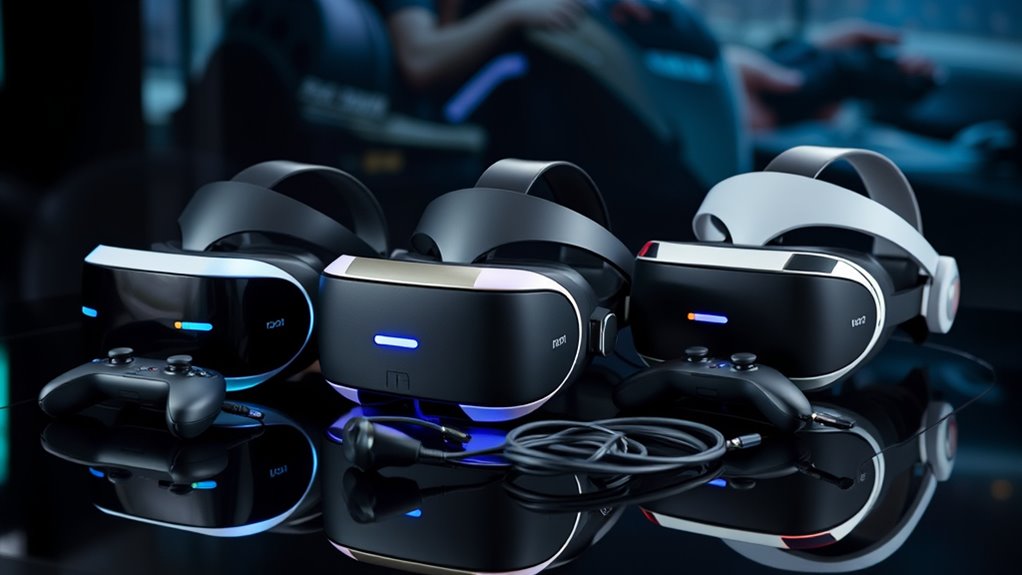

If you’re shopping for high-end VR headsets for gaming, the biggest decision is whether you want a standalone headset like the Meta Quest 3 512GB, a console-tethered option like the PlayStation VR2, or a PC VR powerhouse like the Pimax Crystal Super with its ultra-sharp 3840×3840-per-eye displays. My top pick overall is the Meta Quest 3 512GB, because it balances sharp visuals, a strong game library, and wireless convenience without demanding a gaming PC. The Pimax Crystal Super stands out for simulation enthusiasts who want maximum clarity and field of view, while the PSVR2 is the clear choice for PlayStation 5 owners. The main tradeoffs in this category come down to price versus processing power, wireless freedom versus graphical fidelity, and comfort during long sessions. Keep reading for the full breakdown of all 15 headsets and which one fits your gaming style.
Complete the kit

Key Takeaways
- The Meta Quest 3 512GB takes the top spot because it delivers the best balance of visual clarity, standalone convenience, and library access, while the cheaper Quest 3S sacrifices display sharpness — not performance — to hit a lower price.
- Pimax headsets dominate the ultra-premium tier for flight sims and racing, but they all require a powerful gaming PC and tolerate more setup fuss than anything from Meta or Sony.
- The PlayStation VR2 (with or without the Horizon bundle) is the only sensible pick for PS5 owners, but it’s effectively locked to Sony’s ecosystem, which limits its usefulness for PC gamers.
- The aging Oculus Quest 64GB and Quest 2 128GB still run today’s games but sit at the bottom of a high-end list because their displays and processors lag noticeably behind the Quest 3 generation.
- A renewed Quest 3S is the smartest way into premium VR on a budget, offering the same chip and game library as the new model with only cosmetic risk.
| Meta Quest 3S 128GB Virtual Reality Headset with Gorilla Tag Bundle |  | Best Value Entry Into Current-Gen VR | Storage: 128GB | Processor: Snapdragon XR2 Gen 2 | RAM: 8GB | VIEW ON AMAZON | See Our Full Breakdown |
| Meta Quest 3 512GB Virtual Reality Headset |  | Best Overall Standalone | Storage: 512GB | Display: 4K Infinite Display | Processor: Snapdragon XR2 Gen 2 | VIEW ON AMAZON | See Our Full Breakdown |
| Oculus Quest All-in-one VR Gaming Headset – 64GB |  | Best Budget Pickup for Causal Play | Storage: 64GB | Display Resolution: 1440 x 1600 per eye | Display Type: OLED | VIEW ON AMAZON | See Our Full Breakdown |
| Meta Quest 2 — Advanced All-In-One Virtual Reality Headset — 128 GB |  | Best Mid-Range All-Rounder | Storage: 128GB | Tracking: Inside-out with hand tracking support | Audio: 3D positional audio | VIEW ON AMAZON | See Our Full Breakdown |
| PlayStation VR2 Horizon Call of the Mountain Bundle (PSVR2) |  | Best Premium Visuals for Console Gamers | Platform: PlayStation 5 | Display Resolution: 3840 x 2160 (4K HDR) | Refresh Rate: 120Hz | VIEW ON AMAZON | See Our Full Breakdown |
| HTC Vive Focus Vision Wired Bundle — XR Headset with DisplayPort PC VR Streaming Kit |  | Best for Serious Sim Racing and Full-Body Tracking | Resolution: 2448 x 2448 per eye | Field of View: Up to 120° | Refresh Rate: 90 Hz | VIEW ON AMAZON | See Our Full Breakdown |
| Pimax Crystal Super VR Headset with Micro-OLED and Eye Tracking |  | Best Visual Fidelity — Premium Pick | Display: Micro-OLED | Resolution: 3840 x 3552 per eye | Field of View: 116° | VIEW ON AMAZON | See Our Full Breakdown |
| Pimax Crystal Super VR Headset, 57PPD & 3840×3840 Resolution per Eye, 106° Wide Field of View |  | Best for Flight Simulators | Resolution: 3840 x 3840 per eye | Field of View: 106° | Refresh Rate: 72 Hz / 90 Hz | VIEW ON AMAZON | See Our Full Breakdown |
| Meta Quest 3S 128GB Virtual Reality Headset (Renewed Premium) |  | Best Entry Point to High-End VR | Resolution: 2064 x 2208 | Refresh Rate: 90 Hz | Processor: Snapdragon XR2 Gen 2 | VIEW ON AMAZON | See Our Full Breakdown |
| PlayStation VR2 (PSVR2) |  | Best Console VR Experience | Resolution: 4K HDR | Field of View: 110° | Eye Tracking: Yes | VIEW ON AMAZON | See Our Full Breakdown |
| Pimax Crystal Super VR Headset, 3840×3840 per Eye, Ultrawide, 140° FOV, Eye-Tracking, PC Compatible |  | Best Visual Fidelity for Sim Racing and Flight Sims | Resolution: 3840×3840 per eye | Field of View: 140 degrees | Display Technology: QLED with Mini-LED | VIEW ON AMAZON | See Our Full Breakdown |
| Meta Quest 3 512GB Virtual Reality Headset with Gorilla Tag Bundle |  | Best All-Rounder Wireless Pick | Storage: 512GB | Display: 4K+ Infinite Display | Memory: 8GB RAM | VIEW ON AMAZON | See Our Full Breakdown |
| Galaxy XR Virtual Reality Headset with Mixed Reality, High-Resolution Display, Spatial Audio, Adjustable Comfort |  | Best for Mixed-Use Beyond Gaming | Display: High-resolution | Audio: Spatial Audio | Sensors: Advanced precision head and hand tracking | VIEW ON AMAZON | See Our Full Breakdown |
| Pimax Crystal Light VR Headset with Controllers, 8K QLED Display with Local Dimming, Lightweight & Comfortable for Flight Sims, iRacing & PC Gaming |  | Best Value PC VR for Sim Enthusiasts | Display Resolution: 5760×2880 (2880×2880 per eye) | Display Type: QLED with local dimming | Field of View: 130 degrees | VIEW ON AMAZON | See Our Full Breakdown |
| Pimax Crystal Light VR Headset for PC, 2880×2880 per Eye, 8K QLED Display with Local Dimming, Inside-Out Tracking | | Best for Seated Sim Purists | Resolution: 2880 x 2880 per eye | Display Technology: QLED with HDR and local dimming | Refresh Rate: 120Hz | VIEW ON AMAZON | See Our Full Breakdown |
| highend vr headsets for gaming | Refresh Rate | Field of View | Connectivity |
|---|---|---|---|
| Meta Quest 3S 128GB Virtual Re | — | — | — |
| Meta Quest 3 512GB Virtual Rea | — | — | — |
| Oculus Quest All-in-one VR Gam | 90Hz | 110 degrees | Bluetooth, USB Type A |
| Meta Quest 2 | — | — | Wireless, no PC or console required |
| PlayStation VR2 Horizon Call o | 120Hz | 110 degrees | HDMI, USB Type C |
| HTC Vive Focus Vision Wired Bu | 90 Hz | Up to 120° | DisplayPort, Ethernet, Wi-Fi |
| Pimax Crystal Super VR Headset | 90 Hz | 116° | DisplayPort |
| Pimax Crystal Super VR Headset | 72 Hz / 90 Hz | 106° | USB |
| Meta Quest 3S 128GB Virtual Re | 90 Hz | 96° | USB Type-C, 3.5mm jack |
| PlayStation VR2 | — | 110° | — |
| Pimax Crystal Super VR Headset | 90Hz | 140 degrees | DisplayPort, USB |
| Meta Quest 3 512GB Virtual Rea | — | — | — |
| Galaxy XR Virtual Reality Head | — | — | — |
| Pimax Crystal Light VR Headset | 120Hz | 130 degrees | HDMI, USB |
| Pimax Crystal Light VR Headset | 120Hz | — | — |
More Details on Our Top Picks
Meta Quest 3S 128GB Virtual Reality Headset with Gorilla Tag Bundle
The Quest 3S delivers the same Snapdragon XR2 Gen 2 processing power as the pricier Quest 3, which means nearly identical game performance at a lower cost of entry — you’re mainly trading away display sharpness and pancake-lens compactness rather than raw capability. Compared with the aging Oculus Quest, this model’s dual RGB color cameras make mixed reality passthrough feel like a genuine feature instead of a grainy novelty. The included Gorilla Tag bundle sweetens the deal for younger players or anyone gifting a first headset. The tradeoffs are real, though: 128GB fills up fast with modern game sizes, and the roughly two-hour battery means marathon sessions need a power bank or a break. For buyers who want current-gen performance without the premium display tax, this option makes the most sense.
Pros:- Same Snapdragon XR2 Gen 2 processor as the flagship Quest 3
- Fully wireless with no PC or console required
- Color passthrough cameras enable genuine mixed reality play
- Includes exclusive Gorilla Tag bundle content
Cons:- 128GB storage fills quickly with modern VR game sizes
- Battery life of just over 2 hours limits marathon sessions
- Requires a cleared physical play space for safe room-scale use
Best for: First-time VR buyers and families who want modern performance and a bundled game without paying flagship prices
Not ideal for: Players with large game libraries or long-session habits — the 128GB storage and 2-hour battery will both pinch quickly
- Storage:128GB
- Processor:Snapdragon XR2 Gen 2
- RAM:8GB
- Battery Life:2+ hours
- Cameras:Dual RGB color cameras
- Design:Wireless standalone headset
Our verdict“The smartest entry point into current-generation VR gaming if you can live with modest storage and a shorter battery.”
Meta Quest 3 512GB Virtual Reality Headset
This is the headset that most high-end standalone buyers should aim for. The 4K Infinite Display offers a near 30% resolution bump over the Quest 3S, and that difference shows up where it matters most: text legibility, distant detail in open-world games, and reduced screen-door effect during fast motion. Where the Quest 3S compromises on clarity, this model holds up during long sessions without visual fatigue setting in as quickly. The 512GB of storage is the real differentiator against the rest of Meta’s lineup — you can install a full library of large titles and never think about deleting anything. The compromises remain the platform’s shared weaknesses: battery still taps out at roughly two hours, and the premium pricing stings compared to the 3S. Compared with the PSVR2, you lose raw visual horsepower but gain total freedom from wires and a PS5.
Pros:- 4K Infinite Display with nearly 30% higher resolution than the 3S
- 512GB storage accommodates an entire large-game library
- Snapdragon XR2 Gen 2 keeps demanding titles running smoothly
- Completely untethered with 3-month game trial included
Cons:- Premium price relative to siblings with the same processor
- Battery life still capped at just over 2 hours
- Games must be purchased after the trial period ends
Best for: Committed standalone VR gamers who install many large titles and want the sharpest wireless display Meta offers
Not ideal for: Budget-conscious buyers who play in short bursts — the Quest 3S delivers most of the experience for noticeably less
- Storage:512GB
- Display:4K Infinite Display
- Processor:Snapdragon XR2 Gen 2
- RAM:8GB
- Battery Life:2+ hours
- Cameras:Dual RGB color cameras
- Included Trial:3 months of game access
Our verdict“The best all-around wireless headset for serious gamers who refuse to manage storage or squint at softer visuals.”
Oculus Quest All-in-one VR Gaming Headset – 64GB
The original Oculus Quest still earns a spot as the cheapest legitimate way into standalone VR gaming. Its OLED panels actually deliver deeper blacks than the LCD screens in the Quest 2, which gives atmospheric games a moody richness the newer hardware can’t match. Against the Quest 3S, though, the gap is stark: the older processor, 1440 x 1600 resolution, and 64GB ceiling mean modern titles either look softer or won’t install at all. The Oculus Touch controllers remain excellent, and inside-out tracking still works reliably for seated and standing play. This pick makes the most sense as a low-risk trial of VR, a headset for occasional party games, or a backup unit — not as a primary rig for anyone who has already felt the pull of current-gen fidelity.
Pros:- OLED display produces richer blacks than newer LCD-based models
- Reliable inside-out tracking with no external sensors
- Oculus Touch controllers are precise and comfortable
- Works standalone or connected to a PC
Cons:- 64GB storage severely limits how many titles can be installed
- Display resolution falls well short of current-gen headsets
- Requires a Facebook account to log in
Best for: Curious newcomers or casual players who want to try real VR gaming with minimal financial commitment
Not ideal for: Enthusiasts wanting modern game support and sharp visuals — the 64GB limit and dated processor age poorly against the Quest 3S
- Storage:64GB
- Display Resolution:1440 x 1600 per eye
- Display Type:OLED
- Refresh Rate:90Hz
- Field of View:110 degrees
- Connectivity:Bluetooth, USB Type A
- Platform Compatibility:PC, Standalone
Our verdict“A serviceable, wallet-friendly toe-dip into VR that you’ll outgrow if the hobby sticks.”
Meta Quest 2 — Advanced All-In-One Virtual Reality Headset — 128 GB
The Quest 2 occupies the sensible middle ground between the original Quest’s dated hardware and the Quest 3’s premium pricing. Its library access is the strongest argument here — over 500 titles across gaming, fitness, and social apps, all running wirelessly without a PC or console. Hand tracking and 3D audio add polish that the original Quest lacks, and the 128GB capacity doubles what the older model offers, giving room for a respectable library. Compared with the Quest 3S, the older processor shows its age in demanding titles, and visuals lack the color passthrough mixed-reality features that make the 3S feel current. But for buyers who want a proven, comfortable, no-fuss headset for casual sessions and social VR, this option stands out as the balanced choice that avoids both the cheapest and most expensive ends of Meta’s range.
Pros:- Access to a library of over 500 games and apps
- Hand tracking and 3D audio add immersion without extra hardware
- Highly portable with no PC or console needed
- 128GB storage is workable for a moderate library
Cons:- Older processor struggles with the most demanding new titles
- Storage still too small for hoarding large games
- Requires a designated cleared play space for safety
Best for: Casual and social VR users who want a comfortable, proven headset with a huge content library at a mid-range price
Not ideal for: Graphics-focused gamers — the previous-gen processor can’t match Quest 3S or Quest 3 performance in demanding titles
- Storage:128GB
- Tracking:Inside-out with hand tracking support
- Audio:3D positional audio
- Connectivity:Wireless, no PC or console required
- Content Library:500+ titles
- Power:Built-in rechargeable battery
Our verdict“The dependable middle pick for players who value content variety and convenience over cutting-edge visuals.”
PlayStation VR2 Horizon Call of the Mountain Bundle (PSVR2)
If raw display quality is the priority, the PSVR2 outguns every standalone headset in this lineup. Its 4K HDR OLED panels at 120Hz produce contrast and motion clarity the Quest 3 simply can’t match, and features like eye tracking and headset feedback create sensations no Meta device offers. The bundled Horizon Call of the Mountain showcases the hardware beautifully, from climbing sequences to machine hunts. The tradeoff is structural: this is a tethered PS5 accessory, not a standalone device. You need Sony’s console, you’re wired to it, and the library is limited to PlayStation’s VR catalog rather than the sprawling Quest ecosystem. Compared with PC-only rivals like the Pimax Crystal Light, the PSVR2 is far easier to set up but far less versatile. This pick makes the most sense for PS5 owners who want flagship visuals without building a gaming PC.
Pros:- 4K HDR OLED display at 120Hz for best-in-class contrast and motion
- Eye tracking and headset feedback enable unique gameplay features
- Sense controllers translate natural movements intuitively
- Includes a full flagship game in Horizon Call of the Mountain
Cons:- Requires a PlayStation 5 console to function at all
- Tethered design limits movement compared to standalone rivals
- Confined to the PlayStation VR game library
Best for: PlayStation 5 owners who want flagship OLED visuals, eye tracking, and a showcase bundled game
Not ideal for: Anyone without a PS5 or those wanting wireless freedom — the tether and console requirement are non-negotiable
- Platform:PlayStation 5
- Display Resolution:3840 x 2160 (4K HDR)
- Refresh Rate:120Hz
- Field of View:110 degrees
- Controllers:PSVR2 Sense wireless controllers
- Sensors:Eye tracking, accelerometer, gyroscope, proximity
- Connectivity:HDMI, USB Type C
Our verdict“The premium visual choice for PS5 owners, provided the tether and ecosystem lock-in don’t scare you off.”
HTC Vive Focus Vision Wired Bundle — XR Headset with DisplayPort PC VR Streaming Kit
The Vive Focus Vision occupies a unique middle ground: it works standalone, but the DisplayPort wired bundle is what makes it genuinely high-end. Unlike the Pimax Crystal Super, which demands a permanently tethered PC setup, the Focus Vision lets you switch between wireless play and uncompressed PC streaming — a flexibility sim racers with cockpits will appreciate. Its hot-swappable battery system solves the problem that grounds the Meta Quest 3S mid-session, letting marathon flights continue uninterrupted. The magnesium alloy frame feels premium but pushes weight up, so neck fatigue becomes real past the hour mark. Compared with the PSVR2, it trades Sony’s polished haptics for full-body and hand tracking that opens up more physically demanding games.
Pros:- Hot-swappable batteries enable genuinely unlimited session length
- DisplayPort connection delivers uncompressed PC VR without compression artifacts
- Full-body and hand tracking with submillimeter precision
- Glasses-compatible fit with adjustable straps
Cons:- Heavy magnesium frame causes neck fatigue in long sessions
- Full feature set requires PC connection and involved setup
- Accessory ecosystem adds meaningful long-term cost
Best for: Sim racing and flight sim enthusiasts who want uncompressed PC visuals plus full-body tracking in one ecosystem
Not ideal for: Casual players who want grab-and-go VR — the PC setup and heavier frame make this overkill for quick sessions
- Resolution:2448 x 2448 per eye
- Field of View:Up to 120°
- Refresh Rate:90 Hz
- Tracking:Camera + infrared floodlight, full-body and hand tracking
- Memory:12 GB RAM
- Storage:Expandable up to 2 TB via MicroSD
- Battery:Hot-swappable front battery with reserve
- Connectivity:DisplayPort, Ethernet, Wi-Fi
Our verdict“This is the pick for enthusiasts building a permanent sim rig who refuse to compromise on tracking or session length.”
Pimax Crystal Super VR Headset with Micro-OLED and Eye Tracking
If raw image quality is the whole point of going high-end, this Micro-OLED variant of the Crystal Super is the sharpest picture in the lineup. 3840 x 3552 per eye on OLED panels delivers true blacks and contrast that QLED-based rivals like the Pimax Crystal Light simply can’t match — a real advantage in dark cockpits and space sims. The 116° field of view sits between the wider 140° Pimax ultrawide model and the PSVR2’s 110°, striking a reasonable balance between immersion and rendering load. The catch is brutal: that panel density demands a top-tier gaming PC, and the tethered DisplayPort design means no casual living-room use. Comfort over multi-hour sessions remains an open question given the weight of optics this dense.
Pros:- Micro-OLED panels deliver true blacks and unmatched contrast
- 3840 x 3552 per-eye resolution is among the sharpest available
- Eye tracking enables foveated rendering to ease GPU load
- Wide 116° field of view with precise 6DOF tracking
Cons:- Requires a very powerful PC to drive the displays properly
- Tethered DisplayPort connection restricts movement
- Comfort during extended sessions is unproven given dense optics
Best for: Enthusiasts with high-end GPUs who prioritize maximum image quality for flight and racing sims
Not ideal for: Anyone without a powerful PC — this headset is effectively unusable without serious GPU horsepower, and tethered use limits room-scale play
- Display:Micro-OLED
- Resolution:3840 x 3552 per eye
- Field of View:116°
- Refresh Rate:90 Hz
- Tracking:Inside-out 6DOF
- Connectivity:DisplayPort
- Eye Tracking:Yes
Our verdict“The Crystal Super Micro-OLED is for buyers who already own a beastly PC and want the absolute best image money can buy.”
Pimax Crystal Super VR Headset, 57PPD & 3840×3840 Resolution per Eye, 106° Wide Field of View
This Crystal Super variant takes a different tuning than its Micro-OLED sibling: 57 PPD clarity at a tighter 106° field of view, with QLED and MiniLED backlighting pushing brightness and color punch. For flight simmers, that trade is smart — reading cockpit instruments and distant airport signage matters more than peripheral width, and the narrower FOV reduces GPU load compared with Pimax’s 140° ultrawide model. The 58-72mm adjustable IPD range covers nearly every face shape, something the PSVR2 handles less gracefully. Like all Pimax Crystals, it’s a Windows PC VR device first and foremost — no standalone mode, no console support. Weight isn’t disclosed, which is a genuine concern when competitors like the Quest 3S are engineered around comfort metrics.
Pros:- 57 PPD renders cockpit instruments and distant detail with exceptional legibility
- QLED + MiniLED delivers strong brightness and color
- Wide 58-72mm adjustable IPD fits nearly all users
- Eye tracking plus high refresh options for smooth gameplay
Cons:- Requires a capable gaming PC with compatible hardware
- Weight and battery life are unspecified — a real comfort unknown
- 106° FOV is narrower than competing Pimax models
Best for: Flight simulator pilots who need instrument-legible clarity above all else
Not ideal for: Console gamers or standalone users — this is a Windows PC VR headset with no independent operation
- Resolution:3840 x 3840 per eye
- Field of View:106°
- Refresh Rate:72 Hz / 90 Hz
- Display Technology:QLED + MiniLED
- Eye Tracking:Yes
- Adjustable IPD:58-72mm
- Connectivity:USB
- Platform:PC VR (Windows)
Our verdict“Flight sim pilots who spend hours reading gauges will find the 57 PPD clarity here worth the PC tether.”
Meta Quest 3S 128GB Virtual Reality Headset (Renewed Premium)
The renewed Quest 3S is the value play in a lineup dominated by four-figure PC headsets. Its Snapdragon XR2 Gen 2 chip delivers the same next-gen graphics architecture as the pricier Quest 3, and its 2064 x 2208 resolution is sharper than many realize — though well short of the Pimax Crystal Super’s panel density. The real differentiator is freedom: no PC, no cables, no console, unlike the tethered Pimax models or the PSVR2’s PlayStation requirement. Full-color passthrough opens mixed reality games the PC-only options can’t touch. Tradeoffs are honest ones — the ~2 hour battery ends long sessions abruptly, and 128 GB fills fast with modern VR games. Buying renewed also means accepting cosmetic imperfections for the savings.
Pros:- Fully wireless with no PC or console required
- XR2 Gen 2 processor delivers genuinely modern graphics
- Full-color passthrough enables mixed reality titles
- Includes game library access with trial period
Cons:- Around 2 hours of battery per charge limits long sessions
- 128 GB storage fills quickly with modern games
- Renewed condition means possible cosmetic wear
Best for: First-time VR buyers and budget-conscious gamers who want strong standalone performance without PC investment
Not ideal for: Enthusiasts chasing maximum fidelity — the LCD panels and mobile chipset can’t approach Pimax-level visuals
- Resolution:2064 x 2208
- Refresh Rate:90 Hz
- Processor:Snapdragon XR2 Gen 2
- Memory:8 GB RAM
- Storage:128 GB
- Battery Life:Over 2 hours
- Field of View:96°
- Connectivity:USB Type-C, 3.5mm jack
Our verdict“The Quest 3S renewed is the smartest low-risk entry into modern VR before committing to expensive PC hardware.”
PlayStation VR2 (PSVR2)
The PSVR2 earns its spot by doing things no headset here can replicate: headset haptics, eye tracking, and adaptive triggers combine into feedback that makes the HTC Vive Focus Vision and Pimax models feel visually impressive but physically flat. Its 4K HDR OLED output at 110° delivers contrast that beats the Quest 3S’s LCD panels handily, closing much of the gap to Pimax territory without needing a gaming PC. The tradeoff is the starkest in the roundup: PlayStation 5 only. Where the Quest 3S runs anywhere untethered and the Crystals work with any powerful PC, the PSVR2’s library and functionality are locked to Sony’s ecosystem. For existing PS5 owners, that’s barely a drawback; for everyone else, it doubles the true cost.
Pros:- 4K HDR OLED panels with excellent contrast
- Unique headset haptics and adaptive triggers add physical immersion
- Eye tracking and 3D audio included as standard
- No PC setup or compatibility troubleshooting required
Cons:- Locked entirely to the PlayStation 5 ecosystem
- Requires a wired connection to the console
- Limited library compared with PC VR and Quest stores
Best for: PlayStation 5 owners who want premium OLED visuals and haptic-rich exclusives without building a gaming PC
Not ideal for: PC gamers or Xbox owners — without a PS5 the headset is a paperweight, making its effective cost much higher
- Resolution:4K HDR
- Field of View:110°
- Eye Tracking:Yes
- Headset Feedback:Yes
- Audio:3D spatial audio
- Controls:Haptic feedback, adaptive triggers, finger touch detection
- Platform:PlayStation 5
Our verdict“If a PS5 is already under your TV, the PSVR2 delivers flagship-tier immersion for far less total investment than PC VR.”
Pimax Crystal Super VR Headset, 3840×3840 per Eye, Ultrawide, 140° FOV, Eye-Tracking, PC Compatible
This option stands out for buyers chasing maximum image sharpness and peripheral vision, two things that matter more in cockpit-style games than anywhere else. The 3840×3840 per-eye resolution paired with a 140° field of view means distant runway markers and apexes stay readable where narrower headsets force you to lean in. Compared with the Pimax Crystal Light, the Super trades a lighter build for eye tracking and a wider panel, which makes it the stronger pick for seated sim rigs. The 90Hz refresh rate is the honest tradeoff here — it lags behind the Crystal Light’s 120Hz, so fast-twitch FPS players may notice. It also demands a genuinely powerful PC and a DisplayPort tether, so the wireless Meta Quest 3 remains the better pick for room-scale, casual play. This is a specialist tool, and a superb one.
Pros:- 3840×3840 per-eye resolution delivers edge-to-edge sharpness ideal for reading cockpit instruments and distant track details
- 140° field of view provides the widest peripheral awareness in this lineup
- Eye tracking opens the door to foveated rendering and more natural interaction
- Replaceable facial interfaces and balanced weight distribution help long sessions
Cons:- Requires a high-spec PC with DisplayPort — no standalone or wireless option
- 90Hz refresh rate trails the 120Hz offered by the Pimax Crystal Light
- Weight and battery details are not specified, a real gap for a premium headset
Best for: Sim racing and flight simulator enthusiasts with high-end gaming PCs who prioritize image clarity and wide peripheral vision
Not ideal for: Stand-up room-scale gamers — the tethered PC connection and 90Hz cap make wireless options like the Quest 3 far more practical
- Resolution:3840×3840 per eye
- Field of View:140 degrees
- Display Technology:QLED with Mini-LED
- Refresh Rate:90Hz
- Eye Tracking:Yes
- Connectivity:DisplayPort, USB
- Platform Compatibility:Windows 10 PC
- Audio:3D spatial audio with noise-canceling mic
Our verdict“If you sit down to play — in a rig or a cockpit — this is the sharpest, widest view money can buy in this roundup, provided your PC can feed it.”
Meta Quest 3 512GB Virtual Reality Headset with Gorilla Tag Bundle
The Quest 3 512GB remains the easiest high-end headset to actually live with. It’s fully wireless and standalone, which no Pimax in this roundup can claim, and the Snapdragon XR2 Gen 2 with 8GB of RAM keeps gameplay smooth without a gaming PC in the room at all. The 4K+ Infinite Display and dual RGB passthrough cameras also make it the strongest mixed-reality option here — the Galaxy XR competes on versatility, but Meta’s library of over 100 games is the real moat. The tradeoffs are real: resolution per eye trails the Pimax Crystal Super considerably, so sim pilots will find distant detail soft by comparison, and the 2+ hour battery life caps marathon sessions. The 512GB storage and Gorilla Tag bundle sweeten the deal for households with kids or multi-user libraries.
Pros:- Fully wireless standalone design — no PC, no cables, no setup friction
- Snapdragon XR2 Gen 2 and 8GB RAM handle demanding titles smoothly
- Dual RGB color passthrough cameras enable best-in-class mixed reality
- 512GB storage holds large libraries; Gorilla Tag bundle adds immediate value
Cons:- 2+ hour battery life limits extended sessions without a power bank
- Lower per-eye resolution than tethered rivals like the Pimax Crystal Super
- Premium tier pricing within the Quest family
Best for: Households and gamers who want a no-PC-required, wireless headset with a huge game library and room for downloads
Not ideal for: Flight sim and racing purists — the per-eye resolution can’t match tethered Pimax headsets for reading fine cockpit detail
- Storage:512GB
- Display:4K+ Infinite Display
- Memory:8GB RAM
- Processor:Snapdragon XR2 Gen 2
- Battery Life:2+ hours
- Cameras:Dual RGB color cameras
Our verdict“The safest high-end choice for most people — buy it if you value freedom and a massive library over absolute visual fidelity.”
Galaxy XR Virtual Reality Headset with Mixed Reality, High-Resolution Display, Spatial Audio, Adjustable Comfort
Not every buyer wants a headset that only plays games — and that’s where the Galaxy XR carves out its niche. Its strength is versatility across gaming, movies, virtual meetings, education, and fitness, backed by precise head and hand tracking that holds up whether you’re dodging obstacles or gesturing through a presentation. Compared with the Meta Quest 3, which is arguably the stronger pure gaming machine thanks to its established library, the Galaxy XR leans harder into spatial audio and a lightweight adjustable fit suited to non-gaming sessions. The honest caveat: with vague specs like ‘high-resolution display’ and unspecified connectivity, it’s harder to verify performance claims, and buyers with older devices may hit compatibility friction. This pick makes the most sense for buyers splitting time between play and productivity rather than chasing benchmark-topping visuals like the Pimax Crystal Super crowd.
Pros:- Genuinely versatile across gaming, entertainment, education, and productivity
- Precise head and hand tracking keeps interactions responsive across app types
- Lightweight, adjustable design suits long mixed-use sessions
- Immersive spatial audio enhances both games and media
Cons:- Display and connectivity specs are vague, making performance hard to verify before buying
- Requires compatible devices for the full experience
- Weaker established game library than the Meta Quest ecosystem
Best for: Buyers who split their time between gaming, streaming, fitness apps, and virtual meetings and want one headset for everything
Not ideal for: Enthusiasts who want verifiable cutting-edge specs — the unspecified display details and device requirements make it a gamble versus the Quest 3 or Pimax options
- Display:High-resolution
- Audio:Spatial Audio
- Sensors:Advanced precision head and hand tracking
- Design:Lightweight, adjustable comfort fit
- Applications:Gaming, movies, virtual meetings, education, fitness, mixed reality
Our verdict“Choose this if your headset needs to work for Monday meetings as well as weekend gaming — skip it if raw gaming performance is your only metric.”
Pimax Crystal Light VR Headset with Controllers, 8K QLED Display with Local Dimming, Lightweight & Comfortable for Flight Sims, iRacing & PC Gaming
The Crystal Light with controllers hits a sweet spot the more expensive Pimax models overshoot. You still get the 2880×2880 per-eye QLED display with local dimming — the core visual experience that makes flight sims and iRacing feel real — but at a 130° field of view and a more attainable position in the range. Compared with the Crystal Super, you give up eye tracking and 10 degrees of FOV, yet gain a 120Hz refresh rate that makes general PC gaming feel smoother. The inclusion of controllers also matters here: the alternate Crystal Light listing (B0G6YYW3PB) leaves controller inclusion unclear, so this bundle makes more sense for anyone playing standing titles beyond sims. The catch is the GPU demand — that 5760×2880 combined resolution needs serious hardware, and missing weight and battery figures leave some question marks.
Pros:- 2880×2880 per-eye QLED display with local dimming delivers vivid, high-contrast sim visuals
- 120Hz refresh rate beats the Crystal Super’s 90Hz for smoother motion
- Controllers included, unlike the alternate Crystal Light bundle
- Plug-and-play setup with SteamVR compatibility across popular titles
Cons:- Demands a powerful GPU to run the full 5760×2880 resolution well
- No eye tracking, unlike the Crystal Super
- Weight and battery life details are not provided
Best for: PC gamers and sim racers who want near-flagship Pimax visuals with controllers included, without paying Crystal Super money
Not ideal for: Owners of mid-range GPUs — the 8K-class resolution will overwhelm anything but a high-end graphics card
- Display Resolution:5760×2880 (2880×2880 per eye)
- Display Type:QLED with local dimming
- Field of View:130 degrees
- Refresh Rate:120Hz
- Connectivity:HDMI, USB
- Platform:SteamVR (PC, Windows)
- Included Controllers:VR controllers
Our verdict“The smart middle path in Pimax’s lineup — flagship-adjacent visuals, controllers in the box, and a 120Hz panel, as long as your PC can keep up.”
Pimax Crystal Light VR Headset for PC, 2880×2880 per Eye, 8K QLED Display with Local Dimming, Inside-Out Tracking
This version of the Crystal Light is the leanest entry into high-end PC VR — and unlike its sibling, it’s refreshingly transparent about specs: 815 grams, glass aspheric lenses, and a 120Hz QLED panel with HDR. For flight simmers and racing fans who never leave the chair, the missing controllers (unclear in this listing, included in the controller bundle) are barely a loss, since hotas wheels and yokes do the work. The 2880×2880 per-eye resolution sits just below the Crystal Super’s 3840×3840, which shows up as slightly softer text on distant instruments — but the HDR and local dimming produce contrast that makes night racing genuinely dramatic. Against the Meta Quest 3, it’s a different animal entirely: no wireless freedom, but dramatically sharper visuals for anyone tethered to a strong PC. The 815g weight is real and noticeable over long sessions.
Pros:- 2880×2880 per-eye QLED display with HDR and local dimming for dramatic contrast
- Glass aspheric lenses deliver crisp, low-distortion optics
- Fully transparent spec sheet — 815g weight and 120Hz panel are confirmed
- Straightforward inside-out tracking with no external base stations needed
Cons:- 815 grams is heavy for extended sessions without a counterweight or comfort strap
- Requires a powerful PC to run effectively
- Controller inclusion is not clearly documented
Best for: Seated flight sim and racing enthusiasts who already own peripherals and want maximum clarity per dollar in a wired headset
Not ideal for: Room-scale and motion-controlled gamers — controller inclusion is unclear and the wired PC tether limits free movement
- Resolution:2880 x 2880 per eye
- Display Technology:QLED with HDR and local dimming
- Refresh Rate:120Hz
- Weight:815 grams (28 oz)
- Tracking:Inside-out camera tracking
- Lens:Glass aspheric
- Platform Compatibility:PC VR (SteamVR)
Our verdict“The cleanest choice for seated sim purists who want verified specs and HDR contrast over wireless convenience — just plan for the weight.”

How We Picked
I evaluated each headset against the factors that actually shape high-end gaming experiences: display resolution and clarity, field of view, tracking quality, comfort over long sessions, and ecosystem compatibility. Standalone models like the Quest line were judged partly on their internal processing power, while PC-tethered models like the Pimax Crystal Super and HTC Vive Focus Vision were judged on how well they exploit a capable gaming rig. Comfort carried real weight too — a headset with a stunning display but poor weight distribution fails for marathon sim sessions.
The ranking logic favors versatility first: headsets that play the widest range of games across the widest range of hardware rank higher than specialist picks. That’s why the Meta Quest 3 512GB leads, the Pimax Crystal Super earns the premium sim crown despite its niche appeal, and the older Quest models rank lower even though they remain functional. Bundles were treated as a value bonus, never as a reason to rank a weaker headset above a stronger one.
Factors to Consider When Choosing Highend Vr Headsets For Gaming
Before committing to a premium headset, it helps to understand what actually separates a satisfying purchase from an expensive disappointment. These are the factors I weighed most heavily, along with the mistakes buyers make with each one.Standalone, Console, or PC-Tethered?
This is the single biggest fork in the road, and it’s where most buyers go wrong. Standalone headsets like the Quest 3 and Quest 3S have their own processor, so they work anywhere but cap graphical fidelity at what a mobile chip can render. Console headsets like the PSVR2 offer console-level graphics but only work with a PlayStation 5. PC-tethered headsets like the Pimax Crystal Super deliver the highest fidelity available, but they assume you already own (or will buy) a GPU capable of driving 2880×2880 or 3840×3840 per eye — often an RTX 4080-class card or better. A common mistake is buying an ultra-high-resolution headset and discovering mid-range hardware can’t run it at acceptable frame rates, which causes stutter that ruins immersion and can induce motion sickness.
Resolution and Field of View Tradeoffs
Resolution and field of view compete for the same GPU resources, so a headset with both extremes demands serious hardware. Sharper displays reduce the screen-door effect and make distant cockpit instruments and race-track apexes readable, which is why sim racers and pilots gravitate toward Pimax’s high-PPD options. A wider field of view (up to 140° on the ultrawide Crystal Super) increases peripheral immersion but slightly softens perceived sharpness. Casual gamers rarely notice the difference between 110° and 140°, but sim enthusiasts feel it immediately. Don’t pay a premium for specs your games and GPU can’t exploit — most fast-paced action titles prioritize frame rate over raw pixel counts.
Comfort and Session Length
High-end headsets are heavy, and weight distribution matters more than total weight. The Pimax Crystal Super’s glass lenses and Micro-OLED panels push it well past the weight of a Quest 3, which is fine for seated sim sessions but fatiguing for standing, room-scale play. Look for adjustable head straps, glasses-friendly facial interfaces, and balanced weight if you play beyond 45 minutes at a time. Front-heavy designs also strain the neck during upward head movement, which matters in flight sims where you’re constantly scanning the sky. If you can, buy from a retailer with a return window and test the fit with your actual glasses or prescription lenses.
Game Library and Ecosystem Lock-In
Hardware is only half the purchase — you’re also buying into a store. Meta’s Horizon store has the deepest standalone library, PlayStation’s library is smaller but includes excellent exclusives like Horizon Call of the Mountain, and PC VR platforms (SteamVR) offer the widest catalog of sim and enthusiast titles. Ecosystem lock-in is the mistake buyers underestimate: a PSVR2 owner who later builds a gaming PC gets limited reuse, while a Quest owner can pair to a PC later. Check whether your must-play titles exist on the headset’s native platform before buying, not after.
Eye Tracking and Smart Features
Eye tracking sounds like a gimmick but serves two real purposes at the high end. First, foveated rendering lets the GPU render only where you’re looking at full resolution, which can claw back 30-40% performance on demanding displays — the Pimax Crystal Super’s eye-tracked variants exist partly for this reason. Second, it improves auto-IPD adjustment, so the lenses align to your eyes without manual fiddling. The tradeoff is cost and complexity: eye-tracked models need more calibration and can misbehave with certain glasses. If you’re buying primarily for flight sims on a strong PC, eye tracking is worth it; for general gaming, it’s a nice-to-have rather than a need-to-have.
New Versus Renewed Premium
Renewed flagship headsets can cut entry costs noticeably, and for mature designs like the Quest 3S the risk is low — the hardware is proven and the savings are real. The key is buying renewed from a source with a real warranty and return window, not a marketplace listing sold as-is. Check the controller condition and facial interface hygiene specifically, since those are the parts that wear hardest. Renewed makes the most sense one generation into a product’s life; be more cautious with brand-new flagships where early units may have undiscovered issues and the price hasn’t settled.
Frequently Asked Questions
Is the Pimax Crystal Super overkill if I mainly play action games rather than flight sims?
For fast-paced action titles, yes — the Crystal Super’s strengths are largely wasted. Its ultra-high resolution and wide field of view shine in slow-moving, detail-critical scenarios like reading cockpit gauges or spotting distant track markers, but twitchy action games prioritize frame rate stability over pixel density. You’ll also need a top-tier GPU just to keep it smooth, and the heavier design becomes a liability during active standing play. The Meta Quest 3 512GB delivers a better action-gaming experience for most people at a fraction of the total cost. Choose the Crystal Super when simulation fidelity is the point, not a bonus.
Should I buy the PlayStation VR2 bundle or the standalone headset?
It depends entirely on whether Horizon Call of the Mountain appeals to you. The bundle typically prices the game at a discount compared to buying it separately, and it’s one of the best showcases of the PSVR2’s OLED contrast, headset haptics, and eye tracking. If you already own the game or prefer other genres, the standalone headset is the cleaner purchase. Both versions are identical hardware, so there’s no performance or compatibility difference. One caution applies equally to both: verify you’ll stay in the PlayStation ecosystem, because this headset’s PC compatibility is limited compared to native PC VR options.
Is a renewed Meta Quest 3S a safe way to get into high-end VR?
It’s one of the lowest-risk entry points into modern VR, provided the renewed unit comes with a warranty and return window. The Quest 3S uses the same processor and runs the same library as the standard Quest 3, so game compatibility is identical — the main compromise is a lower-resolution display with reduced pass-through quality. Cosmetically, renewed units vary, and the facial interface and controllers show the most wear, so check the seller’s grading standards carefully. For a first headset, that tradeoff is sensible because you’ll learn whether VR suits you before spending flagship money. If VR becomes a daily habit, upgrading later to a Quest 3 or a PC-tethered headset is a natural path.
Do I need eye tracking on a high-end headset?
Only if you’re buying at the very top of the resolution range. Eye tracking’s main practical benefit is foveated rendering, where the GPU concentrates full detail where your eyes look — a near-necessity when driving displays as demanding as the Pimax Crystal Super’s 3840×3840-per-eye panels. Without it, you need substantially more GPU horsepower to hold frame rates. On lower-resolution headsets like the Quest 3 or PSVR2’s standard configuration, eye tracking adds convenience (auto-IPD, gaze menus) rather than performance. If your GPU is mid-range, skip eye tracking and choose a lighter-resolution headset instead of expecting the feature to rescue an underpowered setup.
Is the older Oculus Quest or Quest 2 still worth buying in 2026?
Only at a steep discount, and with clear expectations. The original Oculus Quest 64GB is a generation behind on processing power, storage, and display quality, and its limited storage fills fast with modern game sizes. The Quest 2 128GB holds up better — it still runs the current Meta library — but its display and chip lag noticeably behind the Quest 3 generation, and Meta’s support window is finite. For buyers on a strict budget, a cheap Quest 2 can be a reasonable stopgap. But if you’re specifically shopping the high-end tier, spending up to the Quest 3S or Quest 3 buys sharper visuals and a longer useful life that easily justifies the gap.
Conclusion
After comparing all 15 headsets, the right choice depends less on specs and more on how and where you play. For the best overall pick, the Meta Quest 3 512GB wins on versatility — sharp displays, a huge library, wireless play, and optional PC pairing make it the headset that fits the most gamers. The best value goes to the Meta Quest 3S 128GB (or its renewed variant for even bigger savings), which delivers the same processing power and library at a lower cost. At the premium end, the Pimax Crystal Super with eye tracking is unbeatable for flight sim and racing enthusiasts who want maximum clarity — as long as your PC can feed it. For beginners, the Quest 3S with the Gorilla Tag bundle is the gentlest on-ramp, pairing accessible hardware with a game that shows off VR immediately. And for PlayStation 5 owners, the PSVR2 Horizon bundle is the only answer, offering OLED visuals and headset haptics no standalone headset matches. Match the headset to your platform and play style first; the rest of the decision falls into place.