
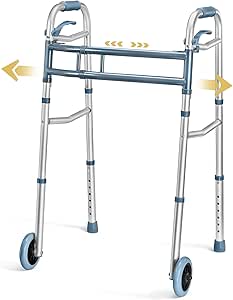
For most seniors seeking a steady, simple frame, I’d start with the Drive Medical Two-Button Folding Walker with Wheels as the best overall pick. The Medline Lightweight Two Button Walker stands out for its stated 300-pound capacity, while the HOMENURSE Z3 offers adjustable width and ski glides for people who want a different kind of movement across indoor floors. The main tradeoff is between a standard walker’s stable, step-by-step support and wheeled or glide-equipped designs that move more easily but may not suit every balance or walking style. A folding frame can help with storage and transport, but fit, doorway clearance, hand comfort, and safe use matter just as much. Continue reading for the full breakdown and guidance on which style fits your needs.

Get health and wellness essentials delivered free with Prime
- Fast, free delivery on millions of items
- Prime Video, Amazon Music and more included
- Member-only deals all year
Complete the kit


Key Takeaways
- Drive Medical’s Two-Button Folding Walker with Wheels earns the overall lead for shoppers who want a familiar folding frame with front wheels; a seated rollator is a different mobility choice, not a direct substitute.
- Wheel and glide attachments change how the frame moves. Front wheels support rolling the walker forward, while ski glides or tennis balls suit users who lift or slide the rear legs; neither should be chosen without checking the user’s control and balance.
- Capacity and adjustability are not interchangeable. The Medline model lists a 300-pound capacity, while select X8 and HOMENURSE Z3 models list 350 pounds; buyers should confirm the exact model’s limits and fit rather than infer them from a product family.
- Small-space needs call for checking frame width, not just the word “narrow.” The HOMENURSE Z3 Narrow model targets tight spaces, but actual doorway clearance and the user’s walking posture still determine whether it will work at home.
- Folding convenience varies by design. Standard two-button frames, a trigger-release model, and a one-hand-folding option offer different release methods; the easiest choice depends on hand strength, dexterity, and whether a caregiver will fold it.




| folding walker for senior | Frame material | Weight capacity | Wheel size | Folding mechanism |
|---|---|---|---|---|
| Drive Medical Two-Button Foldi | Aluminum | 350 lb | — | Two-button release |
| Medline Lightweight Two Button | — | 300 lb | 5 inches | Two-button, independent side folding |
| HOMENURSE Z3 Folding Walker fo | Aluminum | — | 5 inches | Hands-free quick-fold |
| WHLICKS Folding Walker for Sen | Aluminum | 300 lb | 5 inches | — |
| Vive Mobility Lightweight Fold | — | — | 6 inches | One-step |
| Walkers for Seniors Aluminum L | Aluminum | 350 lbs | — | Not specified |
| Drive Medical Trigger Release | Aluminum | — | 5 inches | Trigger release |
| X8 Folding Walkers for Seniors | Reinforced aluminum alloy | 350 pounds | 5 inches | — |
| Loyoda Folding Walker with 2 P | Aluminum | 350 lbs | 5 inches | Trigger release |
| VOCIC Z21 Rollator Walker for | — | — | 8 inches | — |
| X8 Folding Walker for Seniors | Reinforced aluminum alloy | 350 lb | 5 inches | One-handed trigger release |
| Folding Walker for Seniors wit | Aircraft-grade aluminum alloy | 300 lb | — | — |
| Loyoda Folding Walker with 2 S | Aluminum | 350 lb | 5 inches | — |
| HOMENURSE Z3 Narrow Walkers fo | Aluminum | 350 lb | — | — |
| Drive Medical 2-Button Standar | Aluminum | 350 lb | — | Two-button push-button |
More Details on Our Top Picks
Drive Medical Two-Button Folding Walker with Wheels
I rank the Drive Medical Two-Button Folding Walker first for its balanced mix of a 350 lb capacity, familiar height adjustment, and a folding release designed for limited dexterity. Its 5-inch front wheels roll forward while rear glide caps let the user advance without lifting the whole frame, a practical setup for everyday indoor movement. Compared with the Medline Lightweight Two Button Folding Walker, this Drive model offers a higher stated capacity, though Medline lists its weight and height range more explicitly. The tradeoff is that glide caps can wear faster on rough surfaces, and some users may prefer the feel of a sturdier frame. I’d choose it for routine support rather than uneven outdoor routes.
Pros:- 350 lb stated capacity exceeds the Medline model’s 300 lb limit
- Two-button folding mechanism is designed for users with limited dexterity
- Front wheels and rear glide caps support forward movement without lifting every step
- Height adjustment and contoured grips help tailor everyday fit and handling
Cons:- Rear glide caps may wear more quickly on rough surfaces
- Aluminum construction may feel less substantial to users who prefer a heavier frame
Best for: Seniors who want a straightforward folding walker with a higher listed weight capacity and a release designed for limited dexterity
Not ideal for: People who regularly walk on rough outdoor surfaces or want a fully wheeled frame instead of rear glide caps
- Frame material:Aluminum
- Weight capacity:350 lb
- Front wheel size:5 inches
- Folding mechanism:Two-button release
- Height adjustment:Adjustable legs
- Hand grips:Ergonomic contoured vinyl
Our verdict“Choose this Drive model for a capable everyday folding walker with an accessible folding release, but look elsewhere for rough-terrain use.”
Medline Lightweight Two Button Folding Walker with 5-inch Wheels, Aluminum Frame Supports Up to 300 lbs
At a listed 6 lb, the Medline Lightweight Two Button Folding Walker is the clearest choice here for someone who often needs to lift a walker into a car or move it between rooms. Its independent side-folding design can make storage and transport less awkward than a frame that only collapses as one unit. Compared with the Drive Medical two-button model, Medline specifies a 32-to-38-inch height range and a lower 300 lb capacity, making the fit information easier to check but the capacity less generous. The 5-inch wheels suit smoother everyday routes, not rough ground, and the frame may feel too narrow for some users. I’d prioritize its low carry weight over extra width or capacity.
Pros:- Listed 6 lb weight makes lifting and transport easier
- Independent side folding helps with storage and getting the frame into a vehicle
- Height adjusts from 32 to 38 inches
- 5-inch wheels support movement on smoother indoor and outdoor surfaces
Cons:- 300 lb capacity is lower than the Drive Medical two-button model’s 350 lb capacity
- May feel too narrow for some users
- 5-inch wheels are not presented as a solution for rough terrain
Best for: Seniors and caregivers who frequently carry or transport a walker and need a specified height range for fit
Not ideal for: Users who need a wider-feeling frame, a capacity above 300 lb, or wheels intended for rough outdoor routes
- Weight:6 lb
- Weight capacity:300 lb
- Height adjustment:32–38 inches
- Wheel size:5 inches
- Frame:Aluminum
- Folding mechanism:Two-button, independent side folding
Our verdict“Pick the Medline if carrying ease and a clearly stated height range matter more than a higher capacity or a wider fit.”
HOMENURSE Z3 Folding Walker for Seniors with Ski Glides, Adjustable Width & Height
The HOMENURSE Z3 earns its place for adjustability: its frame width spans 17.7 to 25.8 inches, while eight height settings cover a 30.7-to-37.7-inch range. That combination can help buyers match the walker to both their body and the spaces they use, rather than accepting a fixed-width feel. Like the WHLICKS Folding Walker, it pairs front wheels with ski glides, but the HOMENURSE adds a 350 lb capacity and a stated hands-free quick-fold mechanism. The tradeoff is surface sensitivity: ski glides may not move as smoothly over carpet or uneven ground. It also has no seat, so it is strictly a walking aid, not a resting option. I’d favor it when fit flexibility matters more than terrain versatility.
Pros:- Width adjusts from 17.7 to 25.8 inches to suit different users and spaces
- Eight height settings offer more fit options than a simple height-adjustable description
- 350 lb stated capacity is higher than the WHLICKS model’s 300 lb limit
- Hands-free quick-fold design supports storage and transport
Cons:- Ski glides may perform poorly on uneven or carpeted surfaces
- No built-in seat for resting
- Width adjustment adds setup choices that buyers seeking a simple fixed fit may not need
Best for: Seniors who need to tailor both walker width and handle height, including those moving between tighter and more open spaces
Not ideal for: People who need a seat for rest breaks or expect frequent travel over carpet, uneven paths, or rough outdoor surfaces
- Weight:6.8 lb
- Maximum load capacity:350 lb
- Adjustable width:17.7–25.8 inches
- Adjustable height:30.7–37.7 inches
- Height adjustment levels:8
- Wheel size:5 inches
- Frame material:Aluminum
- Folding mechanism:Hands-free quick-fold
Our verdict“Choose the HOMENURSE Z3 if you need unusually flexible width and height adjustment and mainly use the walker on smoother surfaces.”
WHLICKS Folding Walker for Seniors with 2 Skis and 5-inch Wheels, Supports up to 300 lbs
Weighing 6.1 lb, the WHLICKS Folding Walker is a portable pick for buyers who want wheels paired with ski glides without moving up to a heavier frame. Its height range of 30.3 to 37.4 inches gives users room to adjust the fit, while the two front wheels and two skis are intended to keep forward movement smooth on suitable surfaces. Compared with the HOMENURSE Z3, WHLICKS is lighter by a small margin but offers a lower 300 lb capacity and no stated width adjustment. Its own description limits it to indoor use, so I would not choose it for rough paths. The useful distinction is straightforward: portability and basic height adjustment, with fewer fit options than the HOMENURSE.
Pros:- Listed weight of 6.1 lb supports easier carrying
- Height adjusts from 30.3 to 37.4 inches
- Two 5-inch wheels and two ski glides support forward movement on suitable surfaces
Cons:- The product description limits use to indoors and rules out rough terrain
- 300 lb capacity is lower than the HOMENURSE Z3’s 350 lb limit
- No adjustable width range is specified
Best for: Seniors seeking a light walker for indoor use who want front wheels and ski glides with adjustable height
Not ideal for: People who need adjustable width, a capacity above 300 lb, or support for rough outdoor terrain
- Weight:6.1 lb
- Weight capacity:300 lb
- Wheel size:5 inches
- Height adjustment:30.3–37.4 inches
- Number of ski glides:2
- Number of wheels:2
- Frame material:Aluminum
Our verdict“Choose WHLICKS for a lightweight indoor walker with wheels and ski glides, but pick the HOMENURSE Z3 if you need a wider fit range or higher capacity.”
Vive Mobility Lightweight Folding Walker for Seniors
The Vive Mobility Lightweight Folding Walker is the lineup’s space-focused choice: its narrow frame and open-front design are intended to make tight hallways easier to manage while allowing a natural stride without a rear bar in the way. It arrives pre-assembled and uses a one-step fold, reducing setup and collapse steps compared with the two-button Drive and Medline walkers. Its 6-inch wheels are larger than their 5-inch wheels, and the product describes them as all-terrain, though the supplied details do not specify a frame width or prove how it handles every surface. At 9.5 lb, it is heavier than the Medline and WHLICKS options, and it has no seat or basket. I’d choose it for maneuverability and convenience, not minimum carry weight.
Pros:- Narrow-frame design is intended for tight spaces
- Open front avoids a rear bar interfering with the stride
- One-step folding and pre-assembled arrival simplify setup and storage
- 6-inch wheels are larger than the 5-inch wheels on the Drive and Medline models
Cons:- At 9.5 lb, it is heavier than the listed Medline and WHLICKS walkers
- No seat or storage basket is included
- No exact frame-width measurement is provided in the supplied product data
Best for: Seniors navigating narrow hallways or compact living spaces who value an open stride and ready-to-use setup
Not ideal for: Buyers who need the lightest walker to lift, a seat or basket, or a stated width measurement before checking doorway fit
- Weight:9.5 lb
- Maximum user weight:300 lb
- Handle height:36–42 inches
- Wheel size:6 inches
- Material:High-strength aluminum
- Assembly:Pre-assembled
- Folding mechanism:One-step
- Frame design:Narrow, open-frame
Our verdict“Pick the Vive for a ready-to-use, narrow-frame walker with an open stride, but compare its dimensions before buying for a specific doorway.”
Walkers for Seniors Aluminum Lightweight Walker with Wheels
This is a straightforward choice for shoppers who want a wheeled folding walker with a stated 350-pound capacity and do not need a long feature list. Its aluminum construction keeps the frame lightweight, while the wheels can make forward movement easier than a walker that must be lifted at every step. Compared with the Drive Medical Trigger Release Folding Walker, though, this model has fewer documented details: the supplied information does not specify wheel size, height adjustment, folding mechanism, or dimensions. That makes fit and handling harder to judge before buying. I would rank it as a basic capacity-focused option, not the most predictable pick for dialing in handle height or choosing floor-friendly accessories.
Pros:- Aluminum construction keeps the frame lightweight
- Stated weight capacity of 350 pounds
- Wheels support easier forward movement than a non-wheeled frame
Cons:- Product details do not specify handle-height adjustment or fit range
- Wheel size and folding mechanism are not provided
- Limited information makes it difficult to compare maneuverability and portability
Best for: Seniors seeking an aluminum wheeled walker with a stated 350-pound capacity and simple, limited feature requirements
Not ideal for: Buyers who need confirmed handle-height settings, wheel dimensions, or specific folding controls before choosing a walker
- Frame material:Aluminum
- Walker type:Rolling walker
- Weight capacity:350 lbs
- Wheels:Included; size not specified
- Handle-height adjustment:Not specified
- Folding mechanism:Not specified
Our verdict“Choose this for a basic wheeled aluminum walker with a stated 350-pound capacity, but favor the Drive Medical Trigger Release model if you need clearer fit and folding details.”
Drive Medical Trigger Release Folding Walker with Contoured Hand Grips
The Drive Medical stands out for shoppers who want clearly specified fit adjustments and a folding mechanism designed for convenient handling. Its trigger release lets users fold the walker without needing to reach down to press side buttons, while the 32-to-39-inch handle range offers more adjustment than the X8’s 30-to-38-inch range at the upper end. The 5-inch wheels suit indoor movement, but the product is described as intended for indoor use, so I would not choose it for regular rough-ground routes. Compared with the Loyoda walker, it lacks the included floor-gliding tennis balls; its advantage is the better-documented handle fit and contoured grips. The 18-inch inside grip width may also feel restrictive for some users.
Pros:- Trigger-release mechanism supports convenient folding
- Handle height adjusts from 32 to 39 inches
- Contoured hand grips provide a shaped grip surface
- 5-inch wheels support indoor rolling
Cons:- Described as limited to indoor use
- 18-inch inside hand-grip width may not suit users who need more room
- Product description cautions that the lightweight build may not suit very heavy users
Best for: Seniors who mainly walk indoors and want a trigger-release fold with a defined handle-height range
Not ideal for: Users who need outdoor terrain capability, a wider hand-grip area, or floor-protective glide balls included
- Frame material:Aluminum
- Handle height:32 to 39 inches
- Inside hand-grip width:18 inches
- Overall dimensions:16.75 x 25 x 32 inches
- Wheel size:5 inches
- Folding mechanism:Trigger release
- Hand grips:Contoured
Our verdict“Pick this over the less-detailed aluminum models if indoor use, trigger folding, and a broad stated handle-height range are your priorities.”
X8 Folding Walkers for Seniors with 2 Skis and 5-inch Wheels, Supports up to 350 Pounds
The X8 earns its place for people who want a 350-pound capacity plus two ways to manage movement: 5-inch wheels and ski attachments. That combination may be more adaptable across everyday surfaces than the Drive Medical Trigger Release Walker, which is presented as an indoor-use option with wheels but no skis. Its reinforced aluminum frame and one-handed folding also make it a practical choice for users who need to store or transport the walker. The 30-to-38-inch height range gives useful adjustment, although it reaches a lower minimum than the Drive Medical and stops one inch shorter at the top. The added attachments and frame may also take more storage room than a simpler walker, so measure the intended space first.
Pros:- Stated capacity of 350 pounds
- Includes 5-inch wheels and two ski attachments
- One-handed folding supports easier storage and transport
- Height adjusts from 30 to 38 inches
Cons:- May be too large for very small storage spaces
- Height range ends at 38 inches, below the Drive Medical model’s 39-inch maximum
- The supplied information does not state folded dimensions or overall width
Best for: Seniors who want a higher-capacity folding walker with wheels and ski attachments for changing everyday surfaces
Not ideal for: People with very small storage areas or users whose handle-height needs fall outside the 30-to-38-inch range
- Frame material:Reinforced aluminum alloy
- Weight capacity:350 pounds
- Wheel size:5 inches
- Number of wheels:5
- Height adjustment:30 to 38 inches
- Ski attachments:2
- Folding:One-handed folding
Our verdict“Choose the X8 over a basic wheeled walker when ski attachments and one-handed folding matter more than compact, fully specified storage dimensions.”
Loyoda Folding Walker with 2 Pre-Cut Tennis Balls and 5″ Wheels
The Loyoda is the most floor-conscious pick here: it includes two pre-cut tennis glide balls alongside 5-inch wheels, giving shoppers a ready-made option for reducing scuffs on hardwood, linoleum, or Pergo. Its trigger-release fold and stated 350-pound capacity make it a practical indoor choice, while the 32-to-38-inch height range covers a useful span for many users. Compared with the X8 walker, Loyoda emphasizes smooth indoor flooring rather than ski attachments for varied surfaces. That focus is also its main limitation: the product is described as unsuitable for rough outdoor terrain, and its height range does not reach as low as the X8’s 30-inch minimum. Choose it for home use, not as an all-surface mobility solution.
Pros:- Includes two pre-cut tennis glide balls for indoor floor use
- Aluminum frame with a stated 350-pound capacity
- Trigger-release mechanism supports folding and transport
- Height adjusts from 32 to 38 inches
Cons:- Not suited to rough outdoor terrain
- Height range starts at 32 inches, higher than the X8’s 30-inch minimum
- The supplied details do not state folded dimensions
Best for: Seniors who use a walker mainly on smooth indoor floors and want glide balls included to help protect flooring
Not ideal for: Users who regularly travel over rough outdoor terrain or need a handle-height setting below 32 inches
- Frame material:Aluminum
- Weight capacity:350 lbs
- Adjustable height:32 to 38 inches
- Wheel size:5 inches
- Floor-protection glides:2 pre-cut tennis glide balls
- Folding mechanism:Trigger release
- Intended surface use:Smooth indoor surfaces
Our verdict“Choose Loyoda for smooth indoor routes and floor-conscious gliding, but select the X8 if varied surfaces are a bigger concern.”
VOCIC Z21 Rollator Walker for Seniors with Seat and 8″ All-Terrain Wheels
The VOCIC Z21 is the clear choice for shoppers who want more than a basic folding walker: it pairs a built-in seat and backrest with 8-inch all-terrain tires and three brake modes. That makes it better suited to longer outings with planned rests than the Loyoda, which is a simpler indoor walker with wheels and floor-friendly glide balls but no seat. Its stated user-height range of 4’11” to 6’3″ and separate handle adjustments help shoppers check fit, while the 22-pound weight and folded dimensions give a concrete sense of what transport involves. The tradeoff is bulk and weight compared with simpler aluminum folding walkers. The seat-height adjustment spans only 20 to 22 inches, so users should check whether that limited range suits them.
Pros:- Built-in ergonomic seat and breathable backrest provide a place to rest
- 8-inch puncture-proof tires are suited to varied terrain
- Handle height adjusts across five settings for a stated user range of 4’11” to 6’3″
- Three brake modes support free movement, deceleration, and stopping
Cons:- At 22 pounds, it is heavier than the simpler aluminum folding walkers in this lineup
- Seat height adjustment spans only 20 to 22 inches
- The product description advises checking that all parts are secure before use
Best for: Seniors who want a seated rest option, larger wheels for varied terrain, and specified fit ranges for outings
Not ideal for: Users who need a lightweight frame to lift frequently or who require a seat height outside the 20-to-22-inch adjustment range
- Weight:22 lbs
- Maximum user weight:350 lbs
- Wheel size:8 inches
- Folded dimensions:31.5 x 23.6 x 13.8 inches
- User height range:4’11” to 6’3″
- Seat height adjustment:3 levels; 20 to 22 inches
- Handle height adjustment:5 levels; 31.5 to 36.6 inches
- Brake modes:3: free, deceleration, and stop
Our verdict“Choose the VOCIC Z21 over a basic folding walker when a seat, larger terrain-ready wheels, and outing-focused features outweigh the extra lifting weight.”
X8 Folding Walker for Seniors with 2 Skis and 5″ Wheels
I’d pick this X8 for a taller user who wants a folding walker that can adapt to different walking surfaces. Its 30-to-38-inch height range reaches higher than the Loyoda Folding Walker’s 32-to-38-inch range, which gives shorter users within the stated fit range more adjustment room. The 5-inch wheels, rubber feet, and ski glides offer several ways to move: wheels can help on smoother routes, while feet or skis suit users who prefer a different contact with the floor. Its one-handed trigger release also simplifies folding for storage or transport. The tradeoff is that the supplied information does not give its folded dimensions or total weight, so I can’t tell how compact or easy to lift it is compared with the simpler Drive Medical 2-Button Standard Walker.
Pros:- Adjusts from 30 to 38 inches, offering more lower-end height adjustment than the Loyoda model.
- Includes 5-inch wheels, rubber feet, and ski glides for different movement preferences.
- One-handed trigger-release folding can make storage and transport easier.
- Reinforced aluminum frame supports up to 350 pounds.
Cons:- Product details do not state the walker’s own weight or folded dimensions.
- Users may need to switch among wheels, feet, and skis to match their surfaces and movement needs.
Best for: Taller adults, especially those who want a wide height adjustment range and interchangeable contact options for indoor and outdoor use.
Not ideal for: Buyers who need a verified lightweight carry weight or folded dimensions before choosing a walker for frequent car transfers.
- Frame material:Reinforced aluminum alloy
- Weight capacity:350 lb
- Wheel size:5 inches
- Height range:30–38 inches
- Stated user height range:5’4″–6’6″
- Folding mechanism:One-handed trigger release
- Included movement options:Wheels, rubber feet, and ski glides
- Certification:SGS certified
Our verdict“Choose this X8 if you need a highly adjustable walker with multiple movement options, but look elsewhere if carry weight and folded size are deciding factors.”
Folding Walker for Seniors with 8 Height Adjustments and One-Hand Folding
This model stands out for buyers who value a forgiving setup and comfortable handles more than a higher weight limit. It arrives 80% pre-assembled, has eight height positions, and uses a one-hand folding button, which can reduce setup and storage hassle compared with the Drive Medical 2-Button Standard Walker’s more basic design. Its 26-inch base adds a stated stability feature, while 5-inch front wheels and sled pads give users different ways to manage movement on everyday floors. The soft rubber handles are designed to reduce wrist fatigue and are easier to clean than uncovered grips. The main compromise is its 300-pound capacity, below the 350-pound ratings listed for the X8 and Drive Medical models. The supplied details also don’t specify the walker’s own weight or folded size.
Pros:- Eight height positions allow finer fit adjustments than a walker with fewer settings.
- One-hand folding button and 80% pre-assembly can simplify setup and storage.
- Wide 26-inch base and sled pads provide stated stability features.
- Medical-grade soft rubber handles are designed for comfort and easier cleaning.
Cons:- 300-pound capacity is lower than the 350-pound X8 and Drive Medical models.
- Product details do not state its own weight or folded dimensions.
Best for: Seniors or recovering users who want less assembly, multiple height settings, and soft, easy-to-clean handles for regular indoor use.
Not ideal for: Users who need a 350-pound capacity or buyers who require confirmed folded dimensions and product weight.
- Frame material:Aircraft-grade aluminum alloy
- Weight capacity:300 lb
- Height range:30.7–37.4 inches
- Height adjustments:8 positions
- Stated user height range:5.4–6.6 feet
- Base width:26 inches
- Front wheel size:5 inches
- Assembly:80% pre-assembled
- Handle material:Medical-grade soft rubber
Our verdict“Choose this walker for its easy setup and comfort-focused details if its 300-pound capacity fits your needs.”
Loyoda Folding Walker with 2 Skis and 5-inch Wheels, Lightweight Design, Black
The Loyoda is a straightforward choice for someone who wants a folding walker with 5-inch wheels and ski glides without relying on a more elaborate folding description. Its 350-pound capacity matches the X8, but its 32-to-38-inch height range gives less lower-end adjustment than the X8’s 30-to-38-inch range. That difference may matter for users who need the handles set lower; buyers should check their fit rather than assume the models are interchangeable. The aluminum frame and foldable design suit indoor and outdoor use, though the product details don’t give the walker’s weight or a specific folding mechanism. The listed drawbacks also matter in practice: height changes require manual adjustment, and the pre-installed skis may not suit every surface. Its stated color is black, with limited color choice.
Pros:- 5-inch wheels and ski glides support different movement preferences across surfaces.
- 350-pound weight capacity matches the higher-capacity X8 and Drive Medical options.
- Aluminum frame combines a stated lightweight design with durability.
- Folds for storage and transport.
Cons:- Height range starts at 32 inches, two inches higher than the X8’s minimum.
- Height changes require manual adjustment.
- Pre-installed skis may need replacement for some surfaces, and the product offers limited color choice.
Best for: Adults who fit the 32-to-38-inch handle range and want a basic aluminum walker with wheels and ski glides.
Not ideal for: Users who need lower handle settings, a one-handed folding control, or confidence that the included skis suit their flooring.
- Frame material:Aluminum
- Weight capacity:350 lb
- Wheel size:5 inches
- Height adjustment range:32–38 inches
- Color:Black
- Included movement options:5-inch wheels and 2 skis
- Folding:Folds for storage and transport
Our verdict“Pick the Loyoda if its 32-to-38-inch height range fits and you want a simple wheels-and-skis setup without needing a stated one-handed folding feature.”
HOMENURSE Z3 Narrow Walkers for Seniors, Folding Walker Small Space 350lbs
The HOMENURSE Z3 earns its place for homes where doorways and bathrooms are the main obstacle. Its standout feature is adjustable width from 17.7 to 25.8 inches, changed by moving the wheels from outside to inside. That makes it more adaptable to tight spaces than the fixed 26-inch-base walker in this roundup, though users should confirm the narrowed setup still feels stable for their needs. It also combines 5-inch front wheels and ski glides with a 350-pound capacity and eight height settings. Folding by lifting the handles avoids taking hands off the grips, a useful distinction from the more conventional push-button Drive Medical model. The listing gives a 6.8-pound weight, but does not specify folded dimensions or clarify how width adjustment affects day-to-day setup.
Pros:- Width adjusts from 17.7 to 25.8 inches to help fit narrow doorways and compact rooms.
- Eight height settings cover a stated user range from 5’2″ to 6’5″.
- Folds by lifting the handles, so the user need not remove hands from the grips.
- Weighs 6.8 pounds and supports up to 350 pounds.
Cons:- Changing width requires repositioning the wheels rather than a simple in-use adjustment.
- Product details do not state folded dimensions.
- Wheel-and-ski configuration may take some matching to the user’s surfaces and preferred movement.
Best for: Seniors in homes with narrow doorways, tight hallways, or small bathrooms who need adjustable width and a stated 350-pound capacity.
Not ideal for: Buyers who want a fixed, ready-to-use width without moving the wheels, or those who need published folded dimensions before travel.
- Frame material:Aluminum
- Weight:6.8 lb
- Weight capacity:350 lb
- Adjustable width:17.7–25.8 inches
- Height range:30.7–37.7 inches
- Height adjustments:8 levels
- Stated user height range:5’2″–6’5″
- Wheels and glides:5-inch front wheels and 2 ski glides
Our verdict“Choose the HOMENURSE Z3 if adjustable width solves a real space constraint at home; skip it if you prefer a fixed setup with fewer configuration choices.”
Drive Medical 2-Button Standard Foldable Walker for Seniors, Silver
Unlike the wheeled X8 and Loyoda, this Drive Medical uses a non-wheeled frame with four rubber-tipped legs. That makes it a better match for users who want to place and steady the walker with each step rather than roll it forward, though it can take more effort on rough ground. The two-button folding mechanism offers a familiar, direct way to collapse the frame for storage, and its aluminum construction supports up to 350 pounds. Its U-shaped frame and improved cross-frame design are listed as stability features, but this is a more basic option than the HOMENURSE Z3: there are no width adjustments, ski glides, or wheels. I’d favor it when a simple, fixed-foot walker fits the user’s gait, not when smoother continuous movement is the priority.
Pros:- Four rubber-tipped legs provide a fixed-foot setup for users who prefer placing the walker with each step.
- Aluminum frame supports up to 350 pounds.
- Two-button folding mechanism supports storage and transport.
- Height-adjustable design allows the fit to be changed.
Cons:- No wheels, so repeated lifting can take more effort than with the X8 or Loyoda.
- Basic configuration has no ski glides, seat, basket, or adjustable-width feature.
- Specific height range and walker weight are not provided.
Best for: Seniors who prefer lifting and placing a walker with each step and want rubber-tipped feet rather than front wheels.
Not ideal for: Users who struggle to lift a walker repeatedly, travel over rough surfaces, or need wheels, ski glides, or adjustable width.
- Frame material:Aluminum
- Weight capacity:350 lb
- Color:Silver
- Folding mechanism:Two-button push-button
- Legs:4 rubber-tipped legs
- Frame type:U-shaped, non-wheeled
- Height adjustment:Adjustable
Our verdict“Choose this Drive Medical if you prefer a simple rubber-foot walker that you place with each step, not a model that rolls forward.”
How We Picked
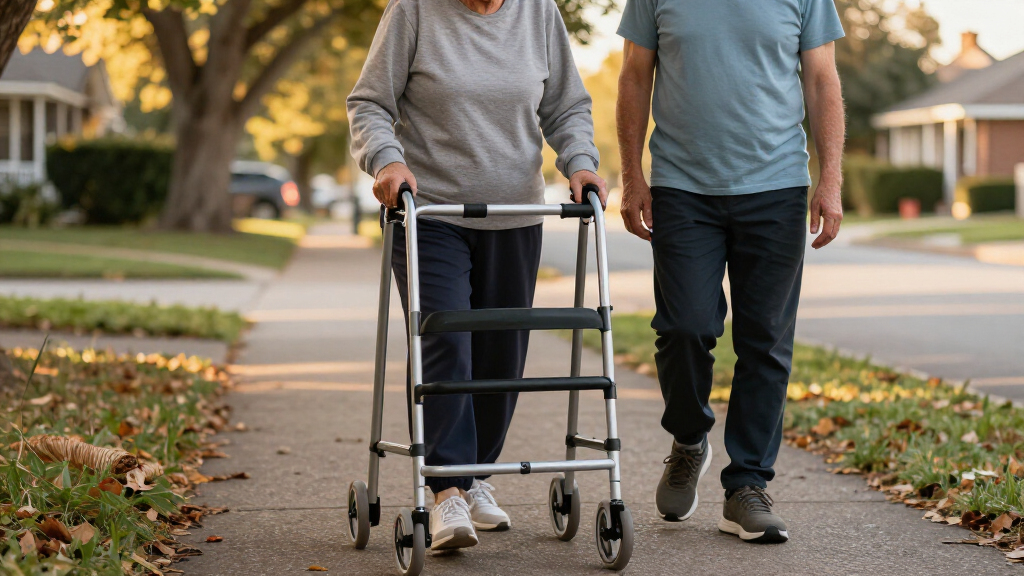
I ranked these options around the jobs a folding walker for seniors needs to do: provide dependable support, fit the user and home, move in a controlled way, and fold without creating extra handling difficulty. I weighed the listed frame type, wheel or glide setup, stated weight capacity, adjustability, grip and release design, and the likely usefulness of each feature in daily routines. A specification only matters when it solves a real buyer problem: for example, a narrow frame may help in tight rooms, while larger all-terrain wheels and a seat serve a different purpose from a basic indoor walker.
The order favors versatile, straightforward folding walkers first, then options with a more specific advantage or a narrower fit. Models with similar names are treated as separate choices when their listed attachments or intended fit differ, and I avoid assuming unlisted dimensions or performance. The VOCIC Z21 rollator appears later because its seat and 8-inch wheels make it a distinct alternative for someone seeking seated breaks, rather than the closest match for buyers who specifically want a standard folding walker. Before purchase, confirm the exact model, fit range, capacity, and any clinician guidance.
| folding walker for senior | Frame material |
|---|---|
| Drive Medical Two-Button Foldi | Aluminum |
| Medline Lightweight Two Button | — |
| HOMENURSE Z3 Folding Walker fo | Aluminum |
| WHLICKS Folding Walker for Sen | Aluminum |
| Vive Mobility Lightweight Fold | — |
| Walkers for Seniors Aluminum L | Aluminum |
| Drive Medical Trigger Release | Aluminum |
| X8 Folding Walkers for Seniors | Reinforced aluminum alloy |
| Loyoda Folding Walker with 2 P | Aluminum |
| VOCIC Z21 Rollator Walker for | — |
| X8 Folding Walker for Seniors | Reinforced aluminum alloy |
| Folding Walker for Seniors wit | Aircraft-grade aluminum alloy |
| Loyoda Folding Walker with 2 S | Aluminum |
| HOMENURSE Z3 Narrow Walkers fo | Aluminum |
| Drive Medical 2-Button Standar | Aluminum |
Factors to Consider When Choosing Folding Walker For Seniors
A walker’s label can make two frames sound alike even when they handle differently. I’d start by matching the frame’s movement and fit to the user’s daily route, then check whether folding and transport are manageable in practice.
Choose the movement style before comparing extras
A standard walker asks the user to lift or advance the frame in short steps, which can suit someone who needs support on both sides and can coordinate that movement. Front wheels reduce the need to lift the front legs, but the walker rolls forward and calls for controlled pacing. Rear ski glides or tennis balls can make the back legs slide across some floors, though they may behave differently on rugs, thresholds, or uneven surfaces. Avoid choosing an attachment just because it sounds easier; consider how the user actually moves and whether they can stop the frame reliably. If balance is uncertain, ask a physical therapist or clinician to assess the walking pattern and setup.
Measure fit and route clearance, not just height
Handle height is only one part of fit: the user should be able to stand comfortably with relaxed shoulders and a slight bend at the elbows while holding the grips. Frame width matters just as much when passing through bathroom doors, between furniture, or beside a bed. Measure the narrowest route at home and compare it with the exact walker’s assembled width; product names such as “narrow” do not replace a dimension check. Also think about turning space, since a frame that clears a doorway may still be awkward to rotate in a compact room. A poor fit can encourage leaning or twisting, so ask a clinician to check setup if the user’s posture looks strained.
Treat stated capacity as a firm model-specific limit
Weight capacity is a safety specification, not a general estimate for an entire brand or product family. The listed options here include models with 300-pound and 350-pound capacities, so buyers should verify the exact variant rather than assume two similar names share the same limit. Allow for clothing and items carried on the frame, and do not use a walker as a seat unless the product is designed for that purpose. A higher stated capacity alone does not prove that a frame will feel more stable or fit better. If the user is near the listed limit, confirm the specification with the seller or manufacturer and seek clinical advice about suitable support.
Test the folding action against hand strength
Button releases, trigger releases, and one-hand folding mechanisms can feel very different for someone with arthritis, reduced grip, or limited dexterity. A caregiver may find a two-button frame simple to collapse, while the user may struggle to press both releases at once. Before relying on the walker for car trips or storage, check whether the intended person can fold and reopen it without pinching fingers or losing balance. Also confirm that the frame locks open securely before walking; quick folding is not useful if reopening feels confusing. If a helper will manage the frame, choose for that person’s handling needs as well as the senior’s walking needs.
Match the attachment to the surfaces at home
Wheels, ski glides, and tennis balls are not interchangeable convenience accessories. Their suitability can depend on flooring, rugs, thresholds, and the user’s ability to control forward movement. A setup that slides smoothly over hard flooring may catch or feel less predictable on a rug, while wheels can make it easier to advance the frame but may roll when the user is not ready. Check the attachment type included with the exact model and ask whether compatible replacement parts are available. If the user walks across several surface types, a clinician or mobility specialist can help judge which setup is safest for those routes.
Decide whether a standard walker or rollator fits the task
A folding walker and a rollator solve different mobility problems. Standard frames prioritize a supportive structure for step-by-step movement, while the VOCIC Z21 adds a seat and larger all-terrain wheels for people who want seated breaks and a rolling format. That seat may be useful on longer outings, but it does not make a rollator the right choice for someone who needs to lift and place a walker with each step. Consider where the device will be used, whether the user can manage its movement and brakes, and whether a seat is genuinely needed. When those needs are unclear, have a clinician compare both styles with the user.
Frequently Asked Questions
Should I choose front wheels, ski glides, or tennis balls for an older adult?
Choose based on how the user advances the walker and what surfaces they cross, not on the accessory alone. Front wheels let the user roll the front of the frame forward, while ski glides and tennis balls are fitted to the rear legs and can slide across suitable floors. Each setup changes how the walker moves, so a user who has trouble controlling forward motion may need a different arrangement from someone who cannot lift the frame easily. Rugs, thresholds, and uneven flooring can change how predictable attachments feel. A physical therapist can assess the user’s walking pattern and recommend a setup to practice safely.
How do I know whether a folding walker will fit through my home’s doorways?
Measure the narrowest doorway and hallway the user must pass through, then compare those measurements with the exact model’s assembled width. Check the route from more than one angle: a walker may fit straight through but leave too little room to turn in a bathroom or bedroom. Also account for furniture, grab bars, and the user’s preferred walking position rather than measuring an empty doorway alone. Do not rely solely on a product name that says “narrow,” since the relevant dimensions can differ by model. If the route is tight, a clinician or mobility specialist can help assess whether the frame and turning space are workable.
Can a senior use a folding walker with wheels if they have balance concerns?
Possibly, but wheels change how the frame responds when pushed and should be matched to the user’s control and gait. Some users benefit from not having to lift the front legs, while others may find a rolling frame harder to manage. The presence of wheels does not make a walker suitable or unsuitable by itself; fit, walking ability, hand control, and floor surfaces all matter. Avoid switching attachments without checking that the user can stop and position the walker consistently. A clinician or physical therapist can observe the user walking and advise whether wheels or a more stationary setup is appropriate.
Is a rollator a better choice than a folding walker for longer outings?
A rollator may suit someone who can control a rolling frame and wants a seat for planned rest breaks, as with the VOCIC Z21 in this lineup. A standard folding walker is generally aimed at step-by-step support rather than sitting or continuous rolling. The seat and larger wheels do not automatically make a rollator safer or easier; the user must be able to manage its movement and any braking system. Think about outdoor surfaces, storage, transport, and whether the user can safely stop before sitting. Ask a mobility professional to compare the two styles if the user needs substantial support or has difficulty controlling a wheeled device.
What should I verify before buying a walker listed with a 300- or 350-pound capacity?
Confirm the capacity for the exact model and configuration you plan to buy, since similar product names can refer to different frames or attachments. Check that the stated limit includes the user’s body weight and any load carried on the walker, and do not treat a higher number as proof of a better fit. Also compare handle-height range and frame width with the user and home; capacity cannot compensate for an ill-fitting frame. If the user is close to the listed limit, ask the manufacturer or seller to confirm the specification before purchase. A clinician can help select a model that meets both the capacity requirement and the user’s mobility needs.
Conclusion
For the broadest match among standard folding frames, I’d choose the Drive Medical Two-Button Folding Walker with Wheels as best overall. The Medline Lightweight Two Button Walker is my best value-style pick for buyers who want a straightforward frame and a stated 300-pound capacity, while the Drive Medical Trigger Release is a useful beginner option to compare when release handling matters. For buyers seeking a premium-style alternative with a seat and larger wheels, the VOCIC Z21 is the distinct choice, provided the user can manage a rollator. Specific needs point elsewhere: consider the HOMENURSE Z3 Narrow for tight spaces, a listed 350-pound-capacity X8 or Z3 variant when that capacity is needed, and ski-glide or tennis-ball options only after checking the user’s movement and floor surfaces. My final pick would depend on a real fit check, the exact model’s specifications, and guidance from a mobility professional when balance or safe use is uncertain.
Halloween Picks
halloween
As an affiliate, we earn on qualifying purchases.