
For most home backup setups using a 30-amp generator, I’d start with the PlugSaf 25-foot 30-amp L14-30 cord: its familiar four-prong connection and moderate length suit many generator-to-inlet runs. The VEVOR 50-amp cord and inlet-box kit stands out for buyers who need a higher-capacity connection and a matched inlet, while the Champion 2-foot adapter is a compact solution for a specific connector mismatch. The main tradeoffs are amperage and connector compatibility, cord length versus voltage drop and handling, and whether you need an inlet box or a simple cord. I compare all 12 options by connection type, intended setup, and practical limitations. Read on for the full breakdown and help matching a cord to your generator and equipment.

Get health and wellness essentials delivered free with Prime
- Fast, free delivery on millions of items
- Prime Video, Amazon Music and more included
- Member-only deals all year
Complete the kit


Key Takeaways
- Connector type is the first filter: the L14-30 cords, 14-50/SS2-50 cords, and Champion fan-style cord serve different connection setups and are not interchangeable.
- Length varies from a 2-foot adapter to 50-foot runs: choose only enough reach for a safe generator location, since extra cable adds bulk and can affect performance.
- Inlet-box bundles are a different buying decision: the VEVOR and 30-amp kit options combine more than a cord, so compare the inlet and installation requirements as well as the cable.
- Long-cord choices split by connector and rating: Vockjour and POWGRN offer 30-amp L14-30 runs, while PlugSaf’s 50-foot cord is a four-prong 30-amp option.
- The Champion 25-foot fan-style cord serves a distinct purpose: its three household receptacles are useful for direct appliance connections, unlike cords made to connect a generator to a power inlet.




| extension cords for generator connection | Amperage | Length | Voltage | Wire gauge |
|---|---|---|---|---|
| PlugSaf 25FT 30 Amp Generator | 30A | 25 feet | 125/250V | 10 AWG |
| PlugSaf 50 Amp Generator Cord | 50A | 25 feet | 250V | — |
| Champion Power Equipment 2 ft. | 30A | 2 feet | 125/250V | 10 gauge |
| 30 Amp Generator Cord 25FT and | — | — | 125/250V | — |
| Vockjour 50FT L14-30P/L14-30R | 30A | 50 feet | 125/250V | 10 AWG |
| POWGRN 35FT 30 Amp Generator E | 30 A | 35 feet | 125/250 V | 10 AWG |
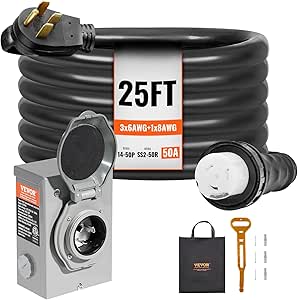
| VEVOR 50 Amp Generator Cord an | 50 A | — | 240 V | 6/3 + 8/1 AWG |
| Southwire 20 Feet Generator Co | 30 A | 20 feet | 125/250 V stated in description | 10 AWG |
| Nilight 30A 25FT Generator Ext | 30 A | 25 feet | 125 V listed | 10 AWG |
| 25FT 50 Amp Generator Cord NEM | 50 A | 25 feet | 250 V | — |
| Champion Power Equipment 25-Fo | 30 amps | 25 feet | — | 10 gauge |
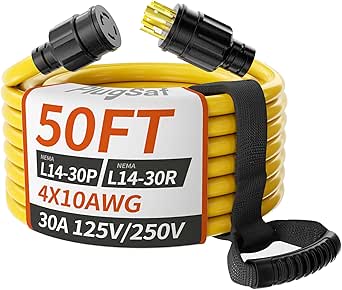
| PlugSaf 50FT 30 Amp Generator | 30 amps | 50 feet | — | 10 AWG |
More Details on Our Top Picks
PlugSaf 25FT 30 Amp Generator Cord 4 Prong, 10AWG 125/250V 3750/7500W STW
I’d choose this as the straightforward 30-amp link between a compatible generator and an L14-30 inlet or transfer switch. Its 25-foot reach, 10-gauge, four-conductor cable, and L14-30 twist-lock ends give it a practical balance of distance and household-backup compatibility. The locking connection helps resist accidental pullout, while the stated IP65 rating suits outdoor placement. Compared with the Vockjour 50FT L14-30 cord, this PlugSaf is easier to manage when 25 feet reaches the connection point; Vockjour is the better fit when the generator must sit farther away. Its main limitation is the same reach advantage in reverse: it cannot solve a longer run, and it offers one connection rather than multiple household outlets. Buyers should also match the cord’s 30-amp L14-30 configuration to their generator and inlet before ordering.
Pros:- L14-30 locking plug and receptacle suit compatible 30-amp generator connections.
- 10 AWG, four-conductor construction supports the stated 125/250V and 7,500W rating.
- 25-foot length offers useful separation without the extra cable of a 50-foot option.
- Stated IP65 weather resistance and included cord organizer support outdoor use and storage.
Cons:- The 25-foot length may not reach a safely positioned generator farther from the inlet.
- One L14-30 receptacle does not provide multiple household outlets.
- Not a match for generators or inlets requiring a 50-amp connector.
Best for: Homeowners with a 30-amp L14-30 generator and transfer-switch or inlet setup located within 25 feet.
Not ideal for: Buyers whose generator needs to sit more than 25 feet from the inlet, or whose equipment uses a 50-amp 14-50 connection.
- Length:25 feet
- Connector:NEMA L14-30P to L14-30R
- Amperage:30A
- Voltage:125/250V
- Wire gauge:10 AWG
- Conductors:4
- Maximum stated wattage:7,500W
- Water resistance:IP65; described as waterproof
Our verdict“Choose this PlugSaf when a compatible 30-amp L14-30 setup needs a weather-resistant cord with a manageable 25-foot reach.”
PlugSaf 50 Amp Generator Cord, 25FT 50 Amp RV Extension Cord 14-50P/SS2-50R
This PlugSaf serves a different connection need from the 30-amp L14-30 cords in this roundup: it pairs a 14-50P male plug with a locking SS2-50R receptacle for a 50-amp setup. That makes it the more relevant choice for compatible high-capacity generator and RV connections, rather than an upgrade that can substitute for a 30-amp cord. Its 25-foot length keeps the run contained, and the stated copper wiring, weatherproof construction, and twist-lock end address outdoor backup use. Compared with the VEVOR 50 Amp Generator Cord and Power Inlet Box Kit, this is a cord-only option, so it avoids bundling an inlet box but leaves that component to the buyer. The listing gives no wire gauge or detailed conductor construction, which makes careful equipment and load matching especially important.
Pros:- 50-amp 14-50P-to-SS2-50R configuration serves compatible RV-style connections.
- Twist-lock female receptacle is designed to resist accidental disconnection.
- 25-foot length provides separation between generator and connected equipment.
- Copper wiring and stated waterproof outdoor construction suit exterior use.
Cons:- The 50-amp connector pairing is incompatible with standard 30-amp L14-30 equipment.
- No wire gauge or conductor count is specified in the supplied product details.
- Cord-only package does not include the inlet box offered with the VEVOR kit.
Best for: RV owners or generator users whose equipment specifically calls for a 50-amp 14-50P-to-SS2-50R connection and a 25-foot cord.
Not ideal for: Owners of 30-amp L14-30 generators or home inlet setups, and buyers who need a cord-and-inlet-box kit or documented wire-gauge details.
- Length:25 feet
- Connector:NEMA 14-50P to SS2-50R
- Amperage:50A
- Voltage:250V
- Maximum stated wattage:12,500W
- Conductors:17 listed
- Outlets:1
- Use:Outdoor
Our verdict“Pick this cord for a compatible 50-amp 14-50P-to-SS2-50R setup, but not as a substitute for a 30-amp L14-30 cable.”
Champion Power Equipment 2 ft. 30A 250V Generator Adapter Cord
Unlike the long generator-to-inlet cords here, Champion’s 2-foot adapter is for changing a compatible 30-amp locking generator connection into three 20-amp household outlets close to the generator. That makes it useful for emergency equipment or remote work when the generator can sit nearby and the loads use ordinary household plugs. Its weather-resistant insulation and LED power indicators add practical cues, while the 10-gauge cable is substantial for this short adapter format. Compared with the PlugSaf 25FT L14-30 cord, Champion offers multiple outlet access but little distance; it is not the better choice for reaching a home inlet or keeping equipment far from the generator. The short run also limits where loads can be placed, and buyers need to confirm the generator plug matches this adapter.
Pros:- Converts a compatible 30-amp locking connection to three 20-amp household outlets.
- LED indicators provide a visible cue that power is present.
- 10-gauge wire and weather-resistant insulation suit a heavy-duty adapter role.
- Short cable keeps the outlet adapter close to the generator connection.
Cons:- Two-foot length offers little flexibility for positioning connected equipment.
- Not a replacement for a long cord connecting a generator to a home inlet.
- The supplied details do not identify the exact locking plug configuration.
Best for: Generator owners who need to power several nearby household-plug devices from a compatible 30-amp locking outlet.
Not ideal for: Homeowners connecting a generator to a distant transfer switch or inlet, or anyone whose generator connector does not match the adapter.
- Length:2 feet
- Amperage:30A
- Voltage:125/250V
- Outlets:3 x 20A household outlets
- Wire gauge:10 gauge
- Weight:2.4 pounds
- Insulation:Abrasion- and weather-resistant
- Additional feature:Integrated LED power indicators
Our verdict“Choose Champion when you need three household outlets beside a compatible generator, not when you need a long connection run.”
30 Amp Generator Cord 25FT and Pre-Drilled Power Inlet Box
This package pairs a 25-foot, 30-amp generator cord with a pre-drilled power inlet box, making it the most setup-oriented pick in this group. The cord’s 10/4 SJTW construction, copper conductors, and stated 7,500-watt capacity suit a compatible 125/250V connection; the inlet box gives the cable a fixed connection point at the home. Compared with the PlugSaf 25FT L14-30 cord, this bundle can reduce the need to source an inlet separately, but it also adds an installation task rather than offering a simple ready-to-use extension alone. The provided details describe multiple connection points and weatherproofing, yet installation still calls for appropriate electrical knowledge and code-compliant work. Its 25-foot limit also matches the PlugSaf, so neither is right when the generator must be placed farther away.
Pros:- Bundles a generator cord with a pre-drilled power inlet box.
- 10/4 SJTW copper cable is specified for outdoor use.
- Stated 125/250V connection and 7,500W capacity suit compatible 30-amp systems.
- Weatherproof inlet-box design is intended for a fixed exterior connection.
Cons:- Installing the inlet box requires electrical knowledge or qualified assistance.
- The 25-foot cord may not reach a generator placed farther from the house.
- The inlet-box connection details are less specific than the cord’s NEMA plug information.
Best for: Homeowners planning a compatible 30-amp generator inlet installation who want the cord and inlet box in one package.
Not ideal for: Buyers seeking a plug-and-play cord only, lacking the skills or professional help for inlet installation, or needing more than 25 feet of reach.
- Cord length:25 feet
- Voltage:125/250V
- Wire type and gauge:10/4 SJTW
- Male plug:NEMA 14-30P
- Female plug:NEMA L14-30R
- Maximum stated wattage:7,500W
- Included component:Pre-drilled power inlet box
- Item weight:11.66 pounds
Our verdict“Choose this bundle if you are setting up a fixed 30-amp home inlet and can arrange a proper installation.”
Vockjour 50FT L14-30P/L14-30R 30 Amp Generator Extension Cord, ETL Listed
When a generator needs to sit farther from the connection point, Vockjour’s 50-foot reach is its clearest advantage over the 25-foot PlugSaf and the 25-foot cord bundled with an inlet box. It keeps the familiar L14-30P-to-L14-30R, 30-amp format, with 10 AWG copper wire and a stated 7,500W rating, so it fits the same broad connection type while adding distance. The twist-lock design and IP65 waterproof rating are aimed at outdoor use, and the stated temperature range covers cold and hot conditions. That extra reach comes with a practical cost: the cord is reported at nearly 14 pounds, so it is less convenient to carry and coil than a shorter cable. I’d choose it only when the longer run is needed, rather than storing surplus cable by default.
Pros:- 50-foot length gives more placement flexibility than the 25-foot PlugSaf options.
- L14-30 twist-lock ends fit compatible 30-amp generator connections.
- 10 AWG copper construction and stated 7,500W capacity support the listed rating.
- IP65 waterproof rating and broad stated temperature range suit outdoor conditions.
Cons:- Reported weight of nearly 14 pounds makes transport and coiling less convenient.
- Extra length is unnecessary bulk when a 25-foot cord already reaches.
- The L14-30 connector limits use with equipment requiring a 50-amp connection.
Best for: Owners of compatible 30-amp L14-30 generators who need to position the generator up to 50 feet from the connection point.
Not ideal for: Buyers with a nearby inlet who prioritize easier handling, or anyone needing a 50-amp connector rather than L14-30.
- Length:50 feet
- Connector:NEMA L14-30P to L14-30R
- Amperage:30A
- Voltage:125/250V
- Wire gauge:10 AWG
- Maximum stated power:7,500W
- Weather resistance:IP65 waterproof rating
- Temperature range:-40°C to 105°C
Our verdict“Pick Vockjour when a compatible 30-amp L14-30 setup needs more reach than a 25-foot cord can provide.”
POWGRN 35FT 30 Amp Generator Extension Cord L14-30P/L14-30R, STW ETL Listed
I’d choose the POWGRN 35-foot cord when a 30A generator connection needs extra reach and a weather-focused jacket. Its L14-30 locking connectors suit compatible generator and transfer-switch connections, while the twist-lock fit helps reduce accidental separation outdoors. Compared with the Southwire 20-foot cord, POWGRN gives more distance from the generator, and its included organizer makes that longer cable easier to store. The tradeoff is that 35 feet can be more cord than a close-in setup needs, and it remains a 30A option rather than the higher-capacity choice represented by the VEVOR 50A kit. Check that your generator and inlet both use L14-30 connectors; this cord does not replace a properly matched inlet or transfer-switch installation.
Pros:- 35-foot length offers more placement flexibility than the Southwire 20-foot cord.
- L14-30P to L14-30R twist-lock connection helps resist accidental disconnection.
- ETL-listed, weather-resistant STW construction is specified for outdoor use.
- Included adjustable organizer helps contain the cable between uses.
Cons:- 30A rating does not suit installations that require a 50A cord.
- Longer cable takes more space to coil and store than a 20- or 25-foot option.
- Compatible only with matching L14-30 connections; it is not a universal generator cord.
Best for: Generator owners with a compatible L14-30 connection who need 35 feet of outdoor reach and want a cord organizer for storage.
Not ideal for: Owners of 50A generator or inlet connections, or buyers who need only a short cable and would rather avoid storing extra length.
- Length:35 feet
- Connector:NEMA L14-30P to L14-30R
- Amperage:30 A
- Voltage:125/250 V
- Wire gauge:10 AWG
- Conductors:4
- Wattage:7,500 W
- Certification:ETL listed
- Water resistance:IP65 waterproof rating, as stated in product description
Our verdict“Choose POWGRN if your L14-30 setup needs weather-resistant 30A reach beyond 20 feet, but skip it for a 50A connection or a compact layout.”
VEVOR 50 Amp Generator Cord and Power Inlet Box Kit, 25FT, NEMA 14-50P/SS2-50R, STW 6/3+8/1 AWG, Twist Lock Connector, ETL Listed
For a compatible 50A setup, the VEVOR kit pairs a 25-foot cord with an inlet box, so it covers more of the connection hardware than a cord-only pick such as the 25FT 50 Amp Generator Cord NEMA14-50P/SS2-50R. Its 14-50P to SS2-50R twist-lock connection, weather-resistant construction and ETL listing make it a fit for outdoor generator hookups, while the inlet’s flip cover and indicator light add practical connection cues. The benefit comes with a substantial handling cost: the listed weight is 23.4 pounds, making it less convenient to carry or coil than the 30A cords in this group. An inlet box also calls for correct installation; this is not a simple plug-in upgrade for every home. Match the connector and installation requirements before buying.
Pros:- Includes both a 25-foot cord and a power inlet box.
- 50A rating and 14-50P/SS2-50R connectors serve compatible higher-capacity setups.
- Twist-lock connection helps keep the cable secured at the inlet.
- ETL-listed outdoor construction, flip cover and indicator light are specified.
Cons:- Listed weight of 23.4 pounds makes carrying and handling cumbersome.
- Requires correct installation of the inlet box.
- 50A connectors are not compatible with 30A L14-30 setups.
Best for: Owners of a compatible 50A generator setup who need a 25-foot cord and inlet box together and can arrange proper inlet installation.
Not ideal for: Buyers with a 30A generator, a different inlet connector, or anyone seeking a lightweight cord-only connection.
- Cord length:25 feet
- Connectors:NEMA 14-50P to SS2-50R
- Amperage:50 A
- Voltage:240 V
- Wire gauge:6/3 + 8/1 AWG
- Conductors:4
- Wattage:12,500 W
- Weight:23.4 pounds
- Certification:ETL listed
Our verdict“Pick the VEVOR kit when you need a matched 50A cord-and-inlet package and accept its weight and installation requirements.”
Southwire 20 Feet Generator Cord – 10-Gauge Heavy Duty Electrical Power Cable with L14-30 Locking Plug & Receptacle, Weather Resistant, Dual Voltage 125V/250V
The Southwire 20-foot cord suits a generator parked fairly close to a compatible connection point, where avoiding excess cable matters more than extra reach. Its 10-gauge construction and L14-30 locking plug and receptacle match the 30A generator-cord role, and the shorter run is easier to route and store than the 35-foot POWGRN. That compactness is also its main limitation: buyers who need more distance will find the POWGRN 35-foot cord or Nilight 25-foot set more accommodating. Southwire’s listing describes weather-resistant construction, but provides fewer storage details than POWGRN’s included organizer and does not offer the inlet-box pairing found in the VEVOR kit. Check the connector and listed electrical ratings carefully, since the supplied specs contain inconsistencies about prong and conductor counts.
Pros:- 20-foot length avoids excess cable in close-proximity setups.
- 10-gauge wire and 30A rating suit compatible generator connections.
- Locking plug and receptacle help resist accidental separation.
- Weather-resistant construction is specified for outdoor use.
Cons:- Shorter reach than the 25-foot Nilight and 35-foot POWGRN options.
- No organizer or inlet box is listed as included.
- Product data gives conflicting electrical details, including the stated dual-voltage claim and conductor/prong counts; verify the exact configuration before purchase.
Best for: Generator owners with a compatible L14-30 connection who need a straightforward 20-foot cable for a nearby inlet or RV setup.
Not ideal for: Buyers whose generator must sit more than 20 feet from the connection point, or those who need a 50A cord or an included inlet box.
- Length:20 feet
- Connector:L14-30 locking plug and receptacle
- Amperage:30 A
- Voltage:125/250 V stated in description
- Wire gauge:10 AWG
- Case material:STW
- Water resistance:Water resistant
- Color:Black
- Model number:65172840
Our verdict“Choose Southwire for a simple, short L14-30 run, but select a longer cord if generator placement needs more flexibility.”
Nilight 30A 25FT Generator Extension Cord Power Inlet Box for RV Camper
Nilight fills the middle ground for buyers who want a 25-foot 30A cord plus an inlet box without stepping up to the VEVOR 50A kit. Its stated L14-30P/L14-30R connectors and 10-gauge cable fit compatible 30A equipment, while the copper wiring, flame-retardant PVC sheath and waterproof claim point toward outdoor use. Compared with the Southwire 20-foot cord, Nilight provides more reach and adds inlet hardware; compared with VEVOR, it serves a lower-capacity 30A setup. The tradeoff is that the listed specs give only limited detail about the inlet box and contain a questionable conductor count, so I’d confirm the full wiring configuration and installation instructions before relying on it. At 25 feet, it also may not reach a generator placed farther from the connection point.
Pros:- Combines a 25-foot cord and power inlet box for a 30A setup.
- L14-30 connectors and 10-gauge wire are specified.
- Copper conductors and flame-retardant PVC sheath are described for outdoor use.
- Storage bag and installation guidance are listed among the product benefits.
Cons:- 30A capacity is not suitable for a 50A generator connection.
- 25-foot length may not reach more distant generator parking locations.
- Listed conductor count is unclear for the stated four-prong connection; verify wiring details before installation.
Best for: RV or generator owners with a compatible 30A L14-30 system who want a 25-foot cord and inlet-box set.
Not ideal for: Owners of 50A systems, buyers needing more than 25 feet, or anyone unable to confirm the inlet’s wiring and installation requirements.
- Length:25 feet
- Connectors:L14-30P to L14-30R
- Amperage:30 A
- Voltage:125 V listed
- Wire gauge:10 AWG
- Conductors:2 listed; confirm configuration
- Wattage:7,500 W
- Sheath material:Polyvinyl chloride (PVC)
- Water resistance:Waterproof
Our verdict“Choose Nilight if you need a 30A cord-and-inlet set with more reach than Southwire, after confirming the wiring details.”
25FT 50 Amp Generator Cord NEMA14-50P/SS2-50R with Twist Lock
This 25-foot 50A cord is the straightforward choice for buyers who already have a compatible 14-50P generator outlet and SS2-50R connection point. Unlike the VEVOR kit, it is presented as a cord rather than a cord-and-inlet-box package, so it avoids adding inlet hardware but does not cover that part of the setup. Its twist-lock connector, weatherproof description and ETL certification suit outdoor generator connections, while the non-slip handle is intended to make plugging and unplugging easier. The tradeoff is limited reach: the 25-foot cable cannot match the longer POWGRN option, though that product serves a different 30A connector system. This cord is also connector-specific, not a universal adapter. Confirm the generator and inlet ratings and connector types before selecting it.
Pros:- 50A rating suits compatible higher-capacity generator connections.
- NEMA 14-50P to SS2-50R connectors with twist-lock interface.
- ETL certification and weatherproof construction are specified.
- Non-slip handle and cable tie support handling and storage.
Cons:- 25-foot length may not reach a distant generator location.
- Cord-only listing does not include the inlet-box package offered by VEVOR.
- Connector configuration is specific and will not fit 30A L14-30 equipment.
Best for: Owners of a compatible 50A generator and SS2-50R connection who need a cord-only extension of up to 25 feet.
Not ideal for: Buyers who need an inlet box, more than 25 feet of reach, or a 30A L14-30 connection.
- Length:25 feet
- Connectors:NEMA 14-50P to NEMA SS2-50R
- Amperage:50 A
- Voltage:250 V
- Prong count:4
- Water resistance:Waterproof
- Certification:ETL certified
- Color:Black-yellow
Our verdict“Pick this cord for a compatible 50A connection when you need a weatherproof 25-foot extension without an inlet-box kit.”
Champion Power Equipment 25-Foot 30-Amp 125-Volt Fan-Style Generator Extension Cord (L5-30P to three 5-15R)
I’d choose this Champion when the goal is to run several standard household devices from a generator’s L5-30 locking outlet without adding a separate splitter. Its three 5-15R outlets offer more connection points than the single-outlet PlugSaf 50FT L14-30 cord, but the Champion is a different kind of cord: it ends in household receptacles rather than connecting directly to a transfer switch. The 25-foot reach can place the generator farther from occupied areas, while its 10-gauge, weather-resistant jacket is described as flexible in hot and cold conditions. The tradeoff is limited versatility: it is 125-volt only, and the three outlets do not increase the generator’s total available power. Skip it if you need a 125/250-volt L14-30 connection or a longer run.
Pros:- Three household receptacles provide multiple connection points without a separate splitter.
- 25-foot length allows the generator to sit farther from occupied areas.
- 10-gauge wire is specified for 30-amp service.
- Weather-resistant insulation and outlet dust covers suit outdoor generator use.
Cons:- 125-volt design does not provide the 125/250-volt output available from L14-30 cords such as the PlugSaf 50FT.
- L5-30P input and household receptacle outputs are not a direct transfer-switch connection.
- At 25 feet, it offers less reach than the 50-foot PlugSaf cord.
Best for: Generator owners with an L5-30 outlet who need to power several 120-volt household devices from one cord.
Not ideal for: Buyers connecting an L14-30 generator to a manual transfer switch, or anyone who needs 125/250-volt output or more than 25 feet of reach.
- Length:25 feet
- Input plug:NEMA L5-30P
- Output receptacles:Three NEMA 5-15R
- Amperage:30 amps
- Wire gauge:10 gauge
- Conductor count:3
- Jacket:SJTW, weather-resistant
Our verdict“Choose this Champion for several 120-volt loads from an L5-30 generator outlet, but pick an L14-30 cord for transfer-switch connections or split-voltage needs.”
PlugSaf 50FT 30 Amp Generator Cord 4 Prong, 10AWG 125/250V 3750/7500W STW
For a generator that needs to sit well away from a home inlet, I’d favor this PlugSaf over shorter L14-30 options such as the Southwire 20-foot cord: its 50-foot length gives more placement flexibility, and the matching L14-30P-to-L14-30R twist-lock ends suit a compatible generator and transfer switch. The 10-gauge, four-conductor cable is rated for 125/250-volt, 30-amp service, unlike the Champion fan-style cord, which branches to household outlets at 125 volts. PlugSaf also lists an IP65 waterproof rating, a cold-weather rating down to -40°C, and a cord organizer. Those details suit outdoor storage and routing, but the extra length means more cable to coil and handle, and a 50-foot cord is unnecessary bulk when the inlet is nearby. Check the generator and inlet ratings before connecting; the cord does not expand their capacity.
Pros:- 50-foot length offers more placement flexibility than the Southwire 20-foot cord.
- L14-30 twist-lock connectors are suited to compatible generator-to-transfer-switch connections.
- Four-conductor, 10-gauge construction is rated for 125/250-volt, 30-amp service.
- Product data lists IP65 water resistance, a -40°C low-temperature rating, and a cord organizer.
Cons:- The 50-foot cable is bulkier to route and store than shorter cords such as the Southwire 20-foot model.
- One L14-30 receptacle does not provide multiple household outlets like the Champion fan-style cord.
- It only fits equipment with compatible L14-30 connections; buyers must verify their generator and inlet.
Best for: Homeowners with compatible L14-30 generator and transfer-switch connections who need a long outdoor run between the generator and inlet.
Not ideal for: Buyers with a nearby inlet, an L5-30 generator outlet, or a need for household outlets at the cord end rather than one L14-30 receptacle.
- Length:50 feet
- Input plug:NEMA L14-30P
- Output connector:NEMA L14-30R
- Amperage:30 amps
- Wire gauge:10 AWG
- Conductor count:4
- Jacket:STW
Our verdict“Pick the PlugSaf when a compatible L14-30 transfer-switch setup needs a long outdoor connection, and choose a shorter cord if the inlet is close.”

How We Picked
I ranked these options around the connection a buyer is trying to make, not a feature count. The main criteria were connector and amperage fit, cord length for likely generator placement, stated wire gauge and voltage, and whether the package includes an inlet box or multiple receptacles. I also weighed practical usability: a short adapter can solve a narrow compatibility problem, while a longer cord provides placement flexibility but takes more space to route and store.
The order favors options with a clear, broadly useful role for generator connection, then separates specialized kits, longer runs, and appliance-distribution cords. A higher amp rating is not automatically a better pick; the generator outlet, inlet, and connected equipment must all match. Product names and listed specifications do not establish compatibility with every generator, so I treat the connector details as a check the buyer must verify before purchase.
Factors to Consider When Choosing Extension Cords For Generator Connection
I’d choose a generator cord by tracing the connection from the generator outlet to the inlet or equipment, then confirming each rating along that path. These broader checks can prevent a cord that looks suitable on paper from becoming an incompatible or awkward purchase.
Match Every Connector, Not Just the Amp Rating
Start by identifying the exact outlet on the generator and the inlet or device at the other end. A 30-amp L14-30 connection is different from a 50-amp 14-50 or SS2-50 connection, even when both cords are described as generator cords. Read the plug and receptacle designations on both the cord and your equipment rather than relying on a product title. An adapter only changes the physical connection; it does not raise the capacity of the generator, outlet, or wiring. If a connection path includes an adapter, verify the rating and intended use of every component in that path. When the outlet labels are unclear, check the generator manual before ordering.
Treat Cord Length as a Safety and Performance Choice
Measure the actual route from the generator to the inlet, allowing enough slack for bends without leaving a large coil of unused cord. A longer run can give you more freedom to place the generator away from occupied spaces, but longer cable is heavier to handle and may have greater voltage drop under load. The effect depends on wire gauge, current, and distance, so do not assume a longer cord with a similar nameplate will perform identically. Avoid joining multiple cords to gain reach unless the manufacturer and electrical setup explicitly allow it. Lay the cord where it will not be pinched, driven over, or exposed to standing water. Select a length that serves the layout rather than buying the longest option by default.
Check the Whole Electrical Path’s Capacity
A cord’s amp rating is only one part of the system: generator output, outlet, cord, inlet, and connected loads all matter. The usable capacity is limited by the lowest-rated component, so a 50-amp cord cannot turn a 30-amp generator outlet into a 50-amp supply. Check voltage and wire gauge alongside amperage, and compare them with the generator manual and the intended load. Do not use an extension cord to exceed an outlet’s stated limits or to feed equipment that requires a different connection. If you are unsure how a cord interacts with a home inlet or transfer equipment, ask a qualified electrician to check the setup. This is especially important for home backup connections, where an incorrect hookup can create serious hazards.
Decide Whether You Need an Inlet Box or Direct Receptacles
A generator cord paired with an inlet box is intended for a different arrangement than a cord with several household receptacles. An inlet-box kit may simplify buying compatible components, but the box still needs proper installation and must match the cord and generator connection. A fan-style cord with multiple household outlets is more suited to powering selected appliances directly, provided their plugs and combined load stay within the cord and generator limits. Do not treat a multi-outlet cord as a substitute for a properly installed home inlet and transfer equipment. Before choosing a kit, confirm what is included and whether installation hardware or electrical work is still required. The cheapest-looking package can leave you with extra parts or a setup that does not match your plan.
Balance Weather Protection With Storage and Handling
Generator cords may be used outdoors, but descriptions such as weather-resistant or a listed cord type do not mean the connection can sit in water or remain exposed indefinitely. Keep plugs and receptacles protected from rain and moisture in line with the product instructions, and avoid using damaged or cracked cable. Longer, heavier cords can be harder to uncoil and store, while a short adapter is easy to handle but cannot solve a distance problem. Inspect connectors and insulation before use, and store the cord clean, dry, and loosely coiled. If the cord will be used frequently outdoors, give more weight to its listed construction and clear care instructions than to length alone. Do not rely on an enclosure or improvised covering that traps heat or moisture.
Frequently Asked Questions
Can I use a 50-amp generator cord with a 30-amp generator?
Only if the plugs and the complete connection path are designed to fit and the setup stays within the generator’s limits. A 50-amp cord does not increase the output of a 30-amp generator, and a connector mismatch cannot be solved safely by choosing a cord based on amperage alone. Check the generator outlet, inlet, any adapter, and the cord specifications together. Never force a plug or use an adapter that is not rated for the connection. If the intended setup is for home backup, have a qualified electrician confirm the components and installation.
Should I choose a 25-foot or 50-foot cord for generator connection?
Measure the route you need from the generator to the inlet or equipment, then add modest slack for safe routing. A 50-foot cord can allow more flexible placement, but it is bulkier and a longer run can increase voltage drop under load. A 25-foot cord is easier to manage when it reaches comfortably, but it should not force the generator into an unsafe location. Compare wire gauge and the manufacturer’s ratings rather than assuming two cords with the same amp rating behave the same over different distances. If the generator must sit farther away for safe operation, choose a suitably rated longer cord rather than stretching or joining cords casually.
Is a generator cord with an inlet box enough to connect a generator to my home?
Not by itself in every setup. The inlet must be compatible with the generator cord and connected through correctly installed transfer equipment that prevents unsafe backfeeding. A bundled inlet box can provide matching parts, but it does not confirm that the kit suits your home’s panel, wiring, or generator capacity. Check what the package includes and whether an electrician must supply or install additional components. Do not connect a generator to a household outlet or improvise a panel connection.
Can a fan-style cord power several appliances at once?
It can provide multiple receptacles, but the combined load still has to remain within the cord, generator outlet, and generator’s operating limits. Add the appliance demands rather than assuming each receptacle can deliver the cord’s full rating independently. Some appliances draw more power at startup, which can cause an overloaded generator even when their running loads seem acceptable. Use the cord only for equipment whose plugs and electrical requirements match its outlets. For a home inlet connection, a fan-style cord is not a replacement for the proper inlet and transfer setup.
When is a short generator adapter a better choice than a full extension cord?
A short adapter makes sense when the generator and the cord or equipment are close together and the only problem is a connector mismatch that the adapter is specifically rated to address. It is compact and avoids storing a long cable you do not need. It cannot provide extra reach, increase generator capacity, or make an incompatible voltage or wiring arrangement safe. Check the adapter’s plug, receptacle, voltage, and amp rating against both connected devices. If distance is the main issue, choose a properly rated extension cord with the correct connectors instead.
Conclusion
For many 30-amp home backup connections, I’d choose the PlugSaf 25-foot 30-amp four-prong cord as the best overall starting point, provided its connectors match the generator and inlet. For buyers prioritizing a higher-capacity matched cord-and-inlet package, the VEVOR 50-amp kit is the premium-style pick, while the 30-amp cord and pre-drilled inlet-box bundle may offer better value when its specifications suit the installation. Beginners should favor a straightforward cord with clearly matching connector labels, then verify the setup against the generator manual rather than adding adapters. For a longer 30-amp run, compare the Vockjour 50-foot and PlugSaf 50-foot options by connector type; for direct appliance distribution, the Champion fan-style cord has the more specific role. Before buying any option, match the generator outlet, cord, inlet, and load ratings as a complete path.