TL;DR

Get health and wellness essentials delivered free with Prime
- Fast, free delivery on millions of items
- Prime Video, Amazon Music and more included
- Member-only deals all year
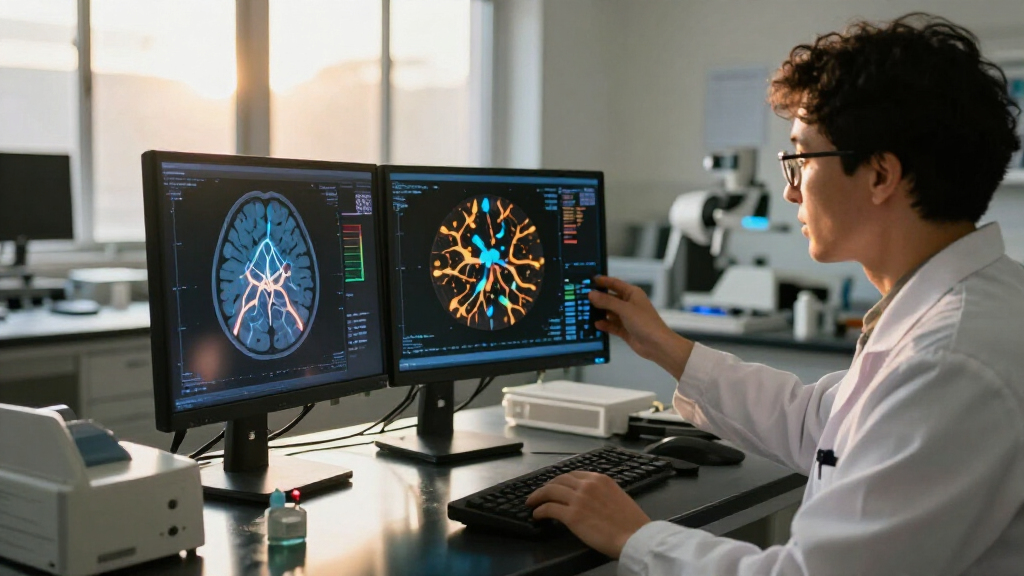
The 2026 Nobel Prize in Physiology or Medicine was jointly awarded to Karl Deisseroth, Peter Hegemann and Georg Nagel for discoveries that enabled optogenetics. The technique lets researchers use light to switch selected nerve cells on or off, helping test how brain circuits contribute to behavior; potential treatments remain at an early stage, especially for conditions inside the brain.
The 2026 Nobel Prize in Physiology or Medicine was jointly awarded on Oct. 5 to Karl Deisseroth, Peter Hegemann and Georg Nagel for discoveries that enabled optogenetics, a method researchers use to control selected nerve cells with light. The approach has helped scientists investigate how particular brain cells contribute to memory, emotion and behavior, while possible clinical applications remain under development.
The research began with studies of Chlamydomonas, a single-celled pond alga that moves in response to light. Hegemann, at Humboldt University of Berlin, and Nagel, at the University of Würzburg, investigated how the organism detects light. Their work focused on channelrhodopsin, a light-sensitive protein in the alga’s cell membrane.
When light reaches a molecule associated with channelrhodopsin, the protein opens a channel that allows positively charged ions to enter the cell. That process helps trigger the alga’s movement. Deisseroth recognized that nerve cells could be genetically modified to produce light-sensitive proteins, allowing researchers to influence their activity by shining a particular wavelength of light.
In optogenetics, scientists combine genetic techniques with light to target cells with selected characteristics. Rather than only recording which neurons are active during an action, researchers can switch targeted cells on or off and examine how that changes an animal’s behavior. The method gives researchers a way to test whether particular cells are necessary for an observed behavior or can help drive it.
How Light Changed Brain Experiments
The award recognizes a method that helped brain researchers move beyond observing associations between neural activity and behavior. As Viviana Gradinaru, a Caltech professor and former doctoral student in Deisseroth’s lab, told Being Patient, optogenetics can help researchers move “from correlation to causation.” By controlling specific groups of cells, researchers can test their role in a circuit rather than infer it from activity measurements alone.
That distinction matters for understanding how brain networks work and how they may be disrupted in disease. Gradinaru’s research in mice, for example, examined how deep brain stimulation affects Parkinson’s symptoms. Her work suggested that the treatment’s effects may involve axons—the projections that carry signals between neurons—rather than only the cell bodies. Such findings can guide research questions, but animal results do not by themselves establish how a treatment works in people.
The Nobel recognition also reflects optogenetics’ spread beyond a niche research method. Gradinaru said its adoption by neuroscientists around the world, as well as interest from industry and health care, has been striking. The distinction is important: widespread research use is not the same as an established clinical treatment. Work aimed at restoring vision is being tested, while optogenetic control of neurons deep in the brain presents additional technical challenges.
As an affiliate, we earn on qualifying purchases.
From Pond Algae to Neurons
The path to optogenetics brought together two lines of research: studies of how algae sense light and efforts to manipulate activity in the brain. Hegemann and Nagel investigated the algal protein’s light response; Deisseroth saw that the same principle might be adapted to nerve cells. Researchers then developed ways to make selected neurons express light-sensitive proteins.
Gradinaru recalled that when she interviewed at Stanford in early 2005, Deisseroth’s lab was just getting started, though its idea of using light and genes to control brain activity was already clear. “In 2005, optogenetics was still a niche specialty,” she told Being Patient. Her account describes a field that grew from an emerging laboratory approach into a tool used by neuroscience groups internationally.
The method has also informed research into brain stimulation and behavior in living animals. Its use depends on targeting cells and delivering light to them, making experiments possible that are difficult with methods that measure activity without selectively changing it. The Nobel is for the discoveries behind this research capability, not an announcement that optogenetics has become a routine therapy for brain disorders.
light-sensitive neuron control device
As an affiliate, we earn on qualifying purchases.
As an affiliate, we earn on qualifying purchases.
Clinical Uses Remain Unsettled
The Nobel award recognizes foundational discoveries; it does not establish that optogenetics can treat brain disorders in people. The source report describes companies testing approaches for vision loss, but says reaching neurons deep in the brain is more difficult than delivering treatment to the eye. It remains unclear when, or whether, those challenges will be overcome for particular neurological conditions.
The report also describes findings from animal research and early-stage clinical work. These results do not settle how well a treatment will work across larger groups of patients, how durable any benefit may be, or what risks may emerge. Those questions require further testing and evidence. The report does not provide a detailed clinical-development timeline for brain applications.
As an affiliate, we earn on qualifying purchases.
Further Trials and Delivery Research
Clinical testing of optogenetics-inspired approaches for vision loss is continuing. The report says Kiora Pharmaceuticals is testing a light-sensitive small molecule in a Phase 2 trial for retinitis pigmentosa. It also reports that GenSight Biologics published Phase 1/2 trial data for a gene therapy used with wearable goggles. In that study, light sensitivity improved in seven of 10 participants, with changes described as clinically meaningful in six. These early findings are not evidence that the approach will work for all patients or receive approval.
For possible brain applications, Gradinaru’s team is working on viruses intended to carry genetic instructions for red-light-sensitive proteins across the blood-brain barrier and into neurons. Red light’s longer wavelength may travel farther into brain tissue, but the team’s work remains under development. Gradinaru said the tools could take several years to develop and that further discoveries and clinical effects may lie ahead. The next major evidence will come from technical progress and clinical studies showing whether these approaches can be delivered safely and provide meaningful benefits.
As an affiliate, we earn on qualifying purchases.
Key Questions
Who received the 2026 Nobel Prize in Physiology or Medicine?
Karl Deisseroth, Peter Hegemann and Georg Nagel jointly received the prize on Oct. 5, 2026, for discoveries that enabled optogenetics.
What is optogenetics?
Optogenetics combines genetic methods and light-sensitive proteins so researchers can use particular wavelengths of light to control selected nerve cells. It allows scientists to test how targeted cells affect brain activity and behavior.
Does the Nobel mean optogenetics can treat brain disorders now?
No. The award recognizes research discoveries and a scientific method. Potential clinical applications are still being studied, and controlling cells deep in the brain presents technical challenges.
Is optogenetics being tested in people?
The report describes clinical trials of optogenetics-inspired approaches for vision loss, including work involving retinitis pigmentosa. Those studies do not establish that the method is an approved or established treatment for brain disorders.
Source: rss
Halloween Picks
halloween
As an affiliate, we earn on qualifying purchases.