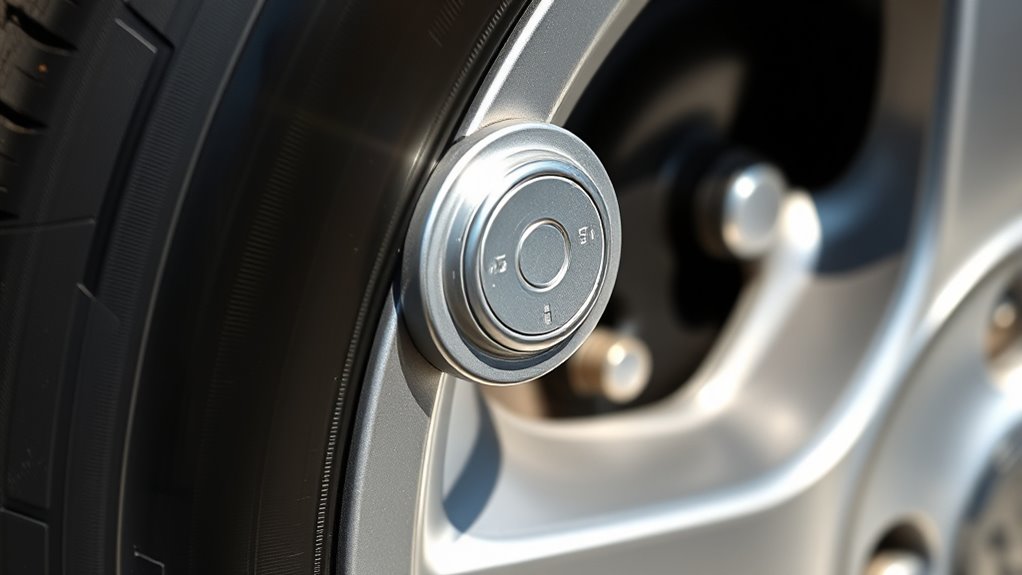

If you’re looking to upgrade your older vehicle with a modern TPMS, I recommend checking out kits like Schrader’s retrofit system, which is easy to install and compatible with various frequencies. Other great options include the Dynamic repair kit, GM-specific sensors, and external sensor systems like Tymate or Marcala. Ensuring the kit suits your vehicle’s make, model, and sensor type is key. Keep exploring to find the best fit for your ride and how to get them set up effectively.
Key Takeaways
- Choose kits compatible with your vehicle’s sensor frequency (315 MHz, 433 MHz, or 314.9 MHz) for proper functionality.
- Opt for OE-quality, easy-to-install retrofit kits with programmable sensors designed for older vehicles without factory TPMS.
- Consider kits with clamp-in or snap-in stems that fit your wheel type and ensure a secure, reliable installation.
- Look for solar-powered wireless displays or simple relearn tools to facilitate quick, hassle-free setup on older models.
- Verify vehicle compatibility and sensor communication protocols to ensure the retrofit kit works seamlessly with your vehicle’s system.
SCHRADER TPMS Retrofit Kit for Passenger Cars and Light Truck
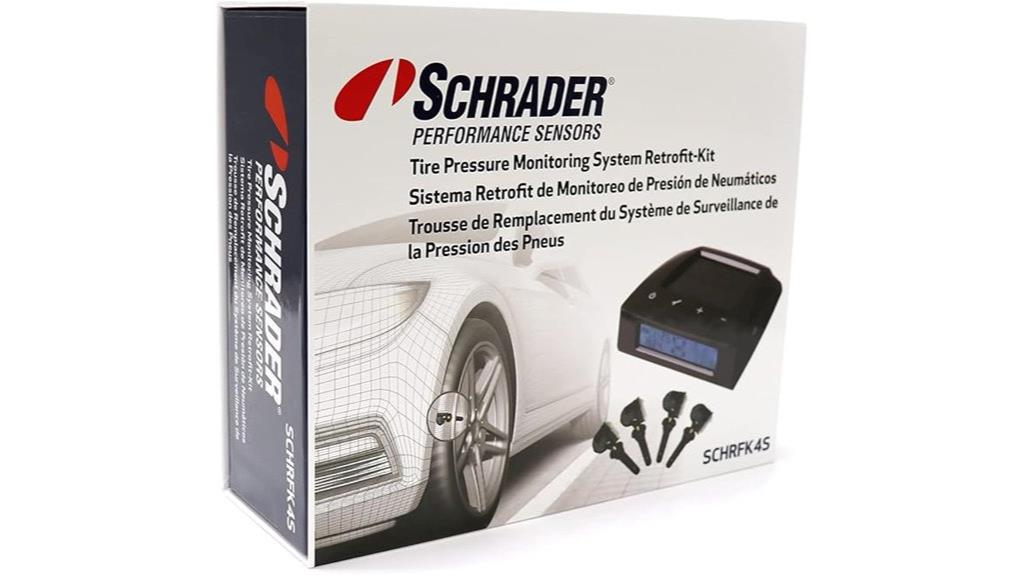
If you’re looking for a reliable way to add OE-quality tire pressure monitoring to your passenger car or light truck, the Schrader TPMS Retrofit Kit is an excellent choice. It’s designed for quick, easy installation on vehicles without factory-installed TPMS. The solar-powered, wireless display offers real-time pressure and temperature readings, with alerts for safety. The kit includes programmable sensors compatible with multiple frequencies and offers clamp-in or snap-in stem options for a seamless, OE-like fit. Schrader’s long-standing reputation since 1997 guarantees you get durable, high-quality sensors that improve vehicle safety and maintenance convenience.
Best For: vehicle owners and tire service providers seeking an OE-quality, easy-to-install TPMS retrofit solution for passenger cars and light trucks without factory-installed sensors.
Pros:
- Quick and easy installation with clamp-in or snap-in stem options
- Solar-powered wireless display provides real-time pressure and temperature monitoring
- Programmable sensors compatible with multiple frequencies (314.9, 315, and 433 MHz)
Cons:
- Not suitable for vehicles already equipped with factory TPMS sensors
- Requires initial setup and programming, which may be challenging for some users
- Limited to aftermarket applications; not compatible with OEM-specific systems
Dynamic TPMS Service Repair Kit (16-A, 400 Piece)

The Dynamic TPMS Service Repair Kit (16-A, 400 Piece) stands out as an ideal choice for professionals and DIY enthusiasts seeking a complete solution for tire pressure sensor repairs. With 400 pieces, including 100 nickel-plated valve cores and nylon caps, it covers most domestic and import vehicles. The kit features 17 specialized sets tailored for brands like GM, Ford, Honda, BMW, and more, making it highly versatile. Its extensive contents ensure you can handle various repairs efficiently. Lightweight and compact, it’s perfect for garages or personal use. Overall, this kit offers durability, broad compatibility, and a cost-effective way to keep tire sensors functioning properly.
Best For: professional auto repair shops and DIY enthusiasts seeking a comprehensive, versatile TPMS repair kit for a wide range of domestic and import vehicles.
Pros:
- Contains 400 pieces, including 100 nickel-plated valve cores and nylon caps for durability and corrosion resistance
- Includes 17 specialized kits tailored for various vehicle brands, ensuring broad compatibility
- Compact and lightweight design makes it easy to store and transport for both professional and personal use
Cons:
- Slightly heavy at approximately 4 pounds, which may require careful handling during transport
- Some users may find the extensive contents overwhelming if only performing occasional repairs
- As a specialized tool, it may be more costly than basic repair kits for casual users
Alligator U1 Universal Metal TPMS Service Kit Box of 20
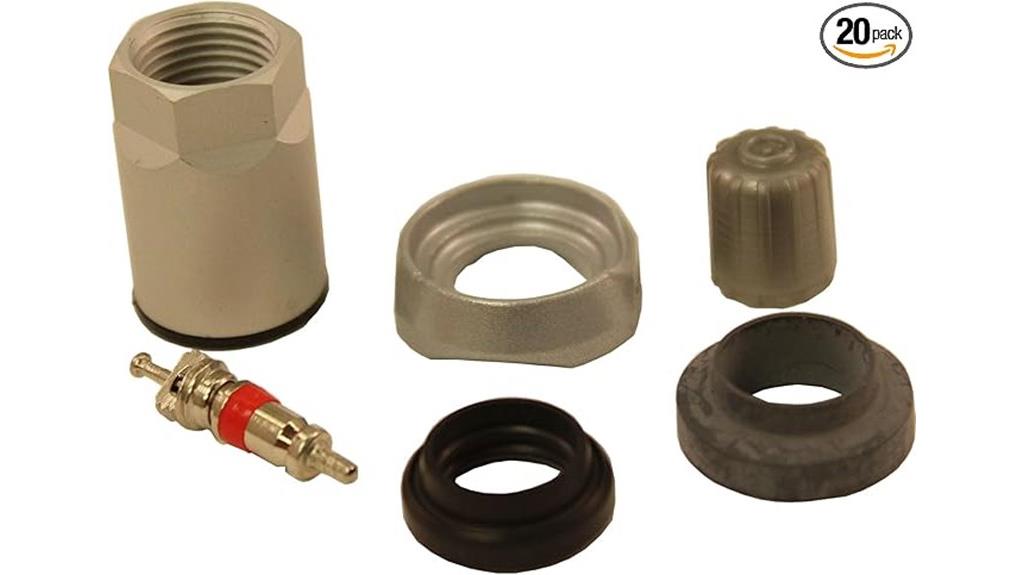
For technicians and fleet managers seeking a reliable, universal solution, the Alligator U1 Universal Metal TPMS Service Kit Box of 20 offers an efficient way to service metal valve sensors. This kit covers 97% of metal valve TPMS sensors on the market, simplifying inventory with a single SKU. It reduces excess stock, streamlines maintenance, and speeds up repairs, preventing lost sales due to unavailable kits. Designed for universal use, it’s perfect for quick, consistent servicing across various vehicle makes. With 20 units per box, you get ample supplies to keep your fleet moving without complicating stock management.
Best For: fleet managers and automotive technicians seeking a universal, efficient solution for servicing metal valve TPMS sensors across a wide range of vehicle makes.
Pros:
- Covers 97% of metal valve TPMS sensors, ensuring broad compatibility
- Simplifies inventory with a single SKU, reducing stock complexity
- Speeds up maintenance and repairs, minimizing vehicle downtime
Cons:
- May not be suitable for vehicles with plastic or other non-metal valve sensors
- Limited to metal valve TPMS sensors, requiring additional kits for other sensor types
- Bulk packaging (box of 20) might be excessive for small-scale operations
Standard Motor Products TPM4012SK Tire Pressure Monitoring System Sensor Service Kit
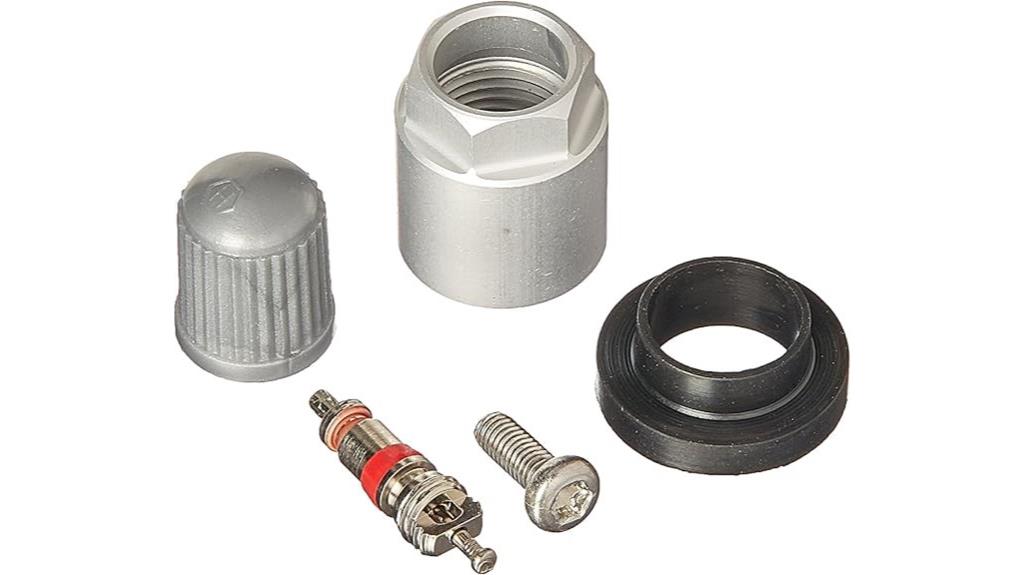
Standard Motor Products TPM4012SK Tire Pressure Monitoring System Sensor Service Kit stands out as an ideal choice for vehicle owners seeking a reliable, vehicle-specific solution for TPMS maintenance. This kit includes a valve core tailored to fit specific vehicle models, ensuring accurate sensor performance. Compact at 4 x 4 x 2 inches and lightweight at just 0.64 ounces, it’s easy to handle and install. With a solid customer rating of 4.5 stars from 366 reviews, it’s a trusted option. The kit’s contents and packaging are designed for secure delivery, and Amazon’s 30-day return policy gives added confidence in your purchase.
Best For: vehicle owners and technicians seeking a reliable, vehicle-specific TPMS sensor service kit for maintenance or replacement.
Pros:
- Includes a valve core tailored for vehicle-specific fitment ensuring accurate performance
- Compact and lightweight design for easy handling and installation
- Highly rated with 4.5 stars based on 366 reviews, indicating customer satisfaction
Cons:
- Limited to specific vehicle models, may not be compatible with all vehicles
- Only includes basic components like valve core, possibly requiring additional parts for full sensor replacement
- Price and availability may vary, potentially affecting accessibility for some buyers
VXDAS TPMS Relearn Tool for GM Vehicles
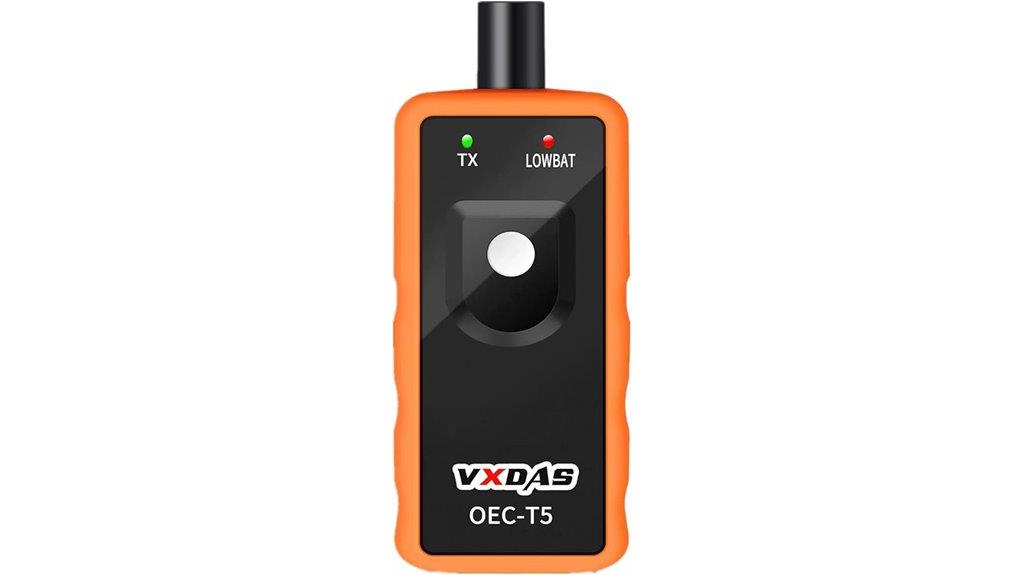
If you own a GM vehicle from 2006 to 2023 and need a reliable way to quickly relearn tire pressure sensors, the VXDAS TPMS Relearn Tool is an excellent choice. This compact, battery-powered device works with GM models using 315/433 MHz sensors, including Chevy, Buick, GMC, Opel, and Cadillac. It allows you to activate and relearn sensors in just 1-2 minutes, saving you trips to the dealer or tire shop. Simply put the vehicle in TPMS Learn Mode, hold the tool near the valve stem, and press the button. Its durable design, user-friendly operation, and positive reviews make it a top pick for quick, safe resets.
Best For: vehicle owners with GM models from 2006 to 2023 seeking a quick, reliable way to relearn tire pressure sensors without visiting a dealer or tire shop.
Pros:
- Fast activation and relearning within 1-2 minutes, saving time and effort
- Compatible with a wide range of GM vehicles (Chevy, Buick, GMC, Opel, Cadillac) using 315/433 MHz sensors
- User-friendly design with clear operation steps and durable build for long-term use
Cons:
- Not suitable for heavy trucks with more than four tires or external TPMS systems
- Requires vehicle to be in TPMS Learn Mode and proper placement for effective operation
- Activation feedback (horn or flashing signals) may vary, requiring familiarity for accurate confirmation
Ken-Tool 29975 Tpms Stem Repair Kit, One Size, Factory
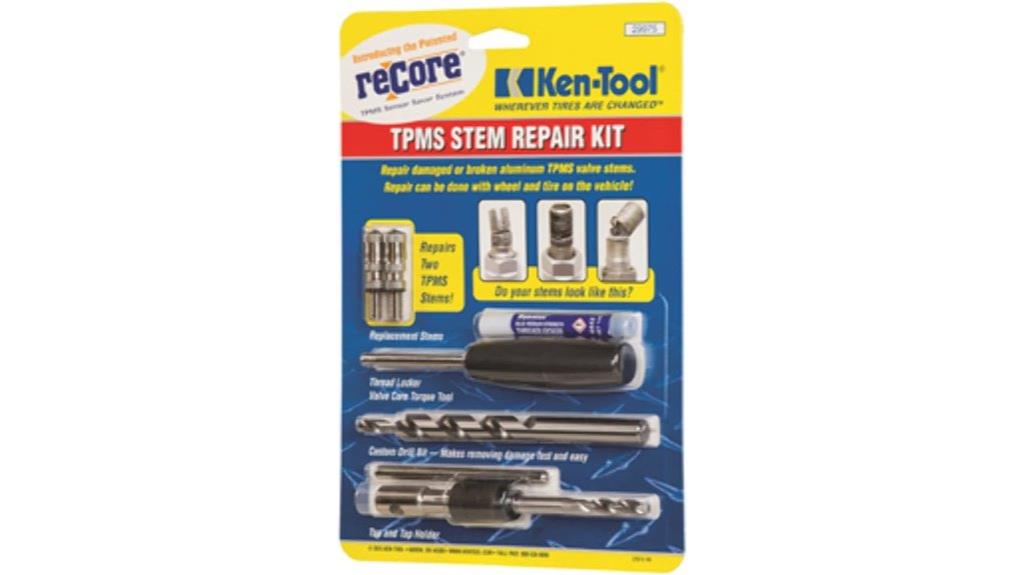
The Ken-Tool 29975 TPMS Stem Repair Kit stands out as an ideal choice for professionals and DIY enthusiasts needing quick, reliable in-tire repairs. This factory model includes two replacement stems, a high-speed drill bit, tap, tap holder, thread locker, and a valve core torque tool, making it a all-inclusive solution. You can repair corroded or damaged valve stems without removing the tire, typically within 20 minutes. It’s compact, lightweight, and easy to use, rated 4.4 stars by customers who value its efficiency and thorough kit contents. Whether for a shop or personal use, this kit offers a convenient way to maintain TPMS functionality.
Best For: professional automotive technicians and DIY enthusiasts seeking fast, reliable in-tire TPMS stem repairs without removing the tire.
Pros:
- Includes all necessary tools and replacement parts for comprehensive repairs
- Enables quick, in-tire repairs typically completed within 20 minutes
- Compact and lightweight design for ease of use and portability
Cons:
- Limited to one size, which may not fit all valve stems
- Requires some technical skill to operate effectively
- Made in China, which may concern some users regarding manufacturing standards
Wheel Accessories Parts PDQ OEM TPMS Sensor Service Kit (12 pcs)

For anyone seeking a reliable and OEM-compliant solution to maintain their TPMS system, the Wheel Accessories Parts PDQ OEM TPMS Sensor Service Kit (12 pcs) stands out. This kit includes rubber valve stems compatible with popular vehicle brands like GM, Ford, Subaru, Chrysler, Dodge, and Jeep, making it versatile and easy to install. The self-tapping screws ensure proper torque and resist loosening from vibrations. Made from ozone-resistant EPDM rubber, these valves withstand extreme temperatures and resist oxidation, ensuring longevity. Rated 4.4 out of 5 stars, it’s a durable, cost-effective option for maintaining your TPMS sensors and keeping your vehicle running safely.
Best For: vehicle owners and service professionals seeking a reliable, OEM-style TPMS sensor service kit compatible with multiple vehicle brands for easy installation and long-lasting performance.
Pros:
- Includes 12 rubber valve stems compatible with major vehicle brands for versatile use
- Made from ozone-resistant EPDM rubber that withstands extreme temperatures and resists oxidation
- Features self-tapping screws for proper torque and secure fit, reducing loosening from vibrations
Cons:
- May require basic mechanical skills for proper installation
- Limited to passenger vehicles; not suitable for heavy-duty or commercial trucks
- Does not include electronic TPMS sensors, only rubber valve stems and related components
Denso 999-0601 TPMS Sensor Maintenance Kit
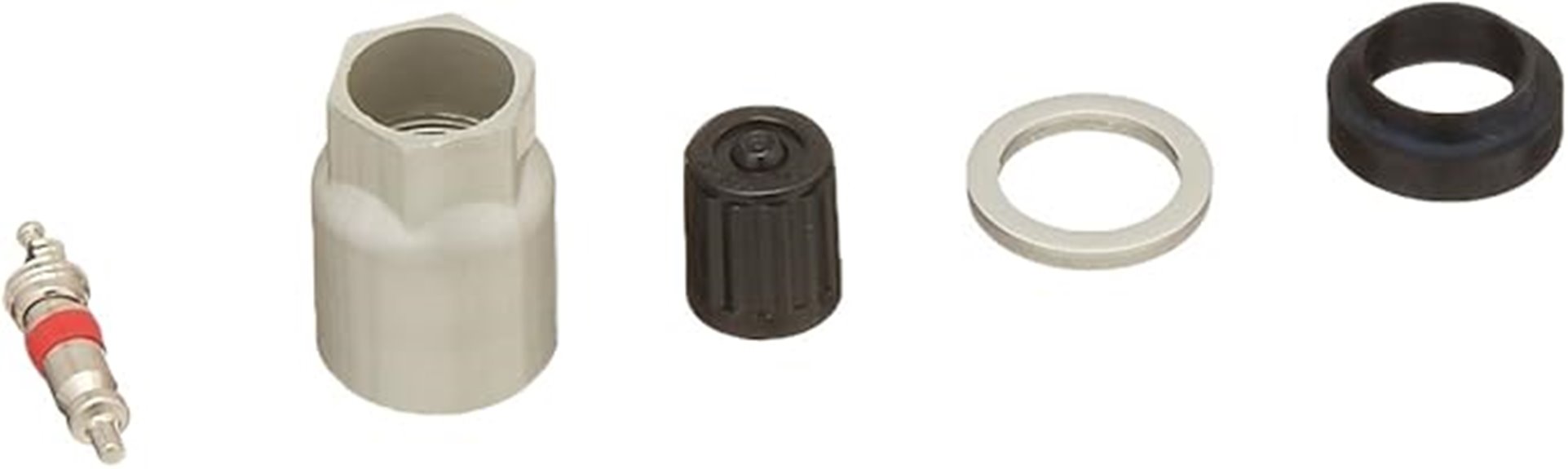
The Denso 999-0601 TPMS Sensor Maintenance Kit stands out for those seeking a reliable, modern clamp-in solution to keep their vehicle’s tire pressure monitoring system functioning smoothly. This lightweight kit is easy to install with its secure clamp-in design, making it suitable for modern TPMS sensors. It’s designed specifically for maintenance and replacement, ensuring your system stays accurate and responsive. With an average rating of 4.5 stars from 86 reviews, users appreciate its simplicity and effectiveness. Plus, it comes with a 30-day return policy, giving you peace of mind. Overall, it’s a solid choice for maintaining your vehicle’s TPMS performance.
Best For: vehicle owners and technicians seeking an easy-to-install, reliable solution for TPMS sensor maintenance and replacement.
Pros:
- Easy clamp-in mounting for secure and hassle-free installation
- Lightweight and compact design for convenient handling and storage
- High customer satisfaction with a 4.5-star rating based on numerous reviews
Cons:
- Limited to modern TPMS sensors; may not be compatible with older systems
- Discontinued status could affect future availability or support
- No core charge or extensive packaging, which may be a drawback for some users
RV Tire Pressure Monitoring System (TPMS) with Sensors and LCD Display
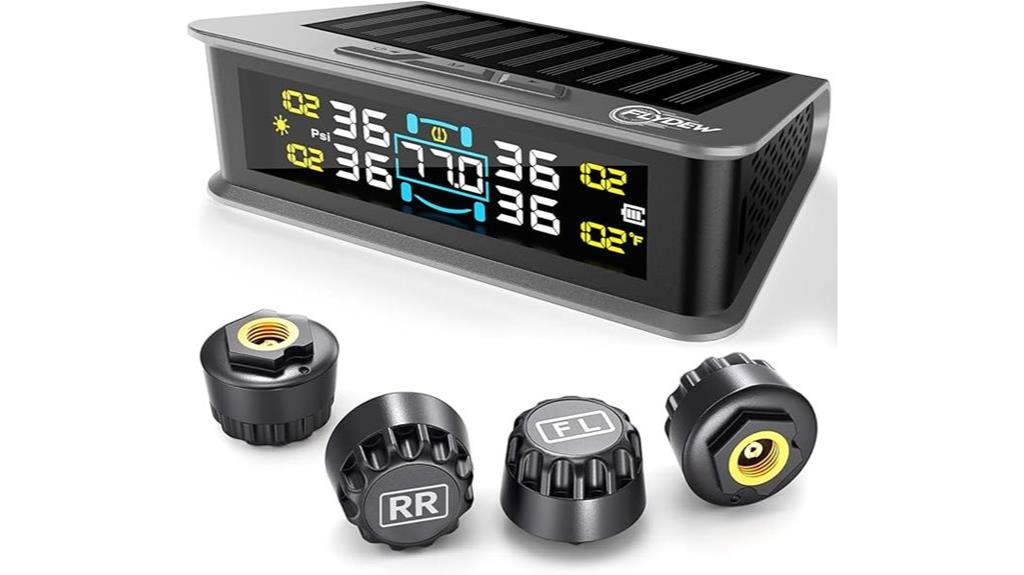
If you’re looking to keep your RV safe and road-ready, this TPMS with sensors and LCD display offers advanced, real-time monitoring that’s hard to beat. It provides 24/7 tracking with ±2 PSI / ±3°F accuracy, updating every 0.3 seconds, and alerting you instantly to leaks or overheating. The LCD refreshes every 6 seconds and supports unit switching between PSI/BAR and °F/°C. With customizable alarms for pressure, temperature, and sensor issues, it adapts to your needs. Easy to install, solar or USB-C powered, and equipped with long-lasting sensors, this system guarantees reliable, hassle-free tire management for your RV.
Best For: RV owners and travelers seeking reliable, real-time tire monitoring to ensure safety and optimal performance during road trips.
Pros:
- Advanced monitoring with ±2 PSI / ±3°F accuracy and 0.3-second sensor updates for instant alerts
- Supports customizable alarm thresholds and unit switching (PSI/BAR, °F/°C) for versatile use
- Easy installation with anti-vibration hex nuts, long-lasting sensors, and dual power options (solar and USB-C)
Cons:
- Might require initial setup and calibration, which could be challenging for some users
- Limited to vehicles under 50ft, not suitable for larger commercial or industrial vehicles
- Battery replacement for sensors is necessary approximately every 2 years, requiring periodic maintenance
Wheel Accessories Parts TPMS Service Kits (12 Pack)
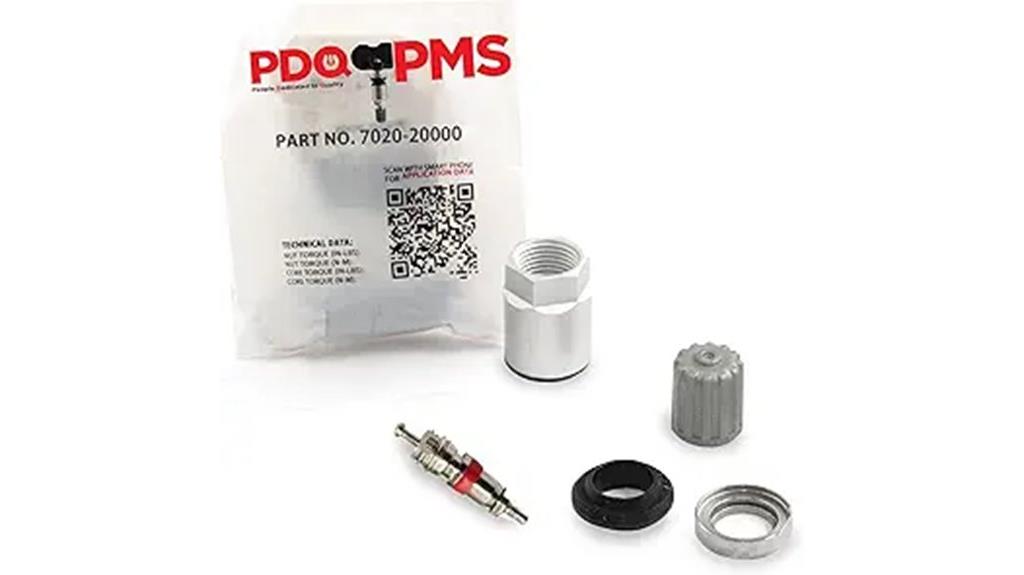
Wheel Accessories Parts TPMS Service Kits (12 Pack) stand out as an ideal choice for professional mechanics and automotive enthusiasts who need reliable, vehicle-specific components to maintain or restore TPMS sensors during tire service. These kits include essential parts like grommets, nuts, washers, and core caps, fitting popular models such as BMW, Chevrolet, and Honda. Manufactured to exact OE standards and tested for durability, they guarantee trouble-free installation and long-lasting performance. Backed by over 15 years of experience from a US-based company, these kits deliver quality and confidence, making tire maintenance quicker, easier, and more reliable for your vehicle’s TPMS system.
Best For: professional mechanics and automotive enthusiasts seeking reliable, vehicle-specific TPMS service components for tire maintenance and sensor upkeep.
Pros:
- Manufactured to exact OE standards ensuring reliable performance and durability
- Includes all essential parts like grommets, nuts, washers, and core caps for complete sensor maintenance
- Designed for vehicle-specific fitment, compatible with BMW, Chevrolet, Honda, and more
Cons:
- Limited to certain vehicle models, may not fit all makes and models outside the listed brands
- Requires professional installation for trouble-free service, which may not be suitable for DIY beginners
- Only available in a 12-pack, which might be more than needed for occasional use
4PCS TPMS Valve Stem Repair Kit for BMW, Toyota, Honda, Dodge, Chrysler, Chevrolet, Ford, Hyundai, Infiniti, Jaguar, Land Rover, Volvo, Jeep, Acura
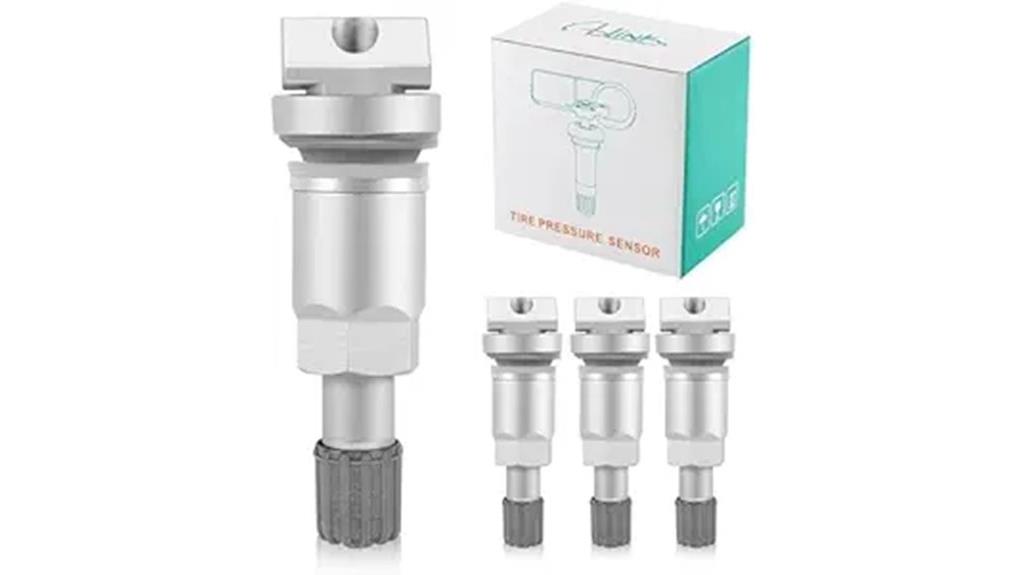
Designed for vehicle owners seeking a reliable solution, the PCS TPMS Valve Stem Repair Kit offers a versatile option compatible with a wide range of brands, including BMW, Toyota, Honda, Dodge, Chrysler, Chevrolet, Ford, Hyundai, Infiniti, Jaguar, Land Rover, Volvo, Jeep, and Acura. Made from high-quality aluminum alloy, these valve stems guarantee durability and reliable performance under tough conditions. They’re easy to install—just deflate, remove, and click in the new valve. Backed by a 2-year warranty and a 30-day return policy, this kit provides a cost-effective, long-lasting fix for maintaining proper tire pressure across numerous vehicle models.
Best For: vehicle owners seeking a durable, versatile, and cost-effective solution for repairing TPMS valve stems across a wide range of car brands and models.
Pros:
- Compatible with numerous vehicle brands including BMW, Toyota, Honda, and more, ensuring broad applicability.
- Made from high-quality aluminum alloy for durability and long-lasting performance under harsh conditions.
- Easy to install with a simple deflate, remove, and click-in process, coupled with a 2-year warranty for added reliability.
Cons:
- May require verifying compatibility with specific vehicle models before purchase.
- Limited to repairing valve stems; not suitable for complete TPMS sensor replacements.
- As a small component, improper installation could lead to leaks or performance issues if not installed correctly.
Autel MaxiTPMS TS508WF KIT Sensor Programming and Relearn Tool

The Autel MaxiTPMS TS508WF KIT stands out as an excellent choice for professionals and serious enthusiasts who need a thorough TPMS programming and relearn solution. It offers advanced features like sensor ID reading, tire pressure and temperature monitoring, fault detection, and system diagnosis. With three relearn methods—stationary, auto, and OBD—it covers all workshop scenarios. The kit includes eight rubber sensors and the TS508WF device, supporting almost all sensor types and frequencies. Its two modes—Quick and Advanced—make it versatile and user-friendly. Overall, this tool simplifies sensor programming and system resets, ensuring reliable TPMS operation for older vehicles.
Best For: professional automotive technicians and serious enthusiasts seeking a comprehensive TPMS programming and relearn solution for diverse vehicle types and sensor configurations.
Pros:
- Supports multiple sensor types and frequencies, including OE and aftermarket sensors
- Offers three relearn methods (stationary, auto, OBD) for versatile workshop applications
- Features both Quick and Advanced modes for streamlined or detailed diagnostics and programming
Cons:
- Limited to Autel MX sensors; may not program all universal sensor types
- Higher initial cost due to comprehensive features and included sensors
- Requires vehicle compatibility verification prior to purchase to ensure functionality
Tymate TM7 Wireless Tire Pressure Monitoring System
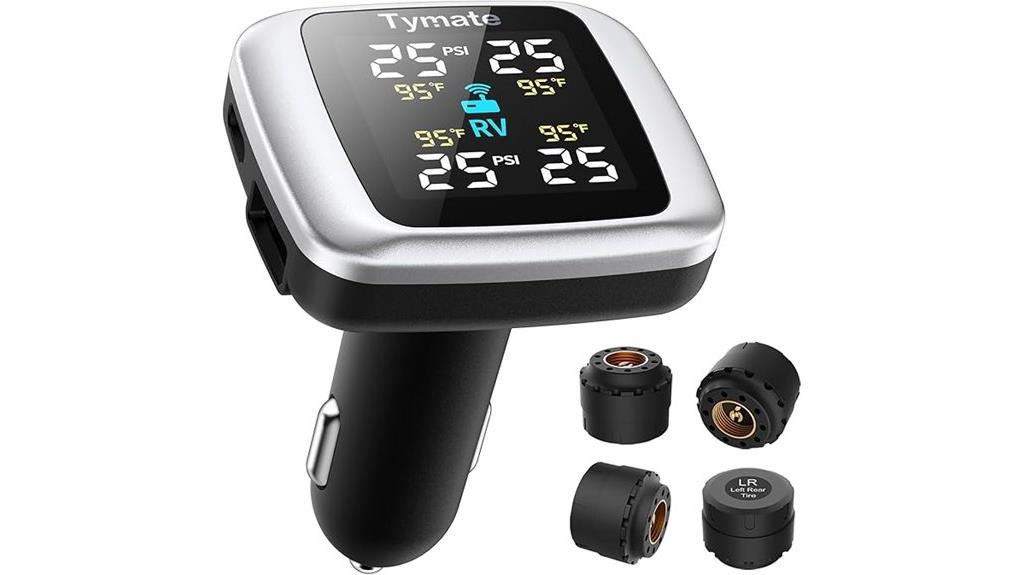
Looking for a reliable TPMS that’s easy to install and perfect for a variety of vehicles? The Tymate TM7 wireless system fits the bill. It features external sensors, a color LCD display, and multiple alert modes, suitable for RVs, SUVs, trucks, and sedans. It detects tire pressure from 0 to 87 PSI with high accuracy and warns you of high/low pressure, leaks, high temperatures, and sensor issues. Powered via the cigarette lighter, it’s simple to set up in just five minutes, with additional USB charging ports. Its automatic calibration and wide signal range make monitoring convenient, ensuring safety on the road without complicated wiring.
Best For: RV owners, SUVs, trucks, and sedan drivers seeking an easy-to-install, reliable tire pressure monitoring system with versatile alert options and smartphone charging capabilities.
Pros:
- Easy to install within 5 minutes with comprehensive guidance.
- Wireless external sensors and color LCD display for clear, real-time monitoring.
- Dual USB ports for convenient charging of smartphones and tablets.
Cons:
- Requires vehicle’s cigarette lighter socket, limiting placement options.
- The sensor batteries (CR1632) may need periodic replacement.
- Compatibility with trailers depends on pairing with Tymate RP05 repeater.
Marcala TPMS Sensors Set of 4
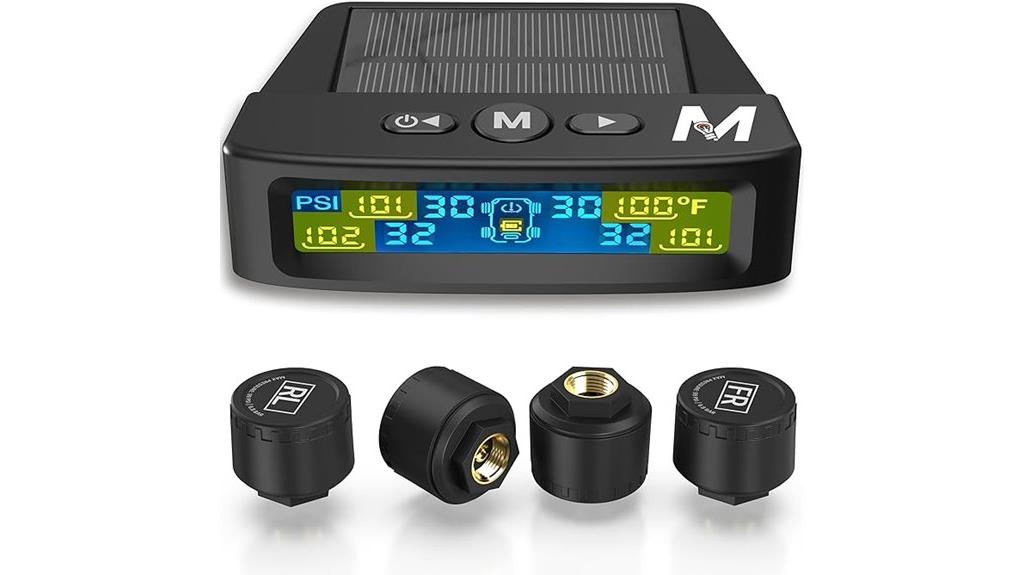
If you want reliable tire pressure monitoring that’s easy to install and provides accurate data, the Marcala TPMS Sensors Set of 4 is an excellent choice. These sensors monitor pressures up to 98 PSI, compatible with cars, trucks, SUVs, and motorcycles. They arrive ready to install in under a minute, with no complex setup needed. Waterproof and durable, they work reliably in all weather conditions. The sensors update every second during driving, providing real-time pressure and temperature alerts with ±1 PSI accuracy. Featuring a bright, auto-dimming LCD display and dual solar and USB charging, they ensure continuous operation and enhanced safety on every trip.
Best For: drivers seeking a reliable, easy-to-install TPMS system compatible with various vehicle types for real-time tire monitoring.
Pros:
- Simple installation with no complex setup, ready in under a minute
- Accurate real-time data with ±1 PSI precision and weatherproof IP67 design
- Dual solar and USB charging ensures continuous operation and convenience
Cons:
- Limited to monitoring 1-4 wheels within a 20-foot range
- Some users may find the display brightness auto-dimming feature less adjustable
- Higher price point compared to basic TPMS sensors without advanced features
TPMS Sensor Set for GM Chevy Silverado Buick Cadillac GMC
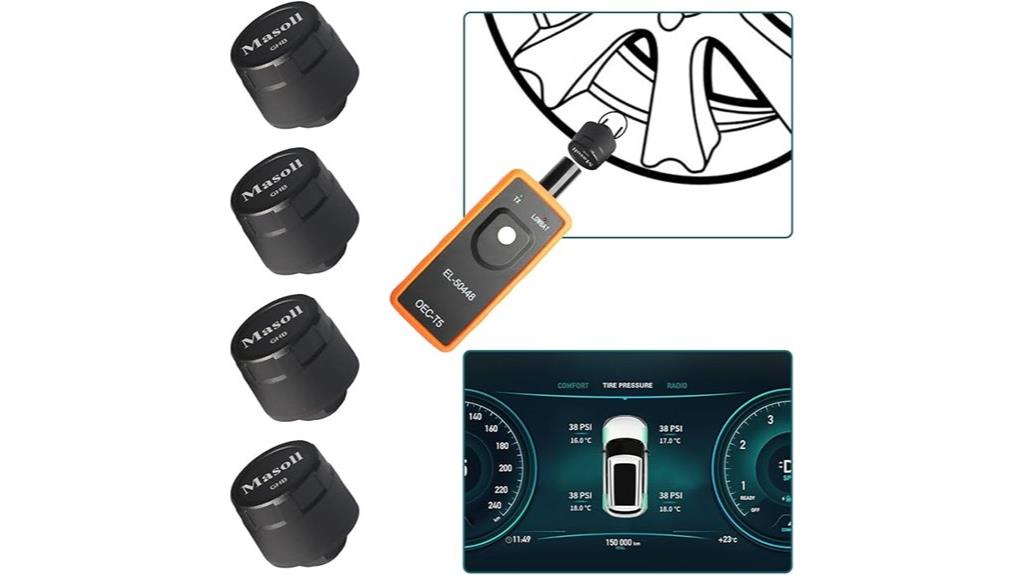
For GM vehicles like Chevy Silverado, Buick, Cadillac, and GMC manufactured after 2006, this TPMS sensor set offers a reliable and easy-to-install solution for maintaining accurate tire pressure monitoring. The Gen 2 sensors, launched in 2025, feature a robust design, stronger transmission signals, and better performance across cars, SUVs, and trucks. They’re direct replacements for original sensors and can be installed in minutes using the included programming tool. With a 2-year replaceable battery and 1.5 PSI accuracy, these sensors deliver dependable readings. The package includes four external sensors and a relearn tool, making DIY installation straightforward and ensuring your TPMS stays functional.
Best For: GM vehicle owners seeking a reliable, easy-to-install TPMS solution for cars, SUVs, and trucks manufactured after 2006.
Pros:
- Compatible with a wide range of GM models including Silverado, Buick, Cadillac, and GMC.
- Simple DIY installation with included programming tool, taking only about 5 minutes.
- Long-lasting, replaceable battery with approximately 2 years of operation and high accuracy of 1.5 PSI.
Cons:
- Only compatible with GM vehicles manufactured after 2006.
- External sensors may be exposed to harsh elements, potentially affecting longevity.
- Requires the use of the provided TPMS programming tool for relearning, which may be unfamiliar to some users.
Factors to Consider When Choosing TPMS Retrofit Kits for Older Vehicles

When selecting TPMS retrofit kits for older vehicles, I focus on compatibility with my car’s specific model to guarantee proper fit and function. I also consider the sensor technology type and how easy it is to install, since some kits are more user-friendly than others. Finally, I look at system accuracy and reliability to make sure I get consistent, trustworthy readings on the road.
Compatibility With Vehicle Models
Choosing a compatible TPMS retrofit kit requires careful attention to your vehicle’s specific make, model, and year, especially for older cars that didn’t come with factory-installed sensors. First, verify that the kit is designed for your vehicle to avoid mismatches. Check if the sensors operate on the correct frequency—common ones are 315 MHz, 433 MHz, or 314.9 MHz—to ensure proper communication. It’s also important to confirm that the sensors can be programmed to work with your vehicle’s ECU and sensor protocols. Additionally, consider the physical compatibility of the sensors with your wheels, whether they require clamp-in or snap-in stems. Finally, review manufacturer specifications to ensure the retrofit kit aligns with your vehicle’s TPMS standards and communication protocols.
Sensor Technology Types
The type of sensor technology in a TPMS retrofit kit considerably impacts how well it integrates with your vehicle’s existing systems and how reliable the tire pressure readings will be. There are three main types: direct, indirect, and hybrid systems. Direct TPMS sensors use piezoelectric or semiconductor pressure sensors to provide real-time data directly from each tire, offering precise readings. Indirect TPMS relies on vehicle ABS wheel speed sensors and algorithms to estimate pressure based on wheel rotation differences, making it less invasive but potentially less accurate. Hybrid systems combine both methods, using direct sensors with indirect signals to improve reliability. Your choice affects compatibility, sensor lifespan, power use, and installation complexity, so understanding these differences helps you select the best kit for your vehicle.
Installation Ease and Time
Installing a TPMS retrofit kit on an older vehicle can be straightforward if you focus on features that simplify the process. Look for kits with wireless and solar-powered displays, which eliminate the need for complex wiring and reduce installation time. Programmable sensors compatible with your vehicle’s frequency (314.9, 315, or 433 MHz) make setup quicker and easier. Choose kits with snap-in or clamp-in stems resembling OE parts—these resemble factory components and don’t require special tools. Clear, real-time pressure and temperature readings with audio and visual alerts help ensure proper installation and reduce errors. Additionally, thorough instructions and reliable customer support can markedly streamline the process, saving you time and frustration. Prioritizing these features makes retrofitting your older vehicle much more manageable.
Power Source Options
When selecting a TPMS retrofit kit for an older vehicle, the power source options play a crucial role in both installation and long-term maintenance. Solar-powered kits are appealing because they eliminate external wiring and are maintenance-free, making installation straightforward. Wireless display units often use rechargeable or replaceable batteries, which can simplify setup but require periodic battery replacements. Some sensors draw power directly from the vehicle’s 12-volt system, needing wiring connections that can complicate installation but offer consistent power. Battery life varies, with most sensors lasting from 6 months to 2 years, influencing reliability and ongoing upkeep. Ultimately, choosing a power source depends on your preferences for ease of installation, maintenance, and long-term dependability.
System Accuracy and Reliability
Choosing a TPMS retrofit kit that delivers accurate and reliable readings is essential for maintaining safety and performance on older vehicles. Accurate sensors should measure tire pressure within ±1.5 PSI or better, guaranteeing trustworthy data. Reliability depends on sensors maintaining consistent communication with the vehicle’s ECU, even under different environmental conditions. Compatibility with specific valve stems and frequency ranges—such as 314.9, 315, or 433 MHz—is critical for system accuracy. Features like long-lasting batteries, waterproof designs, and stable signal transmission enhance dependability. Proper installation and calibration are also indispensable to ensure the system provides precise tire pressure and temperature readings. When these factors are met, you can trust your retrofit TPMS to deliver consistent, accurate information, keeping you safe on the road.
Relearning Process Simplicity
A straightforward relearning process is essential for ensuring that your TPMS retrofit kit integrates smoothly with your vehicle, especially if you plan to do the setup yourself. A kit that supports multiple relearn methods—such as stationary, auto, or OBD-based reactivation—makes the process easier. Clear, step-by-step instructions and minimal extra equipment are also key factors that simplify relearning. Compatibility with your vehicle’s make, model, and year influences how seamlessly you can complete the process without professional help. The quicker and more user-friendly the relearn process, the more likely it is that you’ll save time and avoid frustration. For older vehicles without factory TPMS, a simple setup is particularly advantageous, making DIY installation a practical option.
Compatibility With Aftermarket Sensors
Ensuring compatibility with aftermarket sensors is essential when selecting a TPMS retrofit kit for older vehicles. I make sure the sensors support the frequency bands used by my aftermarket sensors, like 314.9, 315, or 433 MHz. It’s vital to verify that the sensors are compatible with my vehicle’s make, model, and year, especially since older vehicles often lack factory TPMS. I also check if the sensors can work with my existing aftermarket systems or third-party monitoring devices. The valve stem type matters too—whether clamp-in or snap-in—to guarantee an OE-like installation. Finally, I confirm that the kit’s sensors can communicate with and be programmed from various aftermarket brands, ensuring seamless integration and avoiding compatibility headaches.
Cost and Budget Considerations
When evaluating TPMS retrofit kits, it’s important to take into account the overall cost, which includes more than just the sticker price. Prices can range from $50 to over $200, depending on features and sensor compatibility. Budgeting should also consider installation costs and ongoing expenses like sensor replacements. Cheaper kits might lack OE-quality sensors or advanced features, potentially affecting long-term reliability and accuracy. Investing in a higher-priced kit with programmable sensors and broad compatibility can save money down the line by reducing upgrade costs and fitting various vehicle models. To make a sound choice, compare the total cost of ownership, factoring in maintenance, sensor lifespan, and support. This approach ensures you select a kit that balances affordability with durability and performance.
Frequently Asked Questions
Are TPMS Retrofit Kits Compatible With All Vehicle Makes and Models?
Most TPMS retrofit kits are compatible with a wide range of vehicle makes and models, but not all. I recommend checking the kit’s specifications and your vehicle’s manual to verify compatibility. Some kits are designed specifically for certain years or types of vehicles, so it’s essential to confirm before buying. If you’re unsure, consulting with a professional or the retailer can help you find the right fit.
How Difficult Is Installing a TPMS Retrofit Kit on an Older Vehicle?
Installing a TPMS retrofit kit on an older vehicle is like assembling a puzzle—you need patience and the right tools. It’s generally straightforward, especially if you’re comfortable with basic car repairs. Most kits come with step-by-step instructions, making the process manageable. However, some vehicles might require slight modifications or professional help. Overall, with a bit of effort, you can upgrade your car’s safety system without much hassle.
Do Aftermarket TPMS Kits Affect Vehicle Warranties or Insurance?
Aftermarket TPMS kits generally don’t affect your vehicle’s warranty or insurance, but it’s wise to double-check your policy. I always recommend contacting your insurer or dealer before installation. If the kit is installed professionally and doesn’t interfere with vehicle electronics, you’ll likely face no issues. Just keep receipts and documentation to prove proper installation, and you’re good to go.
What Is the Typical Lifespan of a TPMS Sensor After Installation?
A TPMS sensor typically lasts between 5 to 7 years, but it’s not set in stone—like a ticking clock, it depends on usage and environmental factors. I’ve seen sensors go beyond a decade, especially with proper care. Keep in mind, batteries inside these sensors eventually wear out, which is often the main reason for replacement. Regular checks can help you catch the signs before a sensor completely fails.
Are There Any Legal or Safety Considerations When Retrofitting TPMS Systems?
Yes, there are legal and safety considerations when retrofitting TPMS systems. I make sure to follow manufacturer guidelines and local regulations, as improper installation can lead to safety issues or legal penalties. It’s vital to ensure the system is correctly calibrated and compatible with my vehicle to avoid false warnings or system failures. Consulting a professional or adhering to official standards helps keep me compliant and safe on the road.
Conclusion
Choosing the right TPMS retrofit kit can truly improve your older vehicle’s safety and performance. Did you know that under-inflated tires cause roughly 40% of all tire-related crashes? Installing a reliable kit not only helps prevent accidents but also saves you money on fuel and repairs. With options like these, you can easily upgrade your car today and enjoy peace of mind on every drive.