Practicing Tai Chi helps improve your balance by combining mindful movement, muscle strengthening, and enhanced proprioception. You become more aware of your body, reactions, and subtle shifts in your posture, which allows for quicker adjustments and stability. It’s especially effective for fall prevention because it builds core strength and coordination gradually. Stick with it, and you’ll discover how this gentle exercise can boost your confidence and ability to stay steady through daily activities.
Key Takeaways
- Tai Chi improves balance by enhancing body awareness and detecting subtle shifts before loss of stability.
- Regular practice strengthens major muscle groups, providing better support and stability for prevent falls.
- Mindful movements increase proprioception, allowing real-time adjustments to maintain proper posture.
- Focused breathing and posture promote mental clarity, reducing fall risk caused by distraction or confusion.
- The gentle, low-impact nature of Tai Chi makes it accessible for older adults, supporting sustained fall prevention efforts.
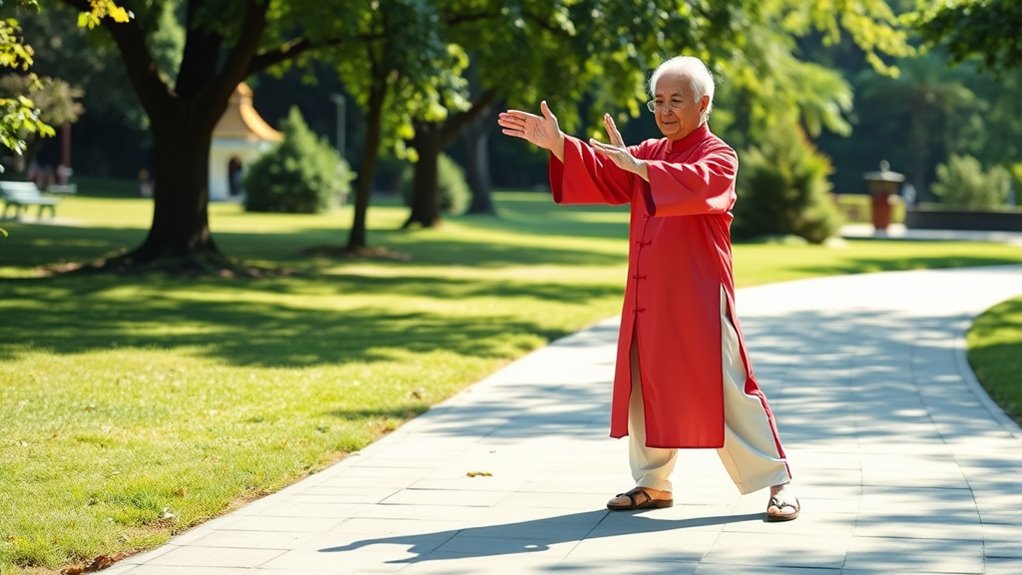
Have you ever wondered how a gentle martial art like Tai Chi can help prevent falls? The answer lies in its unique combination of mindfulness practice and muscle strengthening. Tai Chi isn’t just about slow, flowing movements; it’s a mindful exercise that enhances your awareness of your body and surroundings. This heightened mindfulness allows you to recognize and correct balance issues before they lead to a fall. When you practice Tai Chi regularly, you develop a deeper connection between your mind and body, which improves your ability to maintain stability during everyday activities.
One of the key benefits of Tai Chi is its focus on mindful movement. As you perform each pose, you learn to pay close attention to your breathing, posture, and muscle engagement. This mindfulness practice helps you stay present in the moment, making you more aware of subtle shifts in your balance. Over time, this awareness translates into quicker, more instinctive reactions if you stumble or feel unsteady, reducing your risk of falls. Because you’re actively engaging your mind and body during each session, Tai Chi becomes a powerful tool for improving overall coordination and spatial awareness.
In addition to mental benefits, Tai Chi helps strengthen muscles critical for maintaining balance. The slow, deliberate movements target major muscle groups—legs, hips, core, and even upper body—without the need for strenuous effort. This muscle strengthening is vital because it improves your stability and ability to respond to unexpected changes in terrain or footing. Stronger muscles act as stabilizers, making it easier to recover from a loss of balance. Unlike high-impact exercises, Tai Chi provides a gentle yet effective way to build strength gradually, which is especially beneficial for older adults or those with joint concerns.
Furthermore, Tai Chi’s emphasis on controlled, purposeful movements enhances proprioception—the sense of where your body parts are in space. This heightened awareness helps you make small adjustments to your posture and balance in real-time. Over time, the combination of muscle strengthening and improved proprioception leads to better balance control, reducing the likelihood of falls. Because the practice is adaptable to different fitness levels, you can tailor your sessions to focus on areas where you need the most support, making it accessible and sustainable. Incorporating muscle engagement and mindful movement into your routine can significantly improve your overall stability and confidence.

Senior-Friendly Treadmill with Ultra-Long Handrails for Home, Easy Operation Treadmill for Senior Elderly with PAD Holder & Cup Holder, with Heart Rate Monitor, 300 LBS Capacity, Safety Design
【Senior-Friendly Treadmill】Slow speed range (0.5-6.0 MPH) perfect for walking, rehabilitation exercises, and gentle workouts. Easy-to-read controls and simple...
As an affiliate, we earn on qualifying purchases.
Frequently Asked Questions
Can Tai Chi Be Effective for All Age Groups?
Yes, Tai Chi can be effective for all age groups because it offers age adaptability and can be modified to suit your physical limitations. Whether you’re young or elderly, you can benefit from improved balance, strength, and flexibility. You just need to start at a comfortable level, and with consistent practice, you’ll see positive results. It’s a versatile activity that promotes overall well-being regardless of your age or physical condition.
How Long Does It Take to See Fall Prevention Benefits?
You’ll likely see progress indicators within a few weeks of consistent practice, with fall prevention benefits becoming noticeable around 8 to 12 weeks. Timing expectations vary, but patience pays off as your posture, precision, and balance improve. Keep practicing steadily, and you’ll notice increased stability, strength, and confidence, all helping to prevent falls. Stay committed, and those benefits will steadily, surely, and markedly surface.
Are There Any Risks or Side Effects of Practicing Tai Chi?
Practicing Tai Chi generally has minimal risks, but you might experience muscle strain or joint discomfort if you push yourself too hard or perform movements incorrectly. To avoid these issues, start slowly, listen to your body, and practice under guidance if needed. If you notice persistent pain, stop and consult a healthcare professional. With proper technique, you can enjoy the benefits safely and reduce the risk of injury.
What Specific Tai Chi Moves Improve Balance?
Ever wonder which moves can boost your stability? You should focus on the “horse stance” and “single-leg stance” to improve your balance. These moves enhance stance improvement and teach you controlled weight shifting, essential for maintaining stability. By practicing these, you strengthen your core and legs, helping you stay steady. Can you picture yourself confidently shifting weight with ease? These specific moves make that possible, giving you better balance every day.
How Does Tai Chi Compare to Other Balance Exercises?
You find that Tai Chi offers a unique approach compared to other balance exercises, emphasizing the mind-body connection developed through its cultural origins. Unlike standard workouts, it integrates slow, deliberate movements that improve stability, flexibility, and mental focus. This holistic practice not only enhances physical balance but also fosters relaxation and awareness, making it especially effective for fall prevention and overall well-being.
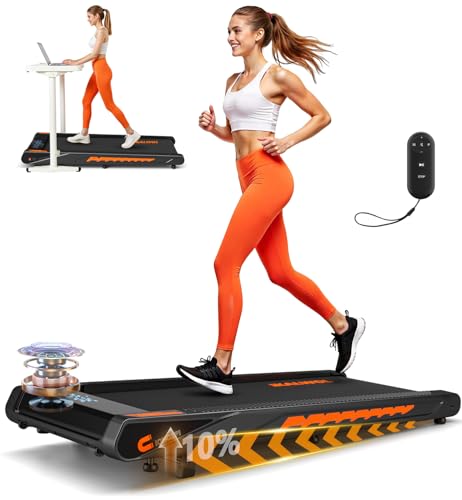
Walking Pad Treadmill with Speaker, 4-in-1 6.2MPH Treadmills for Home with App Compatible, Walking Pad with 10% Incline, LED Display, 2.75HP Brushless Drive, 350 LB Weight Capacity, 12 HIIT Programs
KALWOL: Craftsmanship Meets Quality! With 18 years of dedicated fitness equipment manufacturing, we prioritize precision and durability in...
As an affiliate, we earn on qualifying purchases.
Conclusion
Practicing Tai Chi can markedly improve your balance and reduce fall risk. Imagine Sarah, an 68-year-old who started Tai Chi classes and noticed she felt steadier on her feet and more confident walking. With consistent practice, you too can experience these benefits, helping you stay active and independent longer. Don’t wait until a fall happens—embrace Tai Chi today and take proactive steps toward safer, steadier movement every day.

Walking Pad Treadmill for Home - Folding Treadmills with Handle Bar Portable Compact Fold up Indoor Foldable Handles Electric Walk Pads Small Spaces Mini Running Quiet Under Bed Office
【Folding Treadmill with Handle Bar】This foldable walking pads functions as a traditional treadmill with handle bar, a foldable...
As an affiliate, we earn on qualifying purchases.

Lichico PulseDrive 8.7 MPH Walking Pad Treadmill with BLDC, Fits up to 6' & 47"x16" Super-Long Desk with Handle Bar, Compact Under Desk Treadmill for HomOffice, Running Walking Machine Remote Control
UP TO 8.7 MPH FOR WALKING & RUNNING: This 2-in-1 walking pad treadmill switches from 0.5–3.7 MPH for...
As an affiliate, we earn on qualifying purchases.