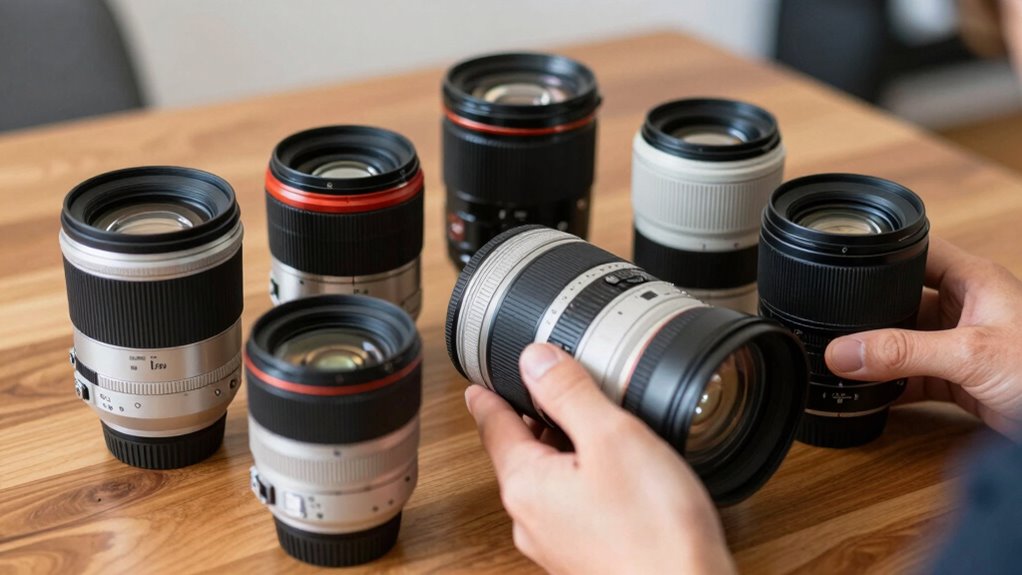

Starting with the right camera lens can make a significant difference in your photography journey. For beginners, the key is balancing image quality, ease of use, and affordability. The Canon EF 50mm f/1.8 STM stands out as an excellent all-around choice thanks to its affordability and sharp images. The Sony FE 50mm F1.8 offers superb build quality and versatility for Sony users, while the kit lens included with many cameras provides convenience and value. The main tradeoffs involve limiting zoom ranges or manual focus struggles, so understanding your priorities is essential. Keep reading for a detailed breakdown of each option and what makes them suitable for newcomers.
Key Takeaways
- The prime 50mm lenses dominate for their sharpness and low-light performance, making them ideal for beginners focused on quality.
- Kit lenses like the 18-55mm offer convenience and versatility but often sacrifice some image quality and aperture size.
- Manual focus options tend to be less beginner-friendly but can teach foundational skills if used carefully.
- Price varies widely; the best choices often balance affordability with good optical performance.
- Compatibility and future expandability should influence your lens choice, especially if you’re planning to upgrade your camera body.
| 85mm f/1.8 Portrait Lens EF/EF-S Mount for Canon EOS Cameras |  | Best for Portraits and Creative Control | Mount: EF/EF-S | Focal Length: 85mm | Aperture: f/1.8 | VIEW ON AMAZON | See Our Full Breakdown |
| EF 85mm f/1.8 Portrait Lens for Canon DSLR Cameras – Manual Focus |  | Best for Artistic Portraits and Manual Focus Practice | Focal Length: 85mm | Maximum Aperture: f/1.8 | Mount: Canon EF/EF-S | VIEW ON AMAZON | See Our Full Breakdown |
| Canon EOS Rebel T7 DSLR Camera with EF-S 18-55mm and EF 75-300mm Lenses |  | Best for Versatility and All-in-One Beginner Kit | Sensor: 24.1 Megapixel CMOS (APS-C) | Lenses: EF-S 18-55mm and EF 75-300mm | Autofocus: 9-Point AF system | VIEW ON AMAZON | See Our Full Breakdown |
| Canon EF 50mm f/1.8 STM Lens for Canon EOS DSLR Cameras |  | Best for Sharpness and Low-Light Portraits | Focal Length: 50mm | Maximum Aperture: f/1.8 | Minimum Focusing Distance: 1.15 feet (0.35 meter) | VIEW ON AMAZON | See Our Full Breakdown |
| Sony FE 50mm F1.8 Standard Lens (SEL50F18F/2), Black |  | Best for Compact Full-Frame Photography | Maximum Aperture: F1.8 | Lens Type: Standard | Compatibility: Full-frame E-mount | VIEW ON AMAZON | See Our Full Breakdown |
| Canon EF-S 18-55mm f/3.5-5.6 IS II SLR Lens |  | Best for Versatility and Beginner-Friendly Features | Focal Length: 18-55mm | Maximum Aperture: f/3.5-5.6 | Lens Construction: 16 elements in 12 groups | VIEW ON AMAZON | See Our Full Breakdown |
| camera lenses for beginner | Focal Length | Maximum Aperture |
|---|---|---|
| 85mm f/1.8 Portrait Lens EF/EF | 85mm | — |
| EF 85mm f/1.8 Portrait Lens fo | 85mm | f/1.8 |
| Canon EOS Rebel T7 DSLR Camera | — | — |
| Canon EF 50mm f/1.8 STM Lens f | 50mm | f/1.8 |
| Sony FE 50mm F1.8 Standard Len | — | F1.8 |
| Canon EF-S 18-55mm f/3.5-5.6 I | 18-55mm | f/3.5-5.6 |
More Details on Our Top Picks
85mm f/1.8 Portrait Lens EF/EF-S Mount for Canon EOS Cameras
This manual focus 85mm f/1.8 lens stands out for its high-quality construction and stunning background blur, making it ideal for portrait photography. Compared to the Canon EF 50mm f/1.8 STM, it offers a longer focal length that creates more flattering portraits and a more durable metal body. However, the lack of autofocus means it requires patience and skill, which might challenge beginners. Its precise manual control offers creative flexibility, but can be a hurdle for those unfamiliar with manual focusing. This lens is perfect for those wanting to develop their portrait skills with a dedicated, high-quality prime lens, but not for users seeking quick, autofocus operation.
Pros:- High-quality metal construction for durability
- Large f/1.8 aperture creates beautiful background blur
- Precise manual focus control for creative flexibility
Cons:- Manual focus only, no autofocus or stabilization
- Requires manual operation and setup, which could slow workflow
Best for: Beginner portrait photographers who want to learn manual focus and improve their control over image quality
Not ideal for: Casual shooters or those preferring autofocus, as manual focus can be tricky for newcomers
- Mount:EF/EF-S
- Focal Length:85mm
- Aperture:f/1.8
- Focus Type:Manual
- Construction:Metal body with hybrid aspherical element
- Compatibility:Canon EOS Rebel T8i/T7i/T7/T6i/T5/T3i/T3/T2i/XSi/XS/SL3/SL2/T100/5D Mark IV/6D II/7D 90D/80D/70D/60D/50D/650D/600D/750D/700D/550D/7D II
Our verdict“This lens suits beginners eager to master manual focusing and portrait techniques, but may be less suitable for quick shooting needs.”
EF 85mm f/1.8 Portrait Lens for Canon DSLR Cameras – Manual Focus
This fully manual 85mm f/1.8 lens offers excellent image quality with beautiful bokeh, making it a good choice for photographers willing to learn manual focus. Compared with the Canon EF 50mm f/1.8 STM, it provides a longer focal length that enhances portrait depth and compression effects, but its fully manual operation may challenge beginners unfamiliar with focusing techniques. The high-quality optics and hybrid aspherical lens produce sharp images, yet the absence of autofocus limits quick shooting scenarios. It’s well-suited for those interested in developing a deeper understanding of manual control, but less so for those needing fast, autofocus performance or convenience.
Pros:- High-quality optical design with beautiful bokeh
- Precise manual focus control for creative expression
- Built with hybrid aspherical lens for sharp images
Cons:- Fully manual focus can be difficult for beginners
- No electronic contacts for autofocus
- Requires camera to be set to full manual mode
Best for: Beginners eager to explore manual focus and portrait artistry with a dedicated lens
Not ideal for: Casual users or those new to manual focusing, as it demands patience and focus skills
- Focal Length:85mm
- Maximum Aperture:f/1.8
- Mount:Canon EF/EF-S
- Focus Type:Manual
- Lens Elements:Hybrid aspherical lens (H-ASP)
- Aperture Blades:6 rounded blades
Our verdict“Ideal for beginners who want to learn manual focusing and portrait techniques, but not suitable for those seeking quick autofocus.”
Canon EOS Rebel T7 DSLR Camera with EF-S 18-55mm and EF 75-300mm Lenses
This DSLR kit offers a comprehensive start for beginners, featuring a 24.1 MP APS-C sensor and versatile zoom lenses. Compared to prime lenses like the Canon EF 50mm f/1.8 STM, the kit’s zoom range covers wide landscapes to distant subjects, making it more flexible for varied scenarios. Its built-in Wi-Fi and NFC facilitate easy sharing, but the autofocus system with just 9 points might be less responsive than higher-end models. The kit is ideal for those starting out and wanting a well-rounded package, but it lacks the advanced features and autofocus precision found in more expensive cameras. It’s best for users who prefer a straightforward, all-in-one solution for learning basic photography.
Pros:- High-resolution 24.1 MP sensor delivers detailed images
- Versatile zoom lenses suitable for various genres
- Built-in Wi-Fi and NFC for quick sharing
Cons:- Limited autofocus points, which can impede fast focusing
- No touchscreen interface for easier navigation
- Basic viewfinder coverage
Best for: Beginners wanting an all-in-one starter kit with zoom versatility and easy sharing features
Not ideal for: Advanced users or those seeking high-speed autofocus and more customization options
- Sensor:24.1 Megapixel CMOS (APS-C)
- Lenses:EF-S 18-55mm and EF 75-300mm
- Autofocus:9-Point AF system
- Viewfinder:Optical with 95% coverage
- Video Resolution:Full HD 1080p
- Connectivity:Wi-Fi and NFC
Our verdict“A solid choice for newcomers seeking a beginner-friendly DSLR kit with versatile lenses and connectivity, but not ideal for fast-paced shooting or advanced controls.”
Canon EF 50mm f/1.8 STM Lens for Canon EOS DSLR Cameras
This 50mm prime lens offers sharp images and excellent low-light performance, making it a favorite for newcomers exploring portrait and night photography. Unlike zoom lenses, it encourages learning composition with a fixed focal length, and its f/1.8 aperture provides a beautiful background blur. Compared to the Sony FE 50mm F1.8, it’s more affordable and widely compatible with Canon APS-C and full-frame DSLRs but lacks image stabilization and has a basic build. The near-silent STM autofocus is a plus for video, but its limited focus distance might restrict some creative shots. It’s a great starter lens for those wanting sharpness and affordability, yet not the best choice for fast-action or handheld videography without stabilization.
Pros:- Sharp image quality with wide f/1.8 aperture
- Near silent STM autofocus for videos
- Affordable price point for entry-level users
Cons:- No image stabilization, which can affect handheld shots
- Basic build quality and plastic construction
- Limited to Canon DSLR cameras
Best for: Beginners focused on portrait, low-light, and everyday photography with Canon DSLR cameras
Not ideal for: Users needing stabilization or planning to shoot fast-moving subjects
- Focal Length:50mm
- Maximum Aperture:f/1.8
- Minimum Focusing Distance:1.15 feet (0.35 meter)
- Lens Construction:6 elements in 5 groups
- Effective Focal Length:80mm on APS-C, 50mm on full frame
- Focus Mechanism:STM
Our verdict“Ideal for beginners seeking a sharp, affordable prime lens for portraits and night shots, but not suited for fast-action or stabilized video work.”
Sony FE 50mm F1.8 Standard Lens (SEL50F18F/2), Black
The Sony FE 50mm F1.8 stands out for its compact design and excellent optical quality, making it a strong choice for full-frame E-mount beginners. Compared to the Canon EF 50mm f/1.8 STM, it offers a more lightweight and modern form factor, along with advanced aspherical elements that effectively control aberration. Its F1.8 aperture produces lovely bokeh, suitable for portraits and creative shots, but its focal length limits versatility for wider landscapes or macro work. The lack of image stabilization might be a concern for handheld shooting in low light, but its overall small size encourages portability. This lens makes sense for those starting with Sony full-frame cameras and wanting a high-quality, portable prime, though at a higher price point.
Pros:- Large F1.8 aperture creates beautiful bokeh
- Compact and lightweight for portability
- Advanced optical elements control aberration effectively
Cons:- Limited to 50mm focal length, less versatile
- No image stabilization mentioned
- Higher price compared to similar primes
Best for: Beginner Sony full-frame E-mount users seeking a compact, high-quality standard lens
Not ideal for: Those on a tight budget or needing stabilization for handheld low-light shooting
- Maximum Aperture:F1.8
- Lens Type:Standard
- Compatibility:Full-frame E-mount
- Design:Compact, lightweight
- Aperture Blades:7-blade circular
- Optical Elements:Aspherical element, Double-gauss
Our verdict“A compelling choice for Sony full-frame beginners prioritizing image quality and portability, though less flexible for varied shooting styles.”
Canon EF-S 18-55mm f/3.5-5.6 IS II SLR Lens
The Canon EF-S 18-55mm f/3.5-5.6 IS II lens stands out as a versatile option for beginners trying to cover a broad range of everyday photography. Its focal length range of 18-55mm makes it suitable for landscapes, portraits, and general snapshots—comparable to the Canon EOS Rebel T7’s bundled kit lens, but with improved image stabilization that helps produce sharper handheld shots. While the maximum aperture of f/3.5-5.6 limits low-light performance, the inclusion of UD-glass and aspherical elements ensures image clarity across its zoom range. The gear-driven focus adjustment may feel sluggish for fast shots, but this is a common tradeoff at this price point. Compared to more specialized lenses like the EF 50mm f/1.8, this lens offers more flexibility, though it sacrifices some speed and low-light ability. It’s a good entry-level choice for those seeking a one-lens solution for casual use, with the understanding that it won’t excel in dim conditions or fast action scenarios.
Pros:- Offers a broad focal length range suitable for multiple styles of photography
- Includes image stabilization for sharper handheld images
- Constructed with high-quality UD-glass and aspherical elements for clearer images
Cons:- Maximum aperture of f/3.5-5.6 limits low-light performance
- Gear-driven focus may be slower, affecting quick shot capture
- Basic kit lens lacks advanced features found in higher-end models
Best for: Beginners who want a versatile, all-around lens for general photography without investing in multiple lenses.
Not ideal for: Photographers planning to shoot extensively in low-light environments or needing fast autofocus, as the aperture is limited and focus adjustment can be slow.
- Focal Length:18-55mm
- Maximum Aperture:f/3.5-5.6
- Lens Construction:16 elements in 12 groups
- Focus Adjustment:Gear-driven
- Image Stabilization:Yes
- Included in:White Box (Never Used)
Our verdict“This lens makes the most sense for beginners seeking a flexible, all-in-one option for everyday photography, with some compromises in low-light conditions.”

How We Picked
Our evaluation focused on lenses that are accessible to beginners, emphasizing affordability, ease of use, and compatibility with popular camera brands. We prioritized optical quality, brightness (aperture), and build quality, considering how forgiving each lens is for new users. Features like autofocus speed and manual focus ease were also critical, as they impact daily usability. The ranking reflects a balance between value and performance, ensuring each lens offers a clear advantage for someone just starting out while acknowledging potential tradeoffs like limited zoom or manual focus complexity.| camera lenses for beginner | Maximum Aperture |
|---|---|
| 85mm f/1.8 Portrait Lens EF/EF | — |
| EF 85mm f/1.8 Portrait Lens fo | f/1.8 |
| Canon EOS Rebel T7 DSLR Camera | — |
| Canon EF 50mm f/1.8 STM Lens f | f/1.8 |
| Sony FE 50mm F1.8 Standard Len | F1.8 |
| Canon EF-S 18-55mm f/3.5-5.6 I | f/3.5-5.6 |
Factors to Consider When Choosing Camera Lenses For Beginners
Choosing the right lens as a beginner involves more than just price tag. To ensure you get a lens that enhances your photography without unnecessary complexity or cost, consider these key factors. The right lens should complement your camera system, match your style, and be forgiving as you learn. Making an informed choice can save you money and frustration in the long run.Focal Length and Versatility
For beginners, focal length determines what you can easily shoot and how flexible your lens will be. Prime lenses like the 50mm are excellent for portraits and low-light shots, offering sharp images in a compact package. Zoom lenses such as 18-55mm provide more versatility, allowing you to experiment with different framing without changing lenses. Consider what subjects excite you most and choose accordingly—if you’re unsure, a kit lens covers many bases at a lower cost.
Aperture Size and Low-Light Performance
The aperture controls how much light enters the lens, directly impacting your ability to shoot in low-light conditions and achieve a pleasing background blur. A lens with a wide maximum aperture like f/1.8 makes it easier to shoot indoors or in dim environments without a flash. However, lenses with wider apertures tend to cost more, so weigh the importance of low-light performance against your budget and typical shooting situations.
Ease of Use and Focus Mechanisms
For newcomers, autofocus speed and accuracy are critical to capturing sharp images without frustration. Lenses with quick, silent autofocus are more user-friendly and help you stay engaged in the moment. Manual focus can be educational but often presents a learning curve; unless you’re confident in your skills, sticking with autofocus is advisable. Consider lenses with focusing distance indicators or stabilization features if you plan to shoot handheld frequently.
Compatibility and Future Expansion
Choosing a lens compatible with your camera system is essential, but also think about future upgrades. Investing in a lens with a common mount like Canon EF or Sony FE ensures broader compatibility and resale value. If you plan to grow your kit, opt for lenses that offer a balance of quality and affordability now, knowing you can upgrade bodies later without needing new lenses each time.
Price and Value
Beginners should aim for lenses that offer the best value rather than the highest specs. Many affordable lenses deliver excellent results for learning purposes, but be cautious of overly cheap options that may compromise image quality or durability. Sometimes investing a bit more upfront can save money and frustration by providing a more durable, high-quality lens that will serve you longer as your skills grow.
Frequently Asked Questions
Should I buy a prime or zoom lens as a beginner?
Prime lenses like the 50mm f/1.8 are excellent for learning composition and achieving sharp images, especially in good lighting. They tend to be lighter and more affordable but lack flexibility. Zoom lenses, such as 18-55mm, offer versatility by covering multiple focal lengths, making them ideal if you’re still discovering your style. As a beginner, starting with a kit zoom and then adding a prime later often provides the best balance of flexibility and quality.
Is a wide aperture necessary for beginners?
While a wide aperture like f/1.8 improves low-light performance and creates a shallow depth of field, it isn’t strictly necessary for beginners. Many great photos can be taken with a standard kit lens at f/3.5-5.6, especially in well-lit environments. Prioritizing a lens with a wider maximum aperture is beneficial if you frequently shoot indoors or want professional-looking background blur, but it can also add cost and complexity.
Can I use a full-frame lens on a crop-sensor camera?
Yes, many lenses are compatible across full-frame and crop-sensor (APS-C) cameras, but the effective focal length will change due to crop factors. For instance, a 50mm lens on a crop sensor tends to behave like a 75mm lens on a full-frame camera, which might be more suited for portraits. Always check compatibility and crop factor implications so you select lenses that match your intended subjects and shooting style.
How important is image stabilization for beginner lenses?
Image stabilization can significantly improve sharpness, especially when shooting handheld at slower shutter speeds. For beginners, it reduces the need for perfect technique and allows for more spontaneous shots. While it adds cost, having stabilization can boost confidence and reduce frustration, making it a worthwhile feature if you plan to shoot in varied conditions or without a tripod.
Should I prioritize brand-specific lenses or third-party options?
Brand-specific lenses guarantee full compatibility and often optimal autofocus performance, but they can be pricier. Third-party lenses can offer excellent quality at lower prices, sometimes with unique features not available from original manufacturers. For beginners, sticking with reputable brands within your camera system is advisable, but exploring third-party options can be a smart way to expand your kit without overspending.
Conclusion
For those just starting out, the Canon EF 50mm f/1.8 STM offers exceptional value with its sharp images and affordability, making it ideal for beginners focusing on portraits and low-light shots. The kit lenses like the Canon EF-S 18-55mm provide versatility for exploring different subjects without a large investment. For photographers who prioritize build quality and future-proofing, the Sony FE 50mm F1.8 makes a compelling choice for Sony users. Serious hobbyists aiming for better optical performance should consider investing in a prime lens, but always weigh the initial cost against long-term usability. Your ideal lens depends on your current camera system, budget, and what you want to shoot most—this guide aims to match your needs with the best options available.